

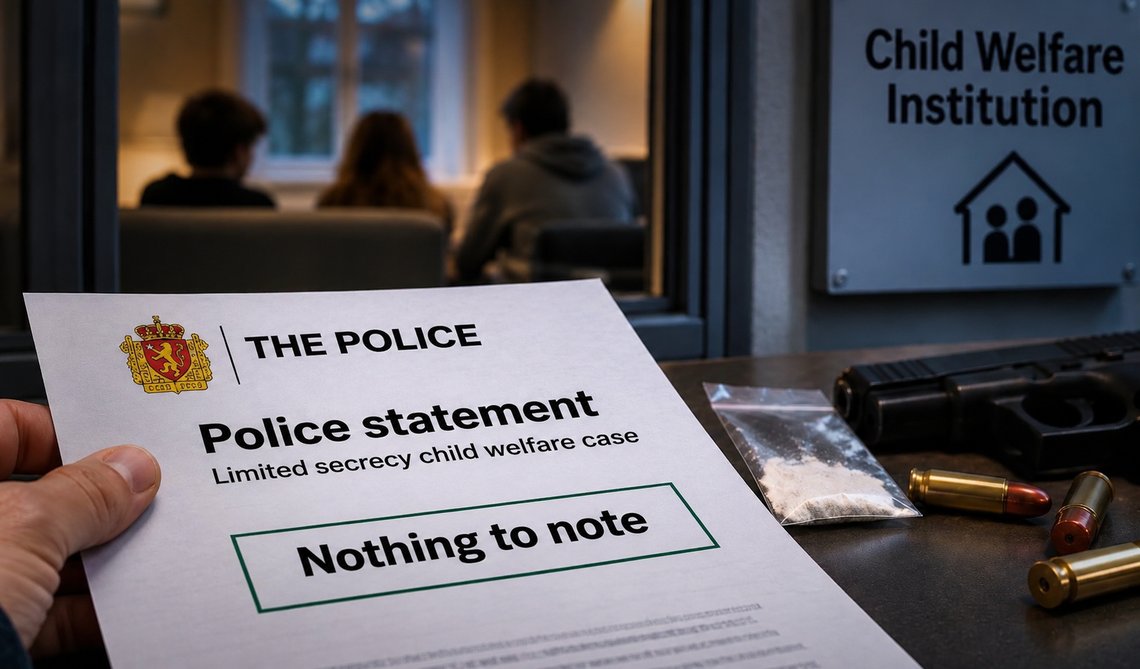


Convictions for driving under the influence of drugs, firearms offences, doping or pimping result in ‘nothing to report’ on the police certificate required to work with children in child welfare services.
The Norwegian Directorate for Children, Youth and Family Affairs (Bufetat) confirms that the type of police certificate requested contains only a limited set of details. The agency is responsible for Norwegian child welfare institutions.
In a letter to which *Document* has gained access, Bufetat states that the police have expressed “grave concern that the rules on entries in the Police Register Act do not appear to protect children to a sufficient degree”.
The Accreditation Unit for Child Welfare Institutions (BEG) can, in principle, only require police certificates from the owners of private child welfare organisations, not from the staff. And only if the owners are also to work at or reside in the institution.
Companies providing services to Bufetat must themselves have their paperwork in order:
Employees who are to have direct contact with children and young people are only obliged to present a valid police certificate to their own employer.
The child welfare institution BevisstUng Bolig AS in Drammen did not have its paperwork in order, as Document reported on in late summer this year. They lost their accreditation when it emerged that they had employed a number of staff with criminal records, some of which were serious. These included violence, drugs and pimping.
One of the employees was convicted earlier this year of producing 72 kilos of amphetamine on a farm in Modum, but he has since appealed.
Accused amphetamine producer and convicted criminals got jobs in child welfare
Physical injuries are excluded from the certificate
The certificate from the police that Bufetat is authorised to request is called a ‘limited child welfare certificate’.

Torbjørn Seljevoll, head of Bufetat’s unit for the approval of child welfare institutions. (Photo: Private)
– This type of certificate will show any convictions for drug offences, human trafficking, grievous bodily harm, murder, domestic abuse, sexual offences and robbery. Under the Child Welfare Act, individuals who have been charged, indicted, have accepted a fixed penalty notice or have been convicted of breaching these provisions shall not be permitted to work with minors, according to Torbjørn Seljevoll, head of BEG.
However, the certificate does not contain information about less severe penalties within the same categories.
Cases that have been dismissed, or cases that have been dropped for other reasons, are also not shown.
People convicted of driving under the influence of drugs will therefore receive a child welfare certificate stating ‘nothing to report’.
Similarly, offences such as crimes committed for financial gain, breaches of the Weapons Act, doping offences, pimping and the facilitation of prostitution do not appear on the child welfare certificate, according to Bufetat.
When it emerged earlier this year that criminals may have infiltrated private providers of child welfare services, Økokrim launched an investigation into 16 companies. Bufetat will not disclose the names of these organisations.
– Persistent weaknesses
Seljevoll informs Document that Bufdir (the Norwegian Directorate for Children, Youthand Family Affairs) has introduced new procedures to improve checks on police certificates. The approval unit can now itself request that the institution submit certificates and staff lists. Previously, the State Administrator had to be involved.
However, the police certificates for child welfare services still contain very little information. The Directorate acknowledges that the regulations still have weaknesses. Document has been informed that work is underway to review the requirements for police certificates, following a ‘grassroots’ initiative within Bufetat.
“There is a need to review which offences are covered, who is covered and the flow of information from the police to the services,” says Seljevoll.
Confusion over certificates of good conduct
Document has gained access to the correspondence in the supervisory case against BevisstUng Bolig AS, which had a turnover of nearly 29,2 million kroner in 2025. In its start-up year, 2024, turnover was 13.2 million over 10 months.
The audit reveals that there were numerous issues to address.
20 employees had police certificates with dates that did not meet the requirements.
In addition:
- Four had police certificates from the wrong employer.
- Three employees had invalid certificates (incorrect legal basis).
- Three employees had remarks on their certificates.
- One employee had not applied for a certificate, even though the certificate date was listed on the staffing overview.
Following a further round of gathering additional documentation, even more issues were uncovered:
- Four people who were not included in the staffing overview had worked over the past six months.
- Eight had provided the wrong date for their police certificate in the staffing overview.
- Five had worked with minors without a valid police certificate.
- Two people listed on the staffing lists were not registered in the A Register.
- One employee had obtained two police certificates. Both contained remarks.
- Three employees with remarks on their certificates of good conduct were still working with children, despite the company having seen the contents of the certificates.
Co-owner was a mercenary in Iraq
One of the board members of BevisstUng Bolig’s holding company, Stega AS, until September this year, is Pål Olsen. He is also listed as a shareholder in BevisstUng Bolig AS through Ayoob AS. When he was in his 20s, he was a mercenary in Iraq for the Special Interventions Group (SIG).
In a confidential police report, SIG was mentioned in connection with recruitment from criminal circles. The company was investigated by the Norwegian police for several years, following suspicions that it had been involved in murders in Iraq.
Document is not aware of whether Olsen has worked directly with children in the care of social services. According to an organisational chart dated 7 August this year, he has sold his stake in BevisstUng Bolig.
Youth offender and drug addict
Another former board member of Stega AS who also helped establish BevisstUng is a former juvenile delinquent and drug addict from Afghanistan who has been widely discussed locally as an example of someone who has managed to turn his life around.
When [name] was 13 years old, he began taking drugs. This was followed by violence and crime. He served numerous prison sentences, as reported by Drammens Tidende in 2019.
That same year, BevisstUng was launched as a non-profit organisation offering support programmes for young people in collaboration with the police and NAV.
The man no longer holds any roles in the companies. His ethnically Norwegian wife is the majority shareholder through her holding company and is the managing director of the spun-off child welfare company.
Both the police’s prevention unit and the headteacher at Galterud School, Jan Dag Michalsen, spoke highly of the man in 2019.
– “He’s doing a brilliant job. [Name] is a fantastic role model for the pupils; he shows that it’s possible to change and build a better life by making the right choices,” said Michalsen, according to DT.
Employee implicated in 50 criminal cases
It was a report of concern from the police that triggered Bufetat’s investigation into BevisstUng Bolig AS. In a redacted letter from Bufetat to which Document has gained access, it states, amongst other things, that one of the employees had ‘financial and social ties’ to a criminal drug network.
Document publishes below an abridged extract from the letter.
The managing director has admitted in a Facebook post that she did not exercise sufficient control over the police certificates:
– I relied on others to keep track of things, when I should have checked myself. That is a managerial error, and it is mine. Bufetat had reason to react. We have now learnt our lesson.
At the same time, she rejects the suggestion that there are grounds for claiming that anyone has been recruited into crime through BevisstUng. She writes that the media have linked the organisation to the A-krim group’s anonymous report without contacting the company.
Despite several rounds of correspondence with the assistance of the Lippestad law firm, BEG ultimately withdrew its approval.
At the end of October, the Norwegian National Collection Agency imposed a lien on a tax claim of 633,000 kroner, according to the Register of Business Enterprises.
On 8 October 2025, BEG received a report of concern from the police regarding [……………] BevisstUng, [……….]. After receiving this report of concern, BEG requested a new police certificate for [……………………………………………………………………….].
BEG decided to obtain information from the police, cf. letter dated 13 May 26. [… ]
On 18 June 26, we held a meeting with representatives of the police, at which we were provided with information regarding the circumstances surrounding [… … … … … …8230;…..] [… … … … … …] […]
[… … … …..] has been recorded as a suspect/accused/convicted in around 50 criminal cases by the police. This relates to reports filed between 1999 and 2025 concerning violence (assault/bodily harm), criminal damage, drugs, threats, disorderly conduct, violence against the police, etc.
The majority of these cases have been dismissed. […….] has been subject to 10 criminal sanctions between 2006 and 2016, of which two were for drug use and one was a fixed penalty notice for carrying a metal knuckle duster. In February 2026, [……] was convicted of, amongst other things, making threats against the police and causing damage to property. BEG also has a copy of this judgement.
[……] is listed as a witness in a case concerning a serious drug offence in December 2025. This case, when considered alongside searches of the police’s criminal records, shows that [….] has financial and social links to a criminal milieu in which individuals have been convicted of serious drug offences.
Furthermore, the police state that [………………] is registered as a suspect/accused/convicted in 12 criminal cases with the police. These relate to reports of reckless behaviour, assault, fraud, etc. The majority of these cases have been dropped. [… … … …] has, amongst other things, been convicted of social security fraud (2009), assault [… …8230;…] (2005), a fixed penalty notice for assault (2008) and a fixed penalty notice for embezzlement (2007).
Furthermore, the police report that three named […………] at the institution have been issued with police certificates containing adverse remarks. According to information from the Employee Register, all of these employees have been allowed to continue working at the institution despite the remarks. BEG has, through staff rosters updated in February 2026, confirmed that these individuals are working in the departments. This is confirmed by actual duty rosters received on 5 August 26. The offences relate to serious drug offences, aggravated theft, driving without a valid driving licence and whilst under the influence of drugs, breaches of the Accounting Act, possession of weapons and handling stolen goods.
One of the judgements against a […………..] was handed down in February 2026. In connection with this trial, the managing director of BevisstUng Bolig AS, [name], stated in court that […………] would be able to get their job back after serving their sentence. [… … … …] was sentenced to 10 years’ imprisonment for the production of 74 kilograms of amphetamine. The sentence has been appealed and is therefore not yet final. The employee is still working in the department.
The police have also carried out spot checks on the criminal records of some employees at the institution who have received police certificates stating ‘nothing to report’. Convictions were found for driving under the influence (drugs), assault resulting in injury, violence against the police, use/possession of drugs, pimping and facilitating prostitution.
[…]
BEG considers that the institution’s recruitment of individuals with remarks on their police certificates does not appear to be a matter of isolated errors of judgement, but rather as a pattern indicating a failure in the institution’s culture, attitudes and practices. […]
[…]
The police further state that [……………….] several staff members are suspected of and have been convicted in a number of criminal cases. These are criminal records that do not appear on a restricted child care certificate.
[…]
BEG considers that the extent to which the institution employs experience-based advisers with a past or ongoing involvement in substance abuse and criminality has an impact on the institution’s operations and its ability to provide children with adequate care, safeguarding and protection. When children are in the care of adults who either have a criminal history, are still involved in criminal activity or maintain links to criminal circles, there is an increased risk that the children will not be looked after in a responsible manner.
This risk is exacerbated by the fact that staff, through their role at the institution, develop close relationships with the children and gain insight into their personal circumstances, challenges and vulnerabilities. In BEG’s assessment, this may give individuals with ongoing or inadequately clarified criminal links a particular opportunity to influence the children. In light of the overall number of individuals with a serious or repeated criminal history associated with the institution, BEG considers that there is a risk that children may be exposed to criminal individuals or environments, and in the worst case, influenced or recruited into crime. […]
In BEG’s view, trust is a fundamental premise for the operation of child welfare institutions. Children, guardians, clients and society at large must be able to trust that institutions approved under the Child Welfare Act are run in a way that safeguards children’s needs for care, safety and protection. […]


