

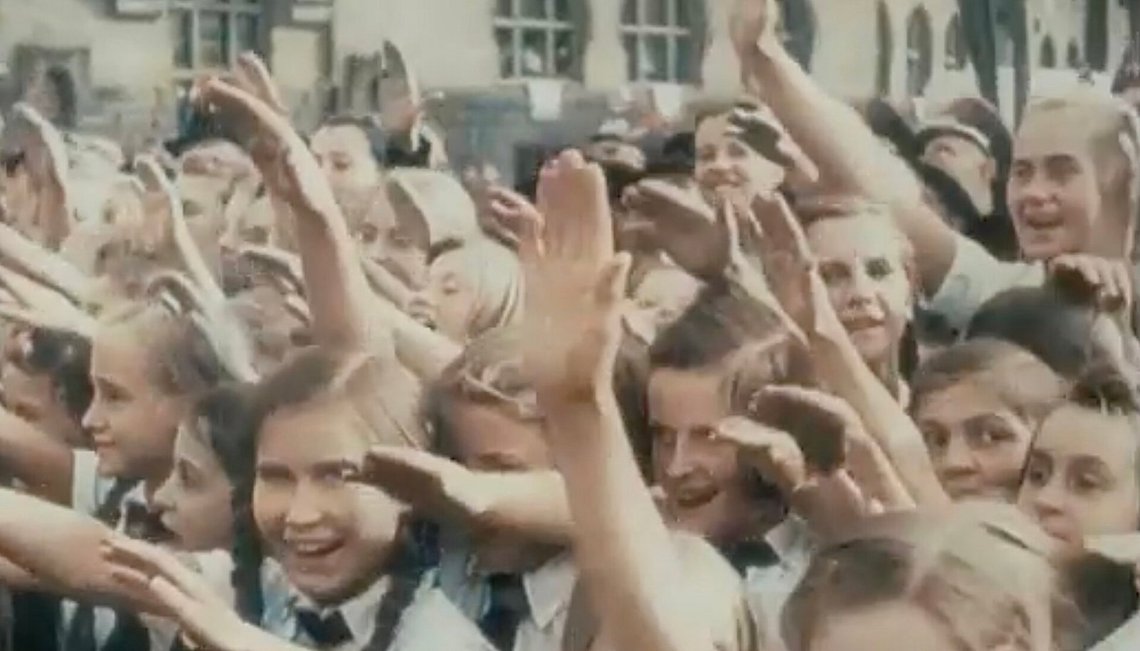


In far-left newspaper Klassekampen’s ‘Signert’ column on 31 October Daša Drndić’s book *Trieste*, about Nazi Germany’s Lebensborn project – eugenics, child abduction, racial hygiene – as a historical example of systematic identity erasure in order to frame Israel’s military operations in Gaza as a similar crime against memory and culture. Drndić’s book deals with specific Nazi practices in the Trieste area and at San Sabba, not with a general ‘genocide’ metaphor.
She writes:
‘It is difficult to read the quote [without memory, the present becomes sick. Mutilated like a torso.] without thinking of the actual mutilation taking place in the Palestinian territories every single day. How are these people to live in the decades following this? With broken bodies, broken souls, with a cultural heritage of which, at best, only remnants remain?’
This is a classic rhetorical device in parts of the left’s coverage of the conflict: historical atrocities (the Holocaust, Lebensborn, colonialism) are invoked to create moral equivalence, whilst the specific context (Hamas’s objectives, its methods, the Jewish historical connection, the repeated rejections of peace agreements) is omitted. The result is a text that feels literary and ethically engaged, but which is selective in its ‘will to know’.
What she skilfully omits is that Hamas and Iran are exploiting civilian casualties. Since they cannot win militarily, they do everything they can to win over Western public opinion. Hamas’ deliberate use of civilian areas, tunnels beneath blocks of flats and hospitals for military purposes, as well as its propaganda regarding civilian casualties, is well documented. Nazi Germany, unlike Hamas, did everything it could to conceal its crimes. The regime built an extensive system of shelters and stored books and works of art in disused mines.
Khomeini’s fatwa against Salman Rushdie in 1989 was a direct attack on freedom of expression, with long-lasting consequences: assassination attempts, the murder of translators and self-censorship. Through Hamas, amongst others, Iran wages proxy wars against Israel (‘the Little Satan’) and the US (‘the Great Satan’). The regime cracks down on any criticism of Islam and the Prophet.
In large parts of the Muslim world, there is strict censorship of liberal, secular and critical Western literature. At the same time, Arabic editions of *Mein Kampf* – often incomplete or consisting of extracts containing the most anti-Semitic passages – are sold in newsagents and bookshops in Egypt, Gaza, Judea and Samaria, and in Lebanon.
‘The Protocols of the Elders of Zion’ are even more widespread and are treated as ‘truth’ by intellectuals, imams and the media. There is a selective openness towards texts that reinforce anti-Semitism and conspiracy theories.
Greece, with a population of approximately 10.4 million, publishes around 3,500 translated titles a year. Egypt, with a population of approximately 110 million, has far fewer translations than Greece. It is worrying that Lillebø and large sections of the left are blind to the acute danger that Islam represents. Islam is an ideology, disguised as a religion, which, through jihad, aims to take over the whole world and impose Sharia law at the expense of our civilisation.
Although I am able to distinguish between Sandra Lillebø’s roles as a commentator for *Klassekampen* and as head of the Academy of Creative Writing, as a composition student in the 1980s I would certainly have reacted if the then principal, Harald Jørgensen, at the Norwegian Academy of Music had publicly expressed support for the Red Army Faction (Hamas) and Enver Hoxha’s Albania (Iran).
I fully agree with Sandra Lillebø that the truth is powerless on its own, that it needs a will behind it, and that the present becomes sick without memory.
Dagfinn Koch is a composer.


