

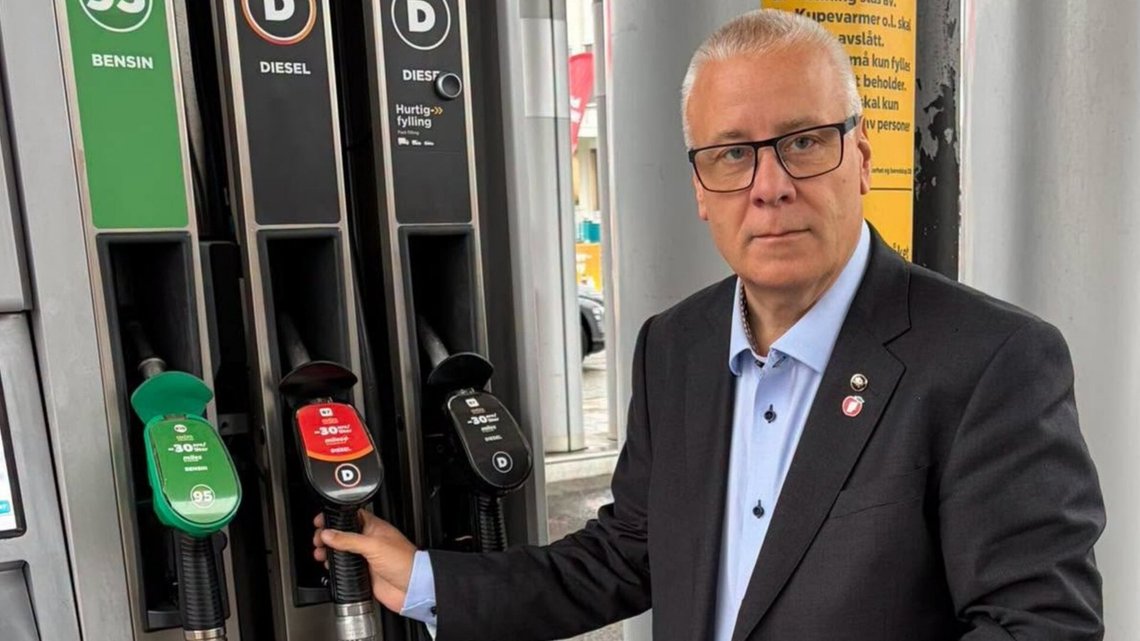


The Norwegian Public Roads Administration is proposing automated monitoring to introduce zones where petrol and diesel cars are banned. This has caused the Progress Party (FrP) to bristle.
“It is a provocation against all those people who cannot afford to buy an expensive electric car,” FrP politician Bård Hoksrud tells Document.
It is rare to see the usually cheerful and jovial Bård Hoksrud (FrP) so incensed. But this proposal has really set his blood boiling.
At the request of Transport Minister Jon Ivar Nygård of the Labour Party, the the Norwegian Public Roads Administration has put forward a new proposal on how local authorities can introduce so-called zero-emission zones. These are areas where petrol and diesel cars are banned.
A 1,000 kroner fine
The proposal allows for automatic monitoring, using cameras that read number plates. The system will then automatically issue a fine of 1,000 kroner to the car’s owner. It also allows for fully automated decisions without human intervention.
– It is not the driver who is penalised, but the owner of the car. You do not need to have done anything wrong, but you may still receive a fine in the post. Or an ‘infringement fine’, as it’s so nicely called,” says Hoksrud, who chairs the Transport Committee in the Storting.
The Norwegian Public Roads Administration is aware of the risk, in the consultation paper, the agency states that such errors can occur. However, the car owner must then lodge a complaint to have the decision overturned.
But they will still have to pay.
Fears this is just the start
The proposal does not stop at zero-emission zones. They also intend to introduce a general legal basis for automatic enforcement and fines for other breaches of the Road Traffic Act. Examples mentioned here include driving in bus lanes, breaching no-turn restrictions, studded tyre charges, overloading and driving a deregistered vehicle, to name but a few.
It was Minister of Transport Jon-Ivar Nygård (Labour) who commissioned the report from the Norwegian Public Roads Administration; he explained this himself in a written reply to the Storting.
“The government must have wanted this; they will then try to absolve themselves of responsibility,” Bård Hoksrud told Document.
As early as April 2025, in a letter of allocation, the Ministry of Transport and Communications stated that the government had decided to initiate the legislative process.
– I started asking questions when the tax authorities were to be given access to toll data. I was brushed off then. Since then, it has escalated, he says.
– The question is: Is this just the beginning?
He fears that data retention will get worse and worse.
– They say it will be deleted immediately. But in the future, many will say it’s handy if it’s stored for a day or two, then a week, then a month. Orwell’s ‘1984’. Or ‘Enemy of the State’. We’re heading down that path. You could well call it a conspiracy theory, but you’re opening the floodgates.
– A key issue for MDG
Oslo has wanted this for a long time. As early as 2021, the city council wanted to ban petrol and diesel cars within Ring 1, and later within Ring 2. The Norwegian Public Roads Administration concluded at the time that there was no legal basis for this – partly because the law did not permit automatic reading of vehicle data. It is precisely this legal basis that the government is now proposing.
– I fear this will become a key issue for MDG and several others on the left, says Hoksrud.
– “The worst thing is that this provides a huge opportunity for local politicians who love to control and dictate to other people,” says Hoksrud.
According to the text of the bill, the zones are intended to cut greenhouse gas emissions from road traffic and promote the transition to zero-emission vehicles. Norway has passed the one-million mark for electric cars, but only around one in three passenger cars is electric, according to the Norwegian Electric Vehicle Association. The rest have internal combustion engines.
– It’s a provocation against all those people who can’t afford to buy an expensive electric car, says Hoksrud.
He also warns against a patchwork of local regulations.
– Either it’s legal, or it isn’t. In some towns it’s the law, in others it isn’t. Where are the boundaries?
The consultation period ended on 2 October. The amendment must be passed by the Storting before it can come into force.
– I don’t want to live in a society where there are cameras everywhere. It’s about people’s freedom, says Hoksrud.


