

The Sweden Democrats are prepared to allow a centre-right government to take office without taking seats in it themselves. The announcement changes the conditions for forming a government and puts the Centre Party in an increasingly difficult position: can the party accept a government that depends on support from the Sweden Democrats?
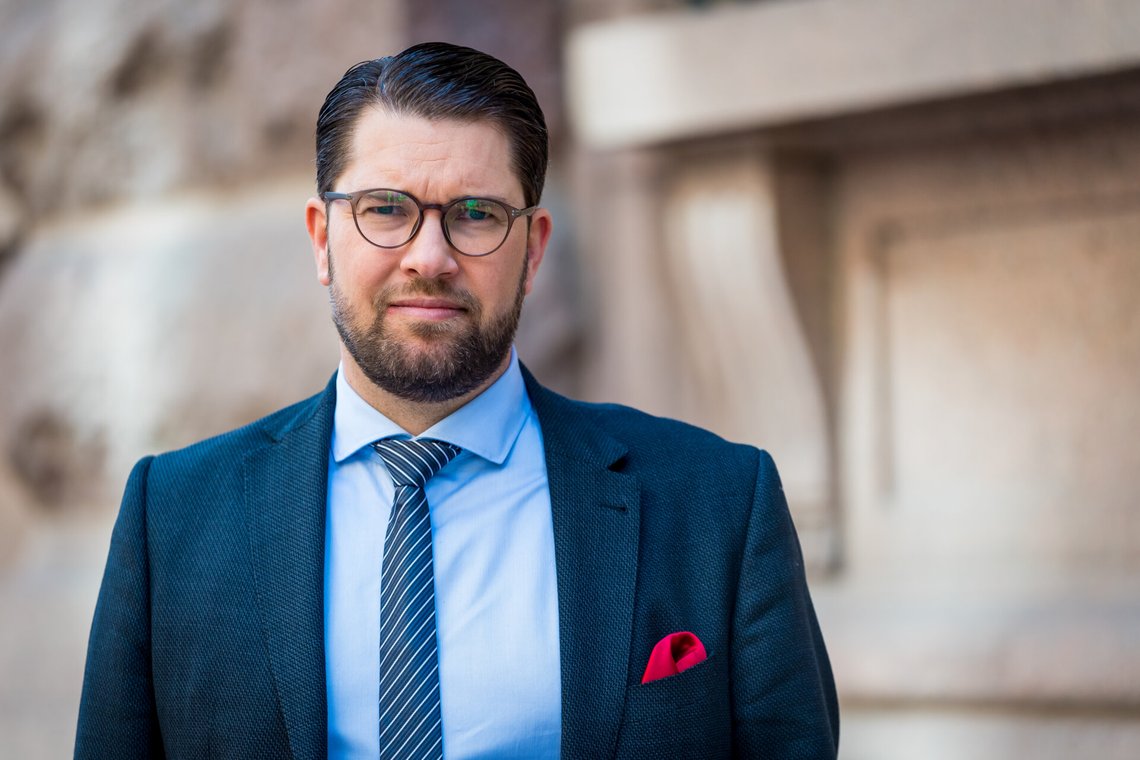
After more than 50 days without a new government, the Sweden Democrats have changed their strategy. On Friday, party leader Jimmie Åkesson announced that the party was dropping its demand for ministerial posts and was instead prepared to go into opposition – while allowing a centre-right government with Ulf Kristersson as prime minister.
The announcement marks a change in the Sweden Democrats’ previous position. Since the election, the party has demanded a place in government in order to support the formation of a new centre-right government. Now, instead, it is opening the door to the Moderates, Christian Democrats, Liberals and possibly the Centre Party forming a government, while the Sweden Democrats remain outside it.
Åkesson has described the move as a matter of adapting to the parliamentary realities. By voting yellow – that is, abstaining – in the upcoming prime ministerial vote on Tuesday, the Sweden Democrats can allow Ulf Kristersson to take office without formally supporting his government.
Negative parliamentarism
This solution is possible because Sweden operates under a system known as negative parliamentarism. This means that a prime ministerial candidate does not need the support of a majority in Parliament. Instead, it is sufficient for fewer than 175 of Parliament’s 349 members to vote against the candidate. If the Sweden Democrats’ 62 MPs vote yellow, they will not contribute to the 175 votes against Kristersson required to block him.
The leader of the Moderates can therefore take office as prime minister at the head of a parliamentary arrangement that will, in practice, amount to a modified Tidö 2.0 – without the Sweden Democrats, but with the Centre Party.
Tidö 2.0: Is the Sweden Democrats’ war on Swedish identity a political strategy?
Jimmie Åkesson has explicitly said that the Sweden Democrats intend to go into opposition afterwards. The party does not want to be bound by the Tidö Agreement or other prior arrangements, but is prepared to negotiate on individual issues when it serves the party’s interests.
But the parliamentary reality does not change: without the Sweden Democrats’ abstentions, the government could fall even before taking office. And although Åkesson promises to go into opposition, this means that Kristersson will govern with a party that can choose to bring him down at any time.
In practice, this means that Kristersson could form a government that depends on the Sweden Democrats for its parliamentary survival, but without any guarantee of their support in future votes.
The Sweden Democrats are therefore giving up ministerial posts – but not necessarily their political influence.
Magdalena Andersson closes the door
The announcement prompted a reaction from Social Democratic Party leader Magdalena Andersson. On Sunday morning, she made it clear that the Social Democrats would not negotiate or cooperate with a government consisting of the Moderates, Liberals, Christian Democrats and Centre Party if it took office with the support of the Sweden Democrats.
Andersson describes such a government as a “Tidö 2” government and argues that the Sweden Democrats’ new announcement does not change the parliamentary realities. She maintains that a government led by Kristersson would still be entirely dependent on the Sweden Democrats, which means that the Social Democrats would therefore go into full opposition to such a government.
The announcement also puts the spotlight on the Centre Party. During the election campaign, the party promised neither to support nor to join a government dependent on the Sweden Democrats. At the same time, the Centre Party has made it clear that it will not accept the Left Party joining a government and receiving ministerial posts either.
The Centre Party caught between two red lines
Centre Party leader Elisabeth Thand Ringqvist has therefore found herself in a difficult position. The party rejects a government in which the Sweden Democrats participate or with which the government cooperates, while at the same time rejecting a government that includes the Left Party.
The Centre Party is thus effectively caught between its own red lines.
Following the Sweden Democrats’ announcement, the Centre Party said it wanted to see concrete, comprehensive policy proposals from both Magdalena Andersson and Ulf Kristersson. The party is demanding clarity on what policies they intend to pursue, which parties will cooperate, and how their proposals will secure support in Parliament.
Thand Ringqvist has also reiterated that the Centre Party’s red lines remain unchanged. The party does not want the Left Party in government, but at the same time demands that Kristersson explain how he intends to govern without allowing the Sweden Democrats to dictate the terms.
As a result, Sweden’s political bickering continues unabated.
A centre-right government including the Centre Party could take office without Sweden Democrat ministers, but it would still need the Sweden Democrats’ support to get its policies through Parliament. The question, then, is whether the Centre Party can tolerate being tolerated by the Sweden Democrats?
On the centre-left side, there is another complication. The Centre Party does not want the Left Party to be part of the government, but a government led by Andersson will depend on support from the Left Party. The Left Party, moreover, refuses to abandon its demand for ministerial posts.
The Sweden Democrats’ new strategy changes the playing field
The Sweden Democrats’ announcement could give the party a new role in Swedish politics. Instead of demanding ministerial posts, it is offering to remain outside the government while retaining the ability to influence its parliamentary position.
This may make it easier for the Centre Party, at least formally, to move closer to a centre-right government alternative. But the fundamental conflict remains: if a government depends on support from the Sweden Democrats, the party also has the opportunity to influence that government – something the Centre Party says it cannot accept.
At the same time, the Centre Party is trying to keep both government alternatives open. By demanding comprehensive policy proposals from both the Social Democrats and the Moderates, the party is postponing its final decision.
But there is limited room for further political balancing. After two failed prime ministerial votes and a prolonged government formation process marked by conflicts and scandals, pressure is mounting on the parties to provide Sweden with a functioning government. The alternative is an extraordinary election, something most parties want to avoid at all costs.
For the Centre Party, the issue is no longer simply who will become prime minister. It is about which side of the political divide the party is actually prepared to cooperate with – and which election promises it is willing to compromise on. Will its fear of the Sweden Democrats keep the party on the centre-left, despite its diametrically opposed views on substantive policy issues, or will the new political landscape make it possible for the Centre Party to return to the centre-right, where its policies belong?
The Sweden Democrats may have dropped their demand for ministerial posts, but the question of their influence over the next government is far from settled. And now the ball —along with Sweden’s future— is in the 7-percent Centre Party’s court. Once again.