

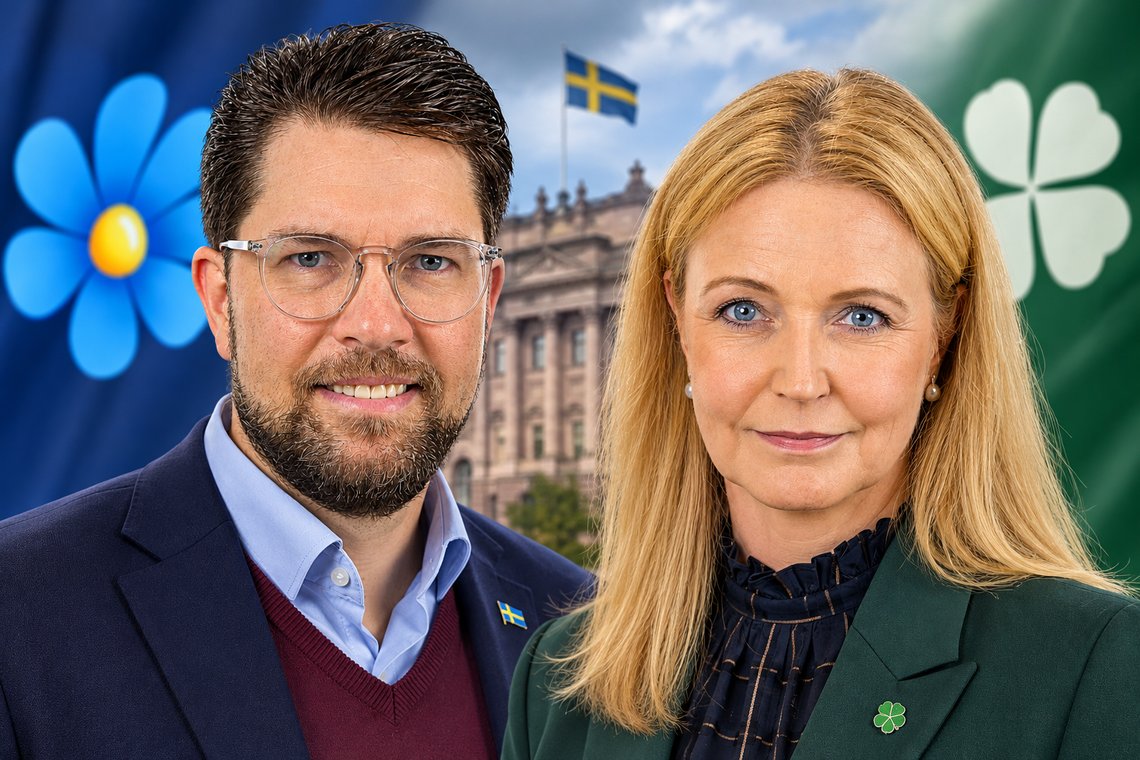


Is the Sweden Democrats’ sudden break with ethnic Swedishness really a way of making the party acceptable to the Centre Party? Behind the bitter conflict over Swedish identity, a much larger political game may be unfolding – with Tidö 2.0 as its possible endgame.
The “broad centre” turned out to be relatively narrow when all was said and done – the Centre Party’s Elisabeth Thand Ringqvist was voted down as prime minister on Tuesday, with 324 votes against and 25 in favour.
Frankly, no one probably expected anything else, but the vote had to be held according to the rules. Even if that meant that the Centre Party’s hallucination about a viable government majority burst faster than a balloon in a cactus garden.
The Speaker has now given Ulf Kristersson the task of exploring the possibilities of forming a government – and things could get interesting.
Abolishing its own USP
How wild the ride could become depends on the combination of conspiracy theories and a vivid imagination. But there is one factor that could influence the outcome of Kristersson’s consultations: the ethnic conflict within the Sweden Democrats over the past few weeks has played out in full view of the public.
On one side, Sweden has watched party veteran Mattias Karlsson, rising star Henrik Vinge and Karlsson’s loyal mouthpiece Carl Eos preach so-called cultural nationalism, in which “open Swedishness” means that anyone who obeys the laws and likes Sweden is Swedish. On the other side, party veteran Richard Jomshof and an estimated ninety per cent of Sweden Democrats have continued to point out that origins do matter, and that Swedes should still be allowed to remain the majority in their own country.
That might seem like an entirely reasonable position – at least to the Sami, Kurds, Persians, Syrians, Assyrians, Basques, Somalis, Aboriginal peoples, Jews and [fill in the blank] – but apparently not to Swedes. In any case, that has been enough to get someone branded a despicable extremist in the outer swamplands, and by the very same party leadership that has spent 16 years in the Riksdag thanks to the fact that they, as the only party, have represented Sweden and the Swedish people.
What the Sweden Democrats are doing now is abolishing their own USP – their Unique Selling Point.
In less than two months, the Sweden Democrats have gone from wanting to “make Sweden Sweden again” to claiming that Sweden can remain Sweden without ethnic Swedes, while threatening members who disagree with expulsion from the party. At best, this is strange. At worst, it is suicidal.
The Centre Party’s vision: Sweden Inc.
The SD conflict has therefore been incomprehensible from every perspective except one: the Centre Party’s red lines.
At its core, the Centre Party views Sweden as one gigantic limited company producing goods and services. Who performs the task is irrelevant, as long as production and efficiency are maintained. It is a vision that embraces open borders, free movement and minimal regulation.
At the same time, however, this vision rejects the protection of the nation-state of Sweden and ethnic Swedes – in other words, precisely what (until now) has been the Sweden Democrats’ USP.
Despite having the most traditionally conservative economic policy in the Riksdag, the Centre Party has therefore chosen to align itself with the left-green bloc – and for one reason alone: its boundless hatred of the Sweden Democrats’ nationalism. The respectable people in the Centre Party would rather cooperate with communists and environmentalist Taliban than with the “racists” in the SD.
In substance, this is somewhat peculiar, considering that today’s Centre Party is yesterday’s Agrarian Party – the party that enthusiastically collaborated with Nazism from the 1920s right up until the end of the war in 1945.
But let us leave that aside.
Mission: Turn red lines pink
The hatred of the SD has given rise to the Centre Party’s “red lines”. And those red lines prevent the Centre Party from joining Tidö, where its politics actually belong. And without the Centre Party, Tidö lacks a majority in the Riksdag.
So what is to be done?
Talks between the party leaders are ongoing – and everyone knows what needs to happen: the red lines must be erased. Or at least made somewhat pinker and fuzzier around the edges.
Enter the Karlsson–Vinge–Eos trio and cultural nationalism.
By claiming that (Swedish) ethnicity is irrelevant, the Sweden Democrats have effectively adopted the Centre Party’s view of Sweden and the Swedish people. By branding their own core voters as racists and extremists, the Sweden Democrats have adopted the Centre Party’s lingo.
Is this how they intend to help Elisabeth Thand Ringqvist move closer to Tidö without losing face and without triggering a massive debate about betrayal? Well, it would certainly be a logical explanation for the current mess – and if so, we will probably see the result shortly.
If the SD’s attacks on ethnonationalism and “racists” are forceful enough, Thand Ringqvist can point to the fact that the party is now breaking with the values the Centre Party has been unable to accept. If the SD gives up its demands for ministerial posts in favour of the Centre Party, the Centre Party can justify joining Tidö. If the SD distances itself from its own core voters, the Centre Party can appease its own.
All, of course, in order to “take responsibility for Sweden”.
The Centre Party belongs in Tidö
The majority of Centre Party voters will probably not mourn the divorce from the Social Democrats, the Greens and the Left Party (S/MP/V). The Centre Party is fundamentally a centre-right party that belongs in the Tidö cooperation. The “only” thing it needs to overcome is its hatred of the SD.
And what about the Sweden Democrats? The party leadership is probably counting on voters forgiving its current statements if that is the price to pay for keeping Magdalena Andersson from becoming prime minister. As we know, the ends justify the means.
There are also four years left until the next election, voters have short memories, and as a supporting party, the SD can get (at least parts of) its own policies implemented.
Dare we hope that this is the game being played behind the scenes?
If so, Sweden could get a Tidö 2.0.
It may be unlikely, but it is far from impossible.
The Tidö Agreement
The Tidö Agreement is a political agreement reached in 2022 between four Swedish parties: the Sweden Democrats, the Moderate Party, the Christian Democrats and the Liberals. It was negotiated at Tidö Castle and established the basis for the current government, with the Sweden Democrats supporting the government from outside the cabinet.


