

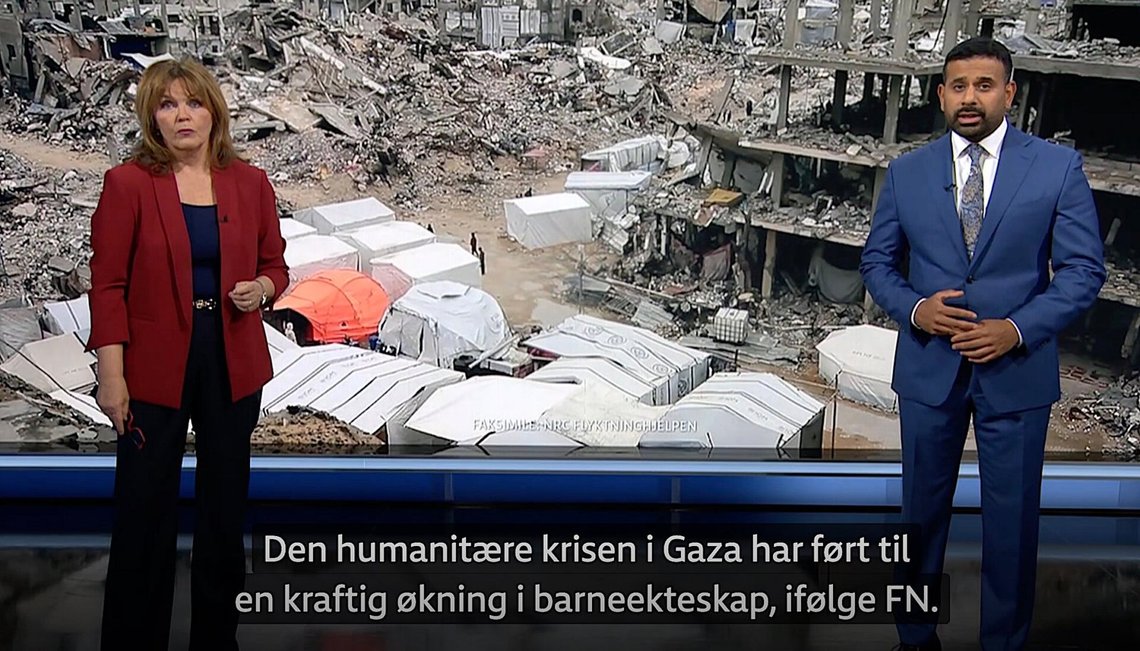


On last Saturday’s edition of Norway’s state broadcaster NRKs flagship Saturday evening news programme‘Lørdagsrevyen’, we saw a report from Gaza focusing on the rise in the number of child brides. The message was that the humanitarian crisis is leading to a sharp rise in weddings where parents feel compelled to marry off young girls.
The phenomenon was presented as a matter of course: hardship results in young girls being married off to ease the financial burden on their parents. In *Klassekampen* too, the newspaper’s writers have done the same; most recently, Rania Jalal Alnahi wrote on 22 October. Her starting point was the rise in child brides in Iraq, and she also pointed to economic reasons as part of the explanation, but in order to downplay the role of Islam.
The left has always pointed to socio-economic conditions to explain our behaviour. But to believe that hardship in society will be alleviated by children starting a new family betrays a fundamental irrationality. Equally bad is the fact that journalists fail to investigate what we ourselves did back when we were poor and hardship was part of everyday life.
The materialist understanding of reality, which claims that our actions – including moral ones – must be understood from an economic perspective, has some alarming consequences. Such a view of humanity turns us all into amoral robots and strips us of our humanity.
If it is the case that Muslim ethics, too, are dictated by our economic circumstances, we should ask a follow-up question about what Islam actually is. A religion that believes that economic hardship can justify abuses such as this is, in fact, not a moral religion. This says everything about its lack of an ethical foundation in general, but also about its view of women: Islam permits such abuse to take place. Child brides in the Middle East are therefore not a result of hardship, but because Islam condones the practice.
How the left, which claims to fight for women’s rights, can embrace Islam is therefore a mystery. This one-sided focus also has another, perhaps unintended, consequence: if hardship justifies child brides, the left must acknowledge that it is allowing the upper classes to have a monopoly on good deeds.
Our own history, however, bears witness to a different view of humanity, in which faith trumped necessity.
If we go back to the 16th century, there was a rise in birth rates in Norway, but what is interesting is that population growth was carefully aligned with the economic base. We lived by a simple rule: no one was allowed to marry or start a family without having a livelihood – that is, a means of supporting themselves and their dependants.
The father usually had to die before his son could take over the farm, a rule which also had its downsides: some had to wait a long time before they could marry, and some never married at all. And those who broke the rule and ‘had’ to marry without having a means of support in place faced bullying and ostracism. According to historians Ståle Dyrvik and Andreas Aase (‘World History and Norwegian History before 1750’), it was important for society ‘that the livelihood rule was respected’.
They write that the strict rules regarding means of support in peasant society created a long period of youth between puberty and marriage. During this phase of life, it was common to enter domestic service. The young person would then move into another household and work there on a contract for six months at a time. 14 April and 14 October were the so-called ‘moving days’, when one began or ended a period of service. When the agreed period was over, the girl or boy could find a new employer, or move back to their childhood home for a while. Many therefore moved several times during their teenage years.
By entering domestic service, young people were able to get out into the world, and they gained many social contacts and varied work experience. The wages for domestic servants were not high – they consisted primarily of board and lodging. Any additional remuneration was provided in the form of clothes and shoes, and less frequently as cash.
The years spent in service gave young people a chance to accumulate some worldly possessions, gain work experience and build a network of contacts. It was also during this period that the search for a spouse began.
What is interesting is the respect for human dignity and the rationality that society at that time demonstrated in the face of the challenges brought about by poverty. It was necessary to balance several factors at once: avoiding population growth that would impoverish the country, whilst safeguarding the integrity and freedom of both women and men.
The systems we ended up with were the result of a particular view of humanity – a view that gave rise to a culture different from that found in the Muslim Middle East.
It is difficult to overlook the significance of Christianity in this regard. With its emphasis on humanity, human dignity, reason and responsibility for one’s own actions, arrangements such as those we see in Gaza (and in several other places) were unthinkable in Norway. Here, girls were the apple of their fathers’ eyes, not a burden. In other cultures, hardship is allowed to become an excuse for abuse of our youngest and most defenceless, but our own history shows that it is entirely possible to let hardship become a starting point for the opposite.


