

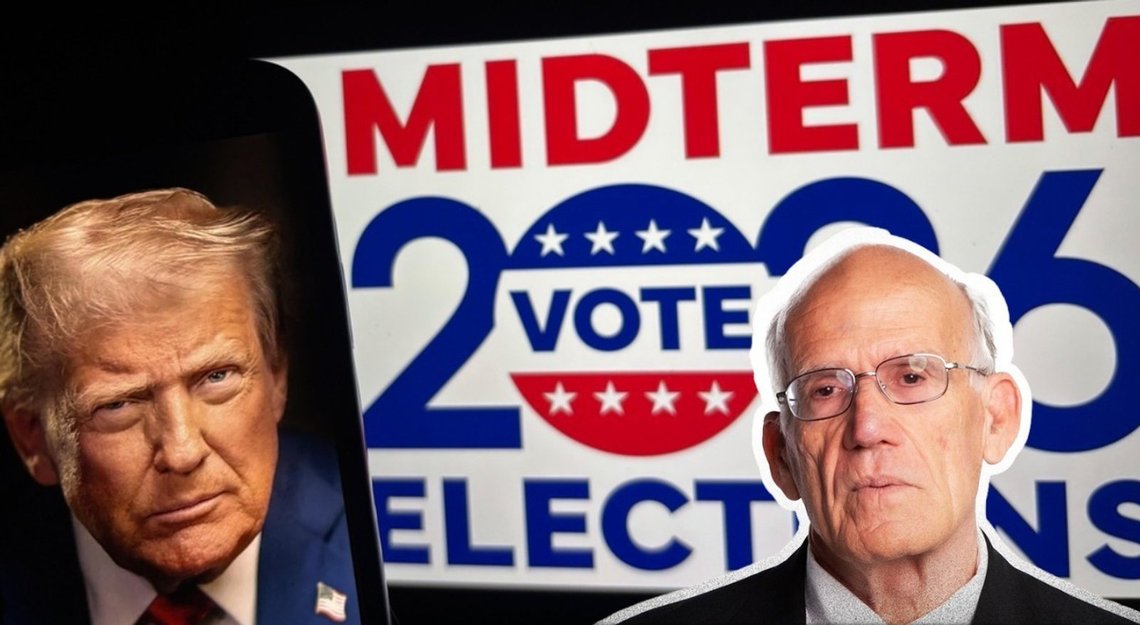


Below is a translation of Victor Davis Hanson’s monologue ‘The Final Countdown to the Midterms’, published on The Daily Signal on 2 November 2026.
The text is a slightly edited transcript of his video, translated into Norwegian using Grok.
Thanks to one of Document’s readers, Alf Kristian, who reminded us of Victor Davis Hanson’s monologue in the comments section.
Victor Davis Hanson: The Final Countdown to the Midterms
Hello, this is Victor Davis Hanson for The Daily Signal.
I’d like to talk about the upcoming mid-term elections. The conventional wisdom six months ago was that the House of Representatives was up for grabs, and that the Senate was a safe Republican stronghold. Now the polls and commentators have done an about-turn, and they’re saying it’s a certainty that the Republicans will lose the House and probably the Senate as well. History has, in a sense, been on their side since 1900.
Over the past 126 years, there have only been three occasions when the party in the White House has gained seats in the House or the Senate: under FDR and the euphoria surrounding the New Deal in 1934, before things started to unravel; Bill Clinton’s mid-term elections in 1998, when people were very angry, even though the economy was doing brilliantly, because he had been impeached; and 2002, when George Bush had rallied the nation after 11 September.
In all the other mid-term elections, 90 per cent of the vote has gone to the opposition party. There is another contributing factor. When the president’s approval rating is 40 per cent or lower – and in the cases I just mentioned, both Obama and Clinton fitted that description – they suffer particularly heavy losses in the mid-term elections.
That is what governs the general historical framework. But there are a couple of mitigating factors. The first is the 2022 mid-term election. Everyone had predicted a ‘red wave’ that would sweep both the House and the Senate by large margins. The withdrawal from Afghanistan had been a disaster. It is November 2022.
We recall that Russia had invaded Ukraine in February. People had blamed Joe Biden because he had said that the response would depend on whether it was a ‘minor invasion’ or not. We lost our deterrent in Afghanistan. We handed over $50 billion’s worth of weapons, equipment, infrastructure and bases to the Taliban.
Inflation that year, a mid-term election year, stood at 9.1 per cent – three times higher than it is now. GDP was lower. Petrol prices peaked at around $5 per gallon in June and July. They had only fallen to just over $4. In other words, the situation was quite similar to the one we have now, and yet Joe Biden lost only nine seats, and he gained one in the Senate.
That sets a precedent. But the big difference is that in 2022, the media downplayed all the bad economic news about inflation exceeding 9 per cent, foreign policy disasters and $5-a-gallon petrol in June of that year. This year, they are exaggerating it, despite solid GDP growth, low poverty and historically high per capita income. That is something to bear in mind.
Another factor is that the opinion polls do not necessarily have a good track record over the last three elections. People have studied this closely in 2016, 2024, the mid-term elections and, in particular, the primaries. It seems that the Republicans are being underestimated by around four percentage points.
The polling organisations appear to lean mostly to the left. They seek to generate support, donations and media coverage through favourable polls, and then they do not fully correct their figures in the end – if they correct them at all. That is why we cannot entirely trust the polls showing major Democratic victories this week. Then there is Israel, British Columbia and Brazil.
We have just witnessed three international elections abroad. Mr Netanyahu was supposedly going to be wiped out. He is fighting for his political life, but in the latest election his party, Likud, won more seats than any other party. That wasn’t supposed to happen. They are in a sort of government deadlock, but he is still at the helm.
We were told right up until election night that the polls were right, and that the exit polls were right, and that he would suffer a crushing defeat. British Columbia hasn’t really had a Conservative provincial government for around 100 years. The polls suggested the Conservatives might show strength, but no one had foreseen this massive victory in which the Conservatives took control of the legislature and executive power in British Columbia.
Brazil was, in a way, the opposite. Bolsonaro was expected to win because he had won the primary election. That election was somewhat different, as it was marred by electoral fraud. But the polls were wrong. It turned out to be a very close race, and Lula won.
There is yet another ‘known unknown’. These candidates on the left are quite a bit of a worry.
I believe that if a normal candidate had stood in Michigan, Texas, Maine and Minnesota, the Democrats would easily have taken those seats, given the Republicans’ problems this year. But James Talarico in Texas has, at some point in his career, advocated vegetarianism over Texan beef, green energy over Texan oil, a strange left-wing form of evangelicalism over traditional Texan religion, and open borders instead of Texan border security.
It makes no sense that he could win. He might, perhaps, but he was the wrong candidate to nominate if you were a Democrat. The same goes for Michigan. Mr Abdul El-Sayed has expressed sympathy with the Muslim Brotherhood. He has family members who have contributed to an anti-Semitic advert, and he is extremely terse.
He never answers questions. He ridicules journalists and so on. There is a strong possibility that Black people and Jews, because of what he has said about those respective groups, will not turn out in sufficient numbers for him to win. We’ll see. There are also a couple of nationwide October surprises.
In Alaska, the Democrats thought they’d be clever with this crazy ranked-choice voting system. There was only one Republican senator, the incumbent Dan Sullivan. They thought they’d have another Republican. And on top of that, they’d have the usual Democratic candidate, and then another Daniel Sullivan – someone who was unknown and wasn’t interested in standing.
They recruited him. So they deliberately put on the ballot paper not just a Republican ‘dummy’ candidate to siphon off votes, but another Republican who wasn’t actually a Republican, but who had exactly the same name, in order to confuse the voters. It appears that the Democrats were behind this. It was a carefully calculated manoeuvre, and it could backfire on them.
These are many of the external factors that suggest it is not entirely certain.
I’ll wrap up quickly by discussing what happens if this does turn out to be the case, and Donald Trump loses. We have historical precedents with Clinton and Obama. Bill Clinton and Obama took office with large Democratic majorities in both the House and the Senate.
They both lost ground in their final two years. They had neither the House nor the Senate. Were they finished for two years? No. Bill Clinton had, at one point, a 39 per cent approval rating. He left office with over 60 per cent. Obama had been down to 37 per cent. He left office with nearly 60 per cent. Of course, it is not good for an incumbent, lame duck president in his second term to lose both the Senate and the House, given the circus we are seeing today, with prosecutions and impeachment.
There is no doubt that Donald Trump will face impeachment, and there is no doubt that everyone around him will be summoned to court. There will be investigations. He will not have any appointments approved by a partisan Senate if he loses control of it. But if we look at the Clinton–Obama precedents, it didn’t bother them in the slightest.
Both Obama and Clinton faced this. What did Clinton do? After he was impeached, he was not convicted. It is extremely rare for the opposition party to have 60 votes. Instead, he held a major summit to try to resolve the Israeli-Palestinian conflict. He worked with Newt Gingrich to deliver a further two years of balanced budgets, making four years in total.
He bombed Serbia without Congress’s approval. He ignored Congress. He said: ‘You’ll never give me permission to bomb Milošević. I have to bomb him out of power so he doesn’t kill any more people in Kosovo.’ He bombed for 77 days. He hit bridges over the Danube. He hit dual targets.
He hit the power grid. In other words, he did as he pleased in foreign policy. Was that an exception? Far from it.
Obama, when he took office, boasted that he still had a pen and a telephone. He used executive orders domestically to do as he pleased.
In foreign policy, he did a lot of harm, in my view, but he did so with complete impunity.
He carried out air strikes. He launched Predator drone strikes. He ended up with 500 of them. They killed over 2,500 people, including 800 civilians on the Pakistani border. He carried on. 26,000 bombing raids. I’m not defending that. I’m saying that he blatantly ignored the majority in Congress.
He didn’t care. He wanted the Iran deal. The Republicans said: ‘That’s a treaty, Barack. You need a two-thirds majority in the Senate.’ He said: ‘No, I don’t. I’ll just go ahead and sign it.’ He sent $400 million overnight as a bonus to the Iranians to get them to sign, on a pallet. Was that all? No, he did plenty of other things in foreign policy.
Not only did he continue with the air strikes, he carried on striking in Libya whenever he pleased. And of course, in addition to the Iran deal, he got us to sign up to the Paris Climate Agreement, which was something of a fiasco. It placed no restrictions on China, but limited emissions from Western countries. Was it a treaty?
Yes. Did he go to Congress? No. So Obama and Clinton have taught us that even when you come in with a large majority and are very unpopular, polling below 40 per cent – and that continues – and then you lose the entire Congress in your final two years following the last mid-term election, you’re by no means finished. For both of them, in many ways, it was the best thing that ever happened to them.
They ended up being extremely popular. They did what they wanted on the international stage. They used executive orders in domestic policy. And you know what? What happens when a president is a lame duck and loses control of Congress? The opposition becomes arrogant and starts speaking in megalomaniacal, narcissistic terms. ‘We’re going to do this to the president. What’s more, we’re going to do this.”
And the president just behaves like a lame duck throughout it all. And more importantly: the next election campaign begins. In 2000, George W. Bush and Al Gore fought hard. Bill Clinton said: “I’m not getting involved. Al Gore doesn’t want me to run any campaign.” And he came across as statesmanlike.
Barack Obama, Hillary, Trump – bitter, tough years in 2015 and 2016. Obama was on the golf course, operating on the assumption that the more you see of Barack Obama, the more you hear, the less you like him; the less you hear and see, the more you like the idea of him, and his support rose.
What do I mean? We don’t really know who will win the mid-term elections. It ought to be the Democrats, but there are enough ‘known unknowns’ that they might not.
And should Trump lose Congress, Obama and Clinton have set a precedent whereby a president actually has powers that Congress cannot stop.


