

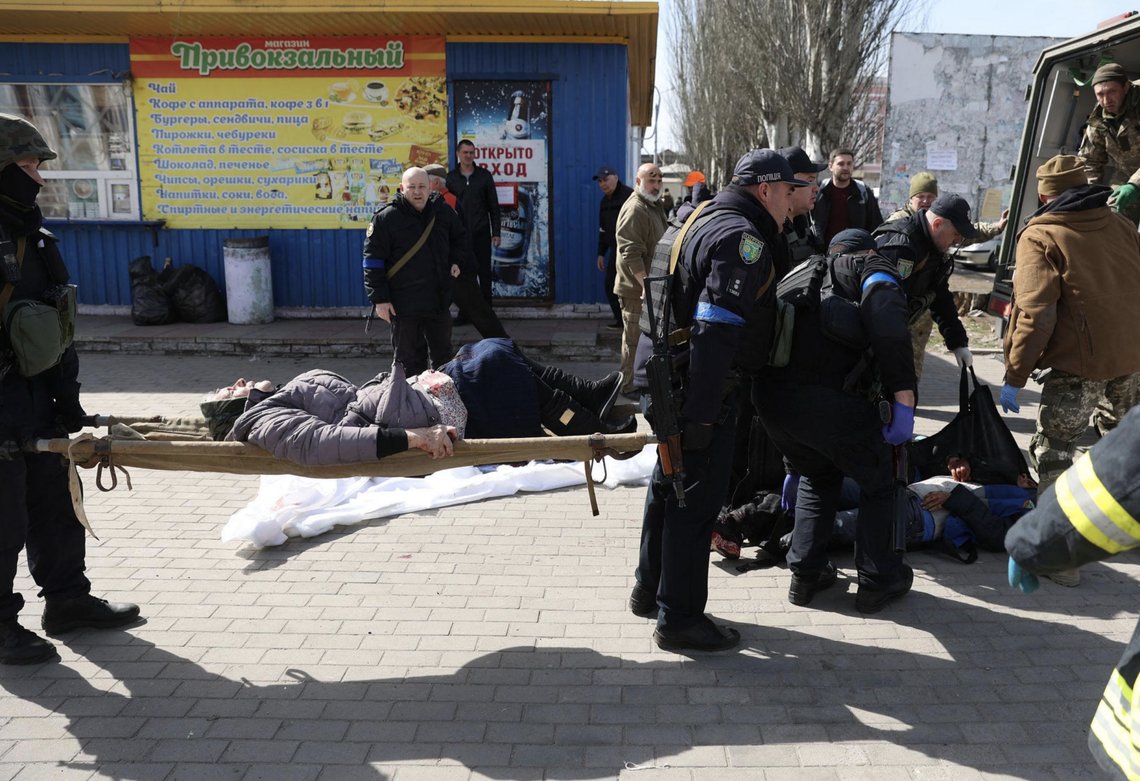


The media and politicians tell us every day about a ‘full-scale war’ in Ukraine that began in February 2022 and which should be brought to an end, as it has been going on for almost five years. Many Ukrainians do not entirely recognise this portrayal. They believe there was a war in the country long before 2022. We can find information suggesting that a conflict has been ongoing since 2014, when Russia annexed Crimea and the Donetsk and Luhansk regions in the south-eastern area known as the Donbas. What is strange about this account is a lack of detail and precision, which creates the impression that there must be something which, for some reason, it is important to avoid mentioning.
Let us therefore rewind to the start of the conflict. In early 2014, the country was in a state of severe internal unrest, with uprisings and coup-like conditions in the capital, as well as a emerging armed resistance against the authorities in Kyiv in those parts of Ukraine which have historically had a Russian-speaking population and strong cultural and religious ties to Russia. This pro-Russian uprising, which was directed against those leading the struggle against the pro-Russian government in Kyiv, had clear political support from the Russian side. For most Russians, this was seen as yet another instance of defending their heartland and motherland against invasion from the West.
Ukraine is not only an ethnically divided country, but in a religious context is also divided between the Orthodox and Catholic Christian faiths. During the conflict, groups also emerged that had historically sided with the Nazis during the Second World War. They still exert influence and are regarded by neighbouring Poland as a problem for future coexistence, and are the reason why the Russian side is demanding the ‘denazification’ of Ukraine.
To understand what triggered the chain reaction of events which, in February 2014, culminated in the ousting of the Yanukovych government, we must take a closer look at events that took place the year before and which directly precipitated the dramatic events of 2014. Until 2013, Ukraine was a relatively stable country which, despite historical internal tensions and conflicts, managed to maintain its unity under a pro-Russian government. That does not mean that everything was peace and harmony. Ukraine, like Belarus, was well known as a thoroughly corrupt and authoritarian country where development following the collapse of the Soviet Union had largely come to a standstill, characterised by internal conflicts and power struggles. Dissatisfaction with the regime had been rife for many years, and the opposition was cracked down on harshly.
A landmark event in 2013 was Russian President Putin’s renewed attempt to breathe new life into an old Russian idea of organising close economic and military cooperation between former Soviet republics, which now included countries such as Belarus and Ukraine. The background to this was the cold shoulder Russia had been given in the early 1990s, when it was working towards closer economic integration at European level and even envisaged the possibility of joining NATO.
However, neither the European nor the American side was prepared for more extensive integration of Russia and its former Soviet neighbours. A Russian response to this rejection during Putin’s presidency was therefore a plan to develop a ‘Eurasian Union’ on the ruins of the Soviet Union. The European Union (EU) was to serve as a clear model for the organisation and objectives of this cooperation. The region’s vast natural resources were to be exploited to create prosperity and international strength.
The idea of the Eurasian Union, which is still relevant and alive, is based, amongst other things, on a growing Russian fear of Western expansion eastwards and deep into Russia’s strategic and economic sphere of influence. For centuries, Ukraine had been Russia’s southern defence flank, with Crimea serving as the main base for the Black Sea Fleet. Western expansion into this area evoked historical memories and deep concern in Moscow, which held the view that that an understanding had been reached that NATO would refrain from an expansionist ‘Eastern policy’. However, Moscow soon gained the impression that the West held a different view on this matter. Central to this picture were the political developments in Ukraine, where a growing popular and political opposition was working towards closer ties with Western Europe and the EU.
In the autumn of 2013, Russian President Putin went so far as to openly advocate the idea of closer economic and political cooperation, initially in the form of a customs union between Russia, Ukraine and other former Soviet states. The aim was a future Eurasian Union modelled on the EU. This led Ukraine’s President Yanukovych to to shelve the idea of entering into negotiations on an association agreement with the EU, something he had already signalled to the EU leadership. This U-turn caused Kiev to erupt in demonstrations and unrest.
The climax of these events came when the EU’s High Representative for Foreign Affairs, Catherine Ashton, travelled to Kyiv in December 2013 in an attempt to persuade Yanukovych to change his mind. The talks between them created uncertainty and led Ashton to believe that Ukraine’s association with the EU was still possible. She made promises of support from the EU and addressed a growing crowd of Ukrainian demonstrators in Kiev’s central Maidan Square. Here she actively urged Ukrainians to choose the EU over Moscow. Those present had no doubt that, given the situation in the country, she was inciting revolution. After all, she herself was a former English ‘young communist’ and knew exactly how to address the crowds gathered there.
It was this that really set in motion the short-lived process that led to President Yanukovych being forced to step down and flee into exile in Russia. The whole operation was obviously carefully planned and carried out by the EU’s representative Catherine Ashton on behalf of the EU’s top leadership. The active interference in a revolutionary situation in Kyiv speaks for itself. The EU leadership was fully aware of what Soria Moria the ordinary Ukrainian believed the EU to be, and how strongly Western Ukrainians in particular longed to be part of European prosperity. Her visit was simple and brief.
The consequences that began to unfold in the days following her visit and promises of aid are still plaguing Ukraine. The country has been largely devastated. Millions are fleeing, and hundreds of thousands have died. We still see no end to the tragedy, which is in truth the most destructive result to date of the EU’s self-absorbed drive for expansion.
It will probably be many years before the whole truth about the war in Ukraine can be told publicly by our authorities. Until then, they are all too deeply involved and complicit. Most people will have to live with the state-funded national media’s narratives about Putin’s ‘full-scale war’, without ever knowing how this tragedy came about. But before long, this war will peter out due to a lack of fuel. We must then hope that voices will emerge even amongst the authorities who are not afraid to tell the truth, even when it is uncomfortable.


