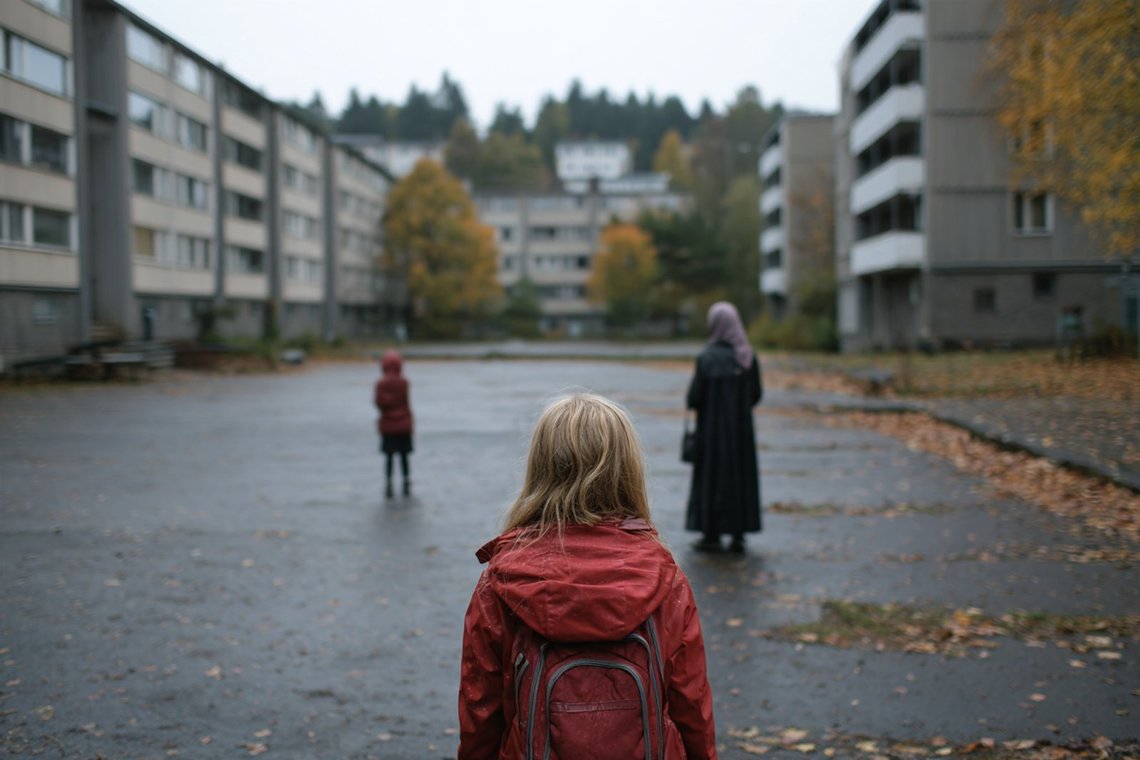


A mother in Groruddalen has to write anonymously about her daughter wondering whether she herself is ‘haram’. That says more about integration in Norway than any ceremonial speech or action plan.
Her daughter wants to know what ‘haram’ means. She wonders if it applies to her, as her friends aren’t allowed to come round to her house.
This is recounted by an anonymous mother in Groruddalen in an opinion piece in *Aftenposten* on Sunday evening. Her friends have explained to her daughter why: she has older brothers, so the house is unsuitable. A playdate, arranged with the other mother in advance, was called off at the last minute. Afterwards, the family was told that the situation had been irresponsible.
A Norwegian girl is thus being socially ostracised in her own town, in her own country, because so many people living in the area have a completely different set of values to what is normal and acceptable in Norway.
An ordinary Norwegian family – open-minded, inclusive and liberal, who even adapt their eating habits to suit those who have moved to our country – has become a moral problem in the eyes of others. And the child has realised this.
Negative social control is nothing new. From Kadra Yusuf to Nancy Herz and ‘the shameless Arab girls’, courageous women from minority backgrounds have, for over twenty years, spoken out about how girls are held back in communities governed by honour and shame. This is the story from the inside.
The Aftenposten article tells us what happens when Norwegians find themselves in the minority. Control no longer remains within one’s own four walls. It brands the neighbour’s home as inappropriate and teaches an ethnic Norwegian girl that there is something wrong with her family. Integration has changed direction. Now it is the Norwegian girl who must put up with being excluded, in a neighbourhood where she is already in the minority.
According to Statistics Norway (SSB) figures, around 50 to 65 per cent of residents in Stovner, Alna, Grorud and Bjerke have an immigrant background. When minority girls are kept at home and their mothers gather in closed religious groups, there aren’t many playmates left. The mother describes parents who fail to attend parents’ meetings, the Parents’ Association (FAU) and voluntary work days, and who do not have their contact details listed in the school’s messaging app. This makes it difficult both to invite children to birthday parties and to arrange playdates.
The most disturbing thing is who she is describing. She emphasises that these are second- and third-generation immigrants. The parents have good jobs and are well-off.
‘They have the system at their fingertips, but choose to disregard values such as equality and children’s freedom,’ she writes.
This undermines the most common reassurance in the Norwegian integration debate: that everything will sort itself out in time. These families have had time. They speak the language, know their rights and understand exactly how the school system works. They have made their choice.
And the school has chosen to give in. At the school mentioned in the post, swimming lessons are segregated by gender because some parents do not accept the children swimming together. In the Norway of old, this would never have been an issue. It still isn’t in western Oslo.
‘Why should girls in Groruddalen be offered a less equal everyday life than girls elsewhere in the city?’ asks the mother.
That question should be on the agenda for Oslo’s education policymakers first thing tomorrow morning.
For the problem is well known. In April 2015, Bente Thorsen of the Progress Party (FrP) raised the issue in the Storting that headteachers at schools with many Muslim pupils were facing increasing demands for single-sex swimming lessons. She pointed out that some county governors had begun to approve gender-segregation on religious grounds, and that the Ministry of Education’s own guidelines allowed for this. Eleven years later, girls at at least one school in Groruddalen are still swimming separately.
This is where the institutional failure lies. School is the place where all children should meet on equal terms. When it bows to parents from a distant culture that rejects Norwegian culture, it shifts the boundaries for all pupils – including the girls who never asked for anything of the sort.
Finally: the mother feels compelled to remain anonymous. *Aftenposten* knows her identity, but out of consideration for the children, she is not coming forward. In Norway in 2026, a mother cannot speak out under her full name about what her daughter is experiencing in the school playground. She writes herself that many remain silent for fear of being labelled as intolerant.
That fear is not imagined. It has built up over decades in which anyone who points out the problem is quickly made into the problem.
She is asking for very little. She wants children to be able to play with whoever they like. The fact that this requires an anonymous opinion piece is a defeat for a country that likes to call itself the world’s most gender-equal.
In reality, we are hurtling away from Norwegian culture, Norwegian values and a society that we all took for granted just a few years ago.
Her daughter has asked a question that no girl in Norway should have to ask. No child is haram. Least of all a Norwegian girl who just wants to play with her friends. But she isn’t allowed to, because it’s scary for Muslim girls to visit a house where there’s an older brother.