

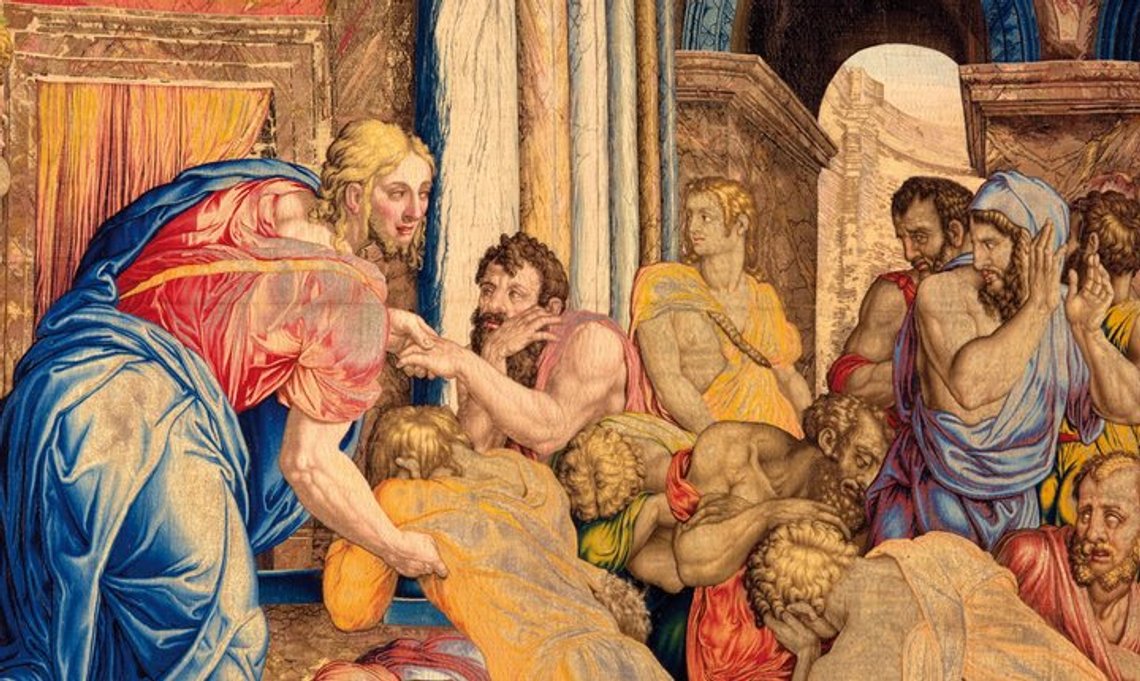


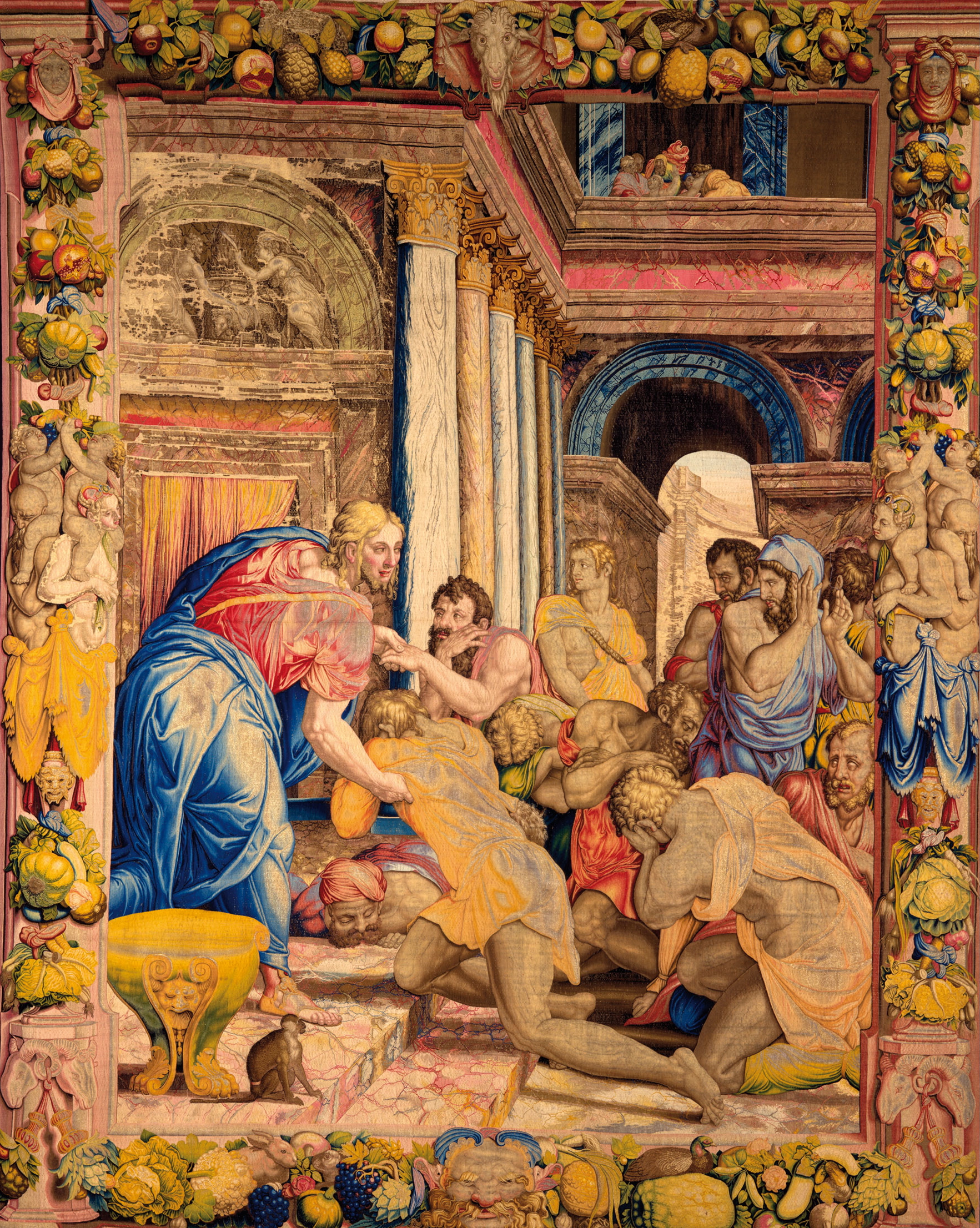
Agnolo Bronzino (1503–1572), ‘Joseph Forgives His Brothers’, Uffizi, Florence. Photo: arte.it / Wikimedia Commons (CC BY-SA 4.0).
1 Keep brotherly love alive! 2 Do not forget to show hospitality, for by doing so some have entertained angels without realising it. 3 Remember those in prison, as though you were chained with them, and remember those who are being mistreated, as though it were your own body.
The Letter to the Hebrews 13:1–3
Today’s Sunday Bible readings have love as their theme, whether it be Jesus’ love for us or humanity’s love for one another. Above we find a passage from Paul, but perhaps the most powerful of today’s texts is found in the Book of Ruth and the story of Ruth and her love for her mother-in-law.
The message of love for our fellow human beings was proclaimed to the Jews from an early time. As early as in the Book of Leviticus, God tells the Jewish people that they are to love the foreigners living in the land they inhabit as themselves.
But what can we demand of the state? This question became relevant during the American Revolution. Here, for example, the Declaration of Independence established that the state must guarantee its citizens the right to pursue their own happiness. At the same time, these rights were rooted in a moral order that existed before the state.
But gradually, something has happened. The perspective has been reversed. The message is no longer directed primarily at the person who is to show love, but at the person who believes they are entitled to it. The commandment for people to love their neighbour has increasingly been transformed into a demand that people can make of others and of society. Now it is society that is expected to accommodate the individual’s demands, demands that are often presented as fundamental human rights.
The reasons for this development are complex, but we can nevertheless observe a shift in the understanding of rights: from rights intended primarily to protect the individual against arbitrary state power, to rights that increasingly entail demands which the individual can direct towards the state.
This concerns the demands placed on the state and its obligation to ensure our ‘right to pursue happiness’. This is often understood as our right to pursue our subjective understanding of happiness. But when this happiness is defined without being rooted in a moral order, the question arises as to who should decide which desires are to be transformed into rights.
When rights are not rooted in a moral order, the right to freedom can be understood as the right, for example, to define one’s own identity (gender, nationality, etc.), the right to have certain choices, such as abortion, carried out, or the right for society to recognise one’s own understanding of history and belonging.
But the God of Christianity does not grant us a general right to demand that our neighbour fulfil our desires or confirm our own understanding of what is good.
Today, the Declaration of Independence is often cited as the basis for liberal rights and the individual’s freedom to shape their own life. But if we look at how one of the Declaration’s key contemporaries, John Adams, understood freedom and happiness, we get a rather different picture.
John Adams had an understanding of freedom and happiness that presupposed a moral order, and which is far removed from an understanding of happiness as purely subjective satisfaction.
The Declaration of Independence begins by stating that rights are granted by ‘their Creator’. Our freedom is therefore embedded in a moral order that predates the state. The state does not, therefore, create rights; it is there to protect them.
And the ‘right to pursue happiness’ must also be understood in the context of the views of the time. It does not mean ‘the right to do whatever feels good’. The wording of the Declaration had its roots in classical and Christian natural law thought, where happiness could mean the realisation of a person’s potential or the good life – not merely subjective satisfaction.
John Adams wrote extensively on the prerequisites for a good society. Among other things, he pointed out that:
the happiness of society is the end of government (the happiness of society is the purpose of the state).
And perhaps even more interestingly,:
the happiness of man, as well as his dignity, consists in virtue.
John Adams went on to argue that good government must be based on moral virtue, because the happiness of society cannot be separated from the moral character of its citizens. Indeed, for Adams, virtue was not an obstacle to happiness. Virtue was a prerequisite for it.
What John Adams meant was that human beings are created for a good life, but that the good life presupposes virtue, and that virtues are therefore a prerequisite for true human happiness.
For Adams, this applied not only to the individual. Our democratic institutions, too, require moral self-restraint on the part of those who wield power. They can only survive if citizens exercise moral self-restraint.
In our own time, however, we are witnessing a political trend in which moral self-restraint is increasingly being replaced by the desire to appear virtuous by facilitating a way of life that is not grounded in a moral order. We are thus witnessing people using the law and institutions to impose demands on their fellow citizens – demands that are steering society in a direction we would, until very recently, have rejected.
Our mistaken understanding of Christian charity prevents us from defending what is good and right.
The problem is not that we have too much love for our neighbour, but that we have forgotten what true love for our neighbour is. Christian love asks first: What can I do for my neighbour? Our contemporary understanding of rights turns this question on its head: What does my neighbour owe me?
But my neighbour does not have a general right to demand that I and others fulfil his wishes or validate his own understanding of what is good. Such an understanding of love for one’s neighbour is a result of both a lack of moral self-restraint and the virtues required for a good society, but it also results in itself in a degradation of moral self-restraint.


