

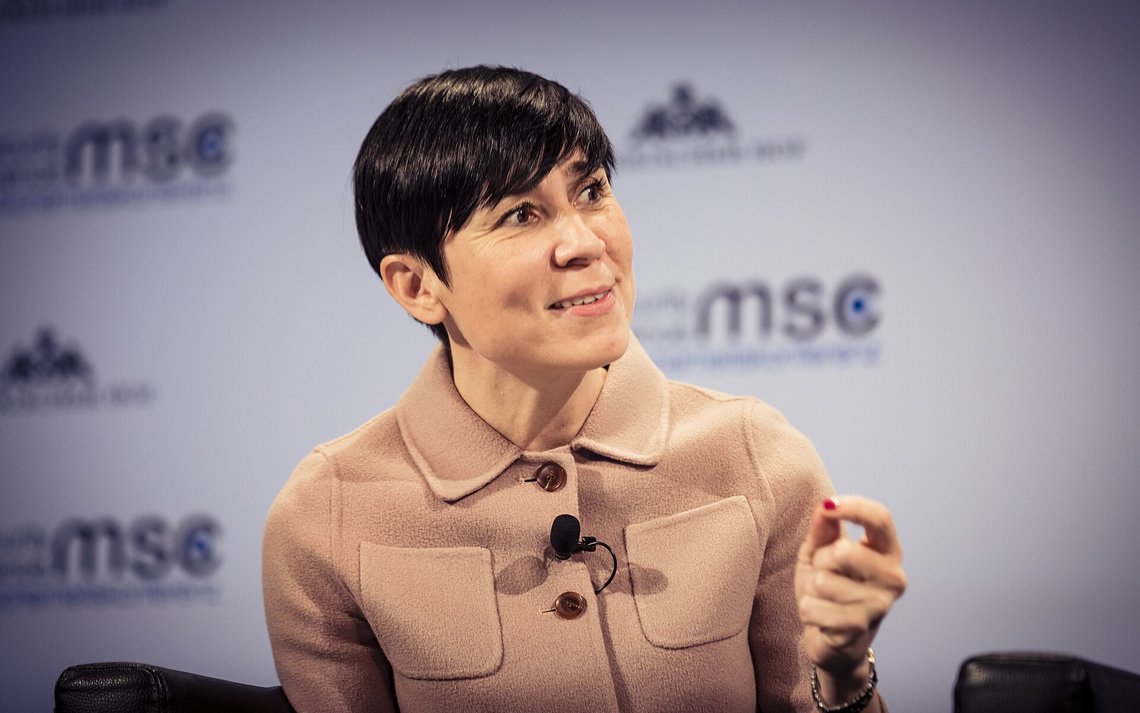
Norway’s largest business newspaper Dagens Næringsliv reminds us of just how bad things are in the Conservative Party (Høyre). At the same time, we are reminded that things are no better at Dagens Næringsliv, should it wish to present itself as a newspaper grounded in business sense.
In the commentary ‘[An empty roar](https://www.dn.no/uten-filter/politikk/uten-filter/drivstoff/et-tomt-brol/2-1-2049699)’ in Dagens Næringsliv (DN) on Saturday, the newspaper’s political editor, Frithjof Jacobsen, reminded us of the poor state in which Høyre finds itself. ‘With friends like Blått distriktsnettverk, Høyre needs no enemies’, he writes.
In short, he supports party leader Ine Eriksen Søreide in refusing to continue the fuel-duty cuts. But he goes further than that. He believes it was a mistake for Høyre to contribute to the temporary duty cuts this spring. Ergo, he believed that the best course for Høyre would have been to follow the Labour government’s line.
Frithjof Jacobsen is the partner of former Labour Party central executive committee member Jette Christensen, a relationship he kept secret while she supplied him with inside information about the proceedings against Trond Giske. When the relationship became known, it resulted in his having to leave his position as a political commentator at VG.
When Labour man Kjetil B. Alstadheim left his position as political commentator at DN, for better or worse for Aftenposten a few months later, the position as political commentator at DN became vacant for Jacobsen.
How Alstadheim and Jacobsen vote, Document of course does not know, but as self-appointed guests at Hadja Tajik’s ‘sausage party’ following the victory over Giske, it is reasonable to believe that the distance to the Labour Party is short.
In the commentary, Jacobsen delivers a reprimand to Nettavisen’s political editor Skjalg Fjellheim and goes straight for the throat of Høyre’s grassroots, who are rebelling against the party leadership’s line on duties or leaving the party as a result of it.
### Blowing the dog whistle
Given recent developments in the opinion polls, this commentary is at best poor consolation for Ine Eriksen Søreide, but more likely a humiliation, which it may have been intended to be.
For if Høyre were to be a credible non-socialist alternative, that disappears in Jacobsen’s text, with the sentence: ‘Large parts of Norwegian business have in recent years wanted both lower taxes and subsidies. It does not add up.’
Herein lies one of Høyre’s main problems. Over a period of years, NHO has been strongly influenced by Fornybar Norge, Enova and a series of climate-policy demands that have been servilely accepted. It is important to remember that Fornybar Norge is the result of the 2023 merger of Energi Norge (the hydropower industry) and Norwea (the wind-power industry).
Fornybar Norge is thus the driving force behind extensive subsidies for offshore wind development, while Enova is the state instrument for channelling subsidies to businesses as part of climate policy.
Høyre, which has traditionally been NHO’s party, has thus also become the party of both tax cuts and subsidies. So when Jacobsen, with his Stoltenbergian logic, proclaims that it does not add up, he is of course proved right and can serve this up on a platter to a humiliated Ine Eriksen Søreide, who is probably desperate to find her place in Norwegian politics, well aware that she could be ousted at Høyre’s next national conference if she does not.
In this way, Jacobsen blows the dog whistle to the naïve part of his readership, as well as to his partner’s circle, that one might as well choose the genuine article, i.e. the Labour Party.
### Failed to do the homework
Had Høyre, on the other hand, been a non-socialist party, and Jacobsen a commentator with non-socialist ideas, let us say an Olav Versto, and DN a newspaper with an editorial standpoint grounded in business sense, the angle would have been quite different.
It would, in brief, have contained the following:
Being a non-socialist party, whether in government or opposition, should entail a principle of limiting the state’s economic power over individuals and businesses.
Since both Ine Eriksen Søreide and Henrik Aasheim have sat at the feet of Erna Solberg, who broke with this non-socialist principle, they now have a unique opportunity to correct the mistakes and bring enthusiasm back to Høyre.
But instead, Ine chooses a path that is difficult to distinguish from the one followed by the Labour Party, apart from the promise of tax cuts further down the road than the eye can see – although it is unclear how these are to be funded.
A genuine non-socialist party has a neutral business policy. That means a business policy without subsidies.
A genuine non-socialist party will strengthen the incentive to work rather than raise benefits and receive housing support.
A genuine non-socialist party does not support formulaic monetary gifts in the form of a given percentage of something over which one has no political control – e.g. GDP.
Ergo, it is not non-socialist policy to hand out almost NOK 60 billion annually in aid, nearly half of which goes to vague categories such as ‘global unspecified’ and ‘multilateral core support’, without thorough audits being conducted every year to ascertain how this money has been spent, and without debate as to whether this has any value for Norwegian taxpayers who financed the whole affair in the first place.
Not to mention the identifiable aid to countries such as China, Iran, Venezuela and Cuba, which last year received a combined NOK 130 million. Aid to countries that undermine the interests and security of Norway or our allies.
A serious non-socialist party does not buy the Stoltenbergian proclamation that it is impossible to cut public expenditure. For that is the same as signalling to individuals and businesses that taxes can only be increased, not reduced. A serious non-socialist party must actively move away from Stoltenberg’s manifesto and always have an up-to-date menu of public spending cuts that, from a non-socialist standpoint, ought to be possible to implement, even if they provoke emotional reactions on the left.
Whether cuts in subsidies, the abolition of Enova, labour-market measures, restrictions on the immigration of welfare recipients who will in any case vote socialist at the first available opportunity, restrictions on support for religious communities and, not least, cuts to the aid budget, which is a growing festering sore in the wake of the Epstein revelations, wildly excessive spending and the lack of auditing. Norwegian aid increasingly appears to be a gross breach of the social contract and people’s sense of justice, and an affront to reason.
Ergo, when, in a society such as Norway, which has the OECD’s highest share of public-sector economy, an opportunity arises to reduce it, whether through tax cuts or duty cuts, the opportunity should be seized. And this should be accompanied by a menu consisting of already prepared funding measures in the form of spending cuts.
But Høyre is not there. Høyre has not done the fundamental homework required to be a credible non-socialist party.
### The window is closing
After 22 years with Erna Solberg as leader, Ine Eriksen Søreide continues on the same course, as a pale version of the Labour Party, albeit with a little rhetoric about tax, for appearance’s sake. But it has no credibility.
The party thus becomes easy prey for people such as Jacobsen, and not least for Jens Stoltenberg, who last year was entirely right when he stated that ‘[Høyre has shown no ability to cut public expenditure](https://www.finansavisen.no/politikk/2025/06/26/8274714/jens-stoltenberg-hardt-ut-mot-hoyre-gode-pa-a-bruke-oljepenger)’.
Thus the window closes for Høyre.


