
 Gunnar Arne Larsen
When transfers and subsidies across development aid, refugee measures, climate and agriculture add up to more than NOK 557 billion over three years, a fundamental question arises: Why are these connections and the simple, aggregated calculations not the subject of major headlines and critical investigations in the country’s national newspapers?
The answer lies in two systematic mechanisms: the bureaucracy’s power of definition and the media’s economic dependence.
Statistical concealment of demographic costs
When it comes to the long-term and ongoing expenditure on immigration, integration and welfare benefits, the system’s statistical models are rigged in such a way that the costs are gradually erased and become impossible for outsiders to trace. Statistics Norway (SSB) operates with a methodology whereby a person is categorised in immigration statistics only under two specific conditions: either that the person was born abroad to two foreign-born parents (first generation), or was born in Norway to two immigrant parents (second generation).
As soon as we move to the third, fourth and fifth generations – that is, children of people who were themselves born in Norway – this categorisation ceases completely. The moment a person has one parent or grandparent who was born in Norway, or as soon as a person is granted Norwegian citizenship, that person is moved into the category ‘the rest of the population’ or ‘without an immigrant background’ in SSB’s main registers.
This means that the economic repercussions of the historical immigration from the 1970s onwards are today completely invisible in the ongoing budget debates. If third- or fourth-generation descendants fall outside the labour market, receive disability benefits or receive extensive municipal benefits, this is not recorded as a cost associated with immigration or failed integration. It is recorded as a general expenditure on the ethnic Norwegian population. In practice, the system wipes its own accounting books clean with each generational change.
When independent economists or political parties commission separate analyses – as was done in a comprehensive SSB commission presented in April 2026 – the underlying realities are nevertheless confirmed: Non-Western immigration represents a net deficit to the Treasury of tens of billions of kroner annually, and the lifetime cost of a single non-Western refugee is estimated at more than NOK 4 million from arrival to death. But in the day-to-day national budget, these figures are effectively dispersed and concealed behind new labels.
Press subsidies and the fear of political sanctions
The second element that ensures the system’s survival is the media’s total integration into the state money machine. The Norwegian media landscape is not independent in an economic sense; it is connected directly to the state’s transfer systems through two massive channels:
- Direct press subsidies (the production grant): The state distributes around NOK 450 million annually in direct cash support to Norwegian newspapers. NRK funding: More than NOK 6 billion is channelled annually directly through the national budget to operate the national broadcaster.
- The newspapers and editorial offices are painfully aware that their economic foundation and framework conditions are decided by the same politicians and parties that administer the rest of the national budget. This creates a subtle but very real loyalty and an inherent fear of challenging the premises of the established system.
This came clearly to the surface during the budget negotiations, when the Green Party (MDG) went on the offensive and demanded changes to the rules governing press subsidies solely in order to halt the funding of alternative and system-critical media. The politicians’ justification was that public funds should not go to platforms that ‘stoke distrust of democracy, institutions and politicians’. This reveals the true nature of press subsidies: They function as a political tool for rewarding loyalty. Media outlets that accept the elite’s premises and repeat the bureaucratic obfuscation are assured of survival, while those that attempt to cut through to the simple economic realities risk being financially strangled.
This is reinforced by a pronounced cultural and social intermingling within the Norwegian elite. Journalists in the major national media, political advisers, ministry bureaucrats and leaders of the major NGOs belong to the same social class. They have identical educational backgrounds from the same universities, they live in the same central Oslo neighbourhoods (Oslo West, Sagene, Nordberg), and they frequent the same debating forums and dinner parties.
When a journalist is covering a story about electricity prices, development aid or agriculture, he or she obtains statements from ‘independent experts’ at publicly funded research institutes (such as CICERO, NUPI or NIBIO), which themselves depend on project funding from the same ministries. The result is a public conversation conducted within a closed echo chamber in which the press acts as the system’s defenders and interpreters, rather than functioning as the critical fourth estate that exposes how citizens’ money is managed.
Summary of the flow of state funds (2024–2026)
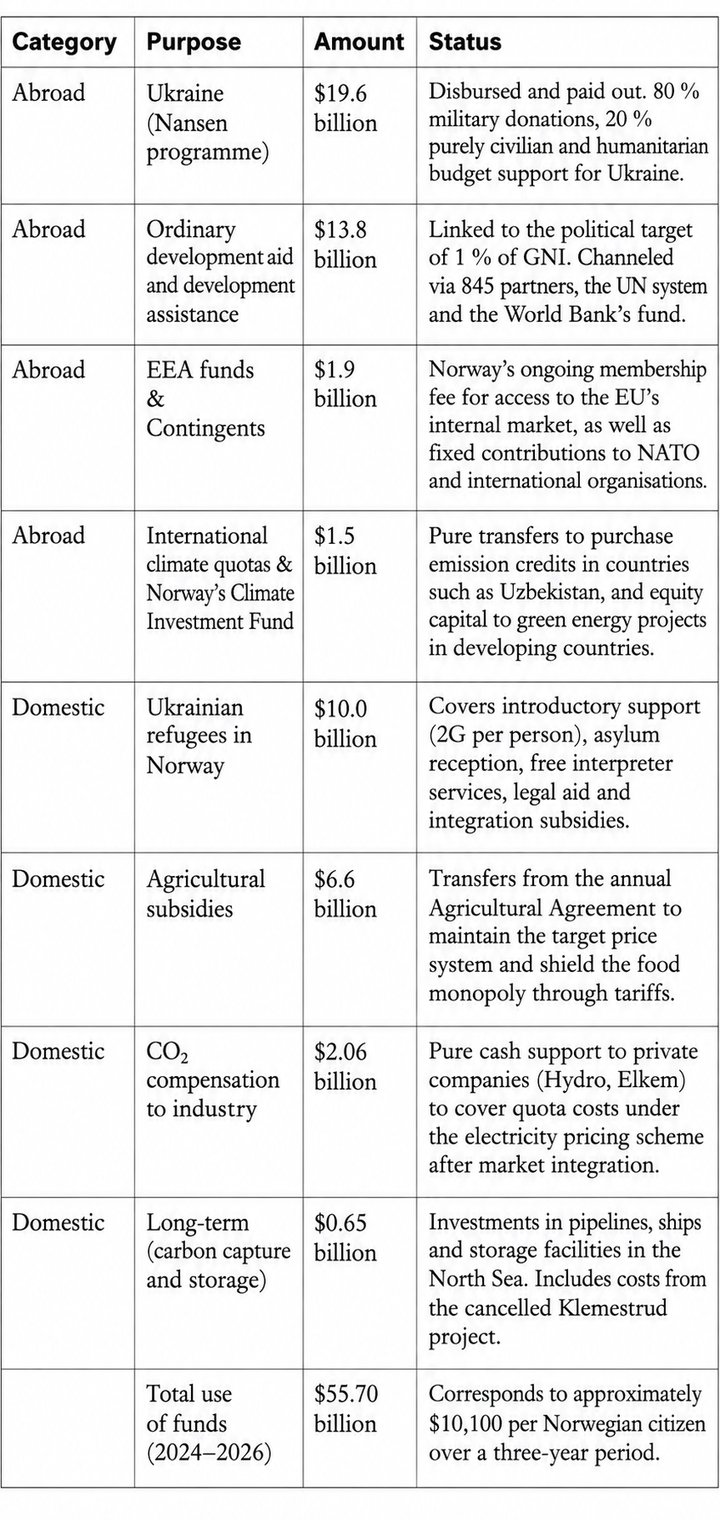
To provide a complete, independent and readily scannable overview of the economic material uncovered in these articles, the figures for the period 2024–2026 are set out in the table below.
This is the bare cash flow showing exactly where the NOK 557 billion has gone. The table draws a strict distinction between capital that has left the Norwegian economic system entirely and capital that has been tied up in domestic subsidy schemes and refugee measures:
Conclusion: The truth about Per and Ole
This entire extensive economic survey, with all its billions, opaque funds, international agreements and bureaucratic definitions, can be distilled into a simple, popular and crystal-clear equation involving two fictitious individuals. This example captures the very essence of the modern Norwegian social model:
Per (the Norwegian taxpayer) owns an enormous, resource-rich garden filled with the natural resources of oil, gas and hydropower, as well as fertile soil. Since Per cannot manage all of this alone, he hires Ole (the state, the politicians and the bureaucrats) to manage the garden, build turbines in the mountains, construct dams, plough the soil and extract the oil. Per pays Ole an exceptionally good and secure salary through his taxes to carry out this task on behalf of the community.
But when autumn arrives, when the vegetables have been harvested, the electricity generated and the oil pumped up, Per discovers that he does not own the fruits of his own enterprise. Ole gives nothing back to Per. Instead, Ole takes the electricity and sends it abroad through a cable, while the oil and vegetables are immediately sold on international exchanges and to AS Sentral (the closed network of UN funds, 845 development-aid partners and commercial NGO conglomerates) in order to extract maximum market profit.
When winter sets in and Per sits at home in his living room freezing, he turns to Ole to obtain electricity and food from his own garden. Ole, however, throws up his hands, points to international agreements and market exchanges, and informs Per that he must buy his own goods back at exorbitant European market prices. To complete the arrangement, Ole requires Per to pay an additional 25% in VAT straight back into Ole’s own wallet for the privilege of filling his shopping basket or turning on the heater.
The money Ole earns from selling Per’s goods and collecting VAT on tax is used to finance NOK 300 billion for the Ukraine conflict, billions for international climate quotas and million-kroner salaries for bureaucrats in Oslo. When Per goes to the newspapers to ask whether this arrangement is actually reasonable, he is met with silence – because the newspapers also receive hundreds of millions in press subsidies from the same pot controlled by Ole, and the journalists live in the same neighbourhoods as Ole’s advisers.
This is the bare, independent and direct reality behind Norway’s public finances in 2026. The system is rigged so that the taxpayers (Per) bear all the risk and foot the entire bill through taxes and duties, while the proceeds are channelled into a global and elitist system in which the consumer must pay full price all over again. NOK 557 billion has disappeared from the immediate Norwegian community in just three years – and the bill is left entirely with ‘Per’.
Alternative use of NOK 557 billion: What the community’s funds could have paid for in Norway
If we take as our starting point the total sum of NOK 557 billion that has been allocated to foreign purposes, the development-aid industry, purchases of emission allowances and major subsidy schemes during the three-year period 2024–2026, we are faced with enormous economic room for manoeuvre.
To illustrate the value of this capital for ordinary taxpayers (‘Per’), we can convert the sum into an annual average of approximately NOK 185.6 billion per year.
Below is a concrete breakdown of what this money could instead have financed directly in Norwegian society in order to reduce the cost of living, abolish duties and upgrade the national infrastructure.
Financial room for manoeuvre: What NOK 185.6 billion annually could have paid for in Norway
- Complete abolition of all toll rings
- Cost: Annual toll revenues from Norwegian motorists amount to around NOK 13–15 billion.
- Effect: By using this pot, every toll station and registration point throughout Norway could have been dismantled and paid off immediately. Neither commuters, families with children nor commercial transport would have paid a single krone to use Norwegian roads.
- Massive reduction or abolition of value-added tax
- Cost: The total VAT collected by the state on food (15%) amounts to just over NOK 20 billion annually. Halving the general VAT rate (from 25% to 12.5%) costs around NOK 80–90 billion annually.
- Effect: It would have been possible to introduce 0% VAT on all food and non-alcoholic beverages in Norway, while simultaneously cutting the general VAT rate on all other goods and services by more than a third. This would immediately have lowered prices in shops and drastically increased the purchasing power of all households.
- Halving electricity, petrol and diesel prices
- Cost: Abolishing the electricity tax and VAT on electricity bills and introducing a national maximum price (administered outside the energy exchange) is estimated to cost around NOK 25–30 billion in a normal year. Abolishing the road-use tax and CO₂ tax on fuel costs the state approximately NOK 20 billion annually.
- Effect: By cutting the state’s own charges and taxes imposed on top of energy products, the pump price of petrol and diesel would have fallen by as much as NOK 7–9 per litre. Electricity bills for ordinary consumers and local industry would have been permanently stabilised at a historically low level, regardless of gas prices in Europe.
- Reduction of tax on ordinary income
- Cost: Reducing income tax for ordinary wage earners by a few percentage points amounts to just under NOK 30–40 billion annually.
- Effect: The state could have given a flat tax cut to everyone in work, which would have left an average industrial worker or nurse with several thousand kroner more in take-home pay every single month.
- Historic infrastructure construction: Four-lane motorways, hospitals and schools
- Cost: By comparison, the state allocates just under NOK 50.4 billion in total to all road purposes through the national budget. Building a brand-new, state-of-the-art major hospital costs between NOK 10 and 15 billion as a one-off investment.
- Effect: With this pot, Norway could have financed continuous, safe four-lane motorways between all the major regions of the country, completely renovated the existing deterioration of county roads, built new hospital wings in every health region to eliminate healthcare waiting lists, and upgraded every dilapidated primary and lower secondary school in the country.
- Lowering the retirement age
- Cost: Reversing the recent tightening of the pension reform and giving people the opportunity to retire earlier with a full, dignified pension is estimated to cost around NOK 10–15 billion annually in increased payments from the National Insurance Scheme.
- Effect: Workers in physically demanding occupations could have retired at the age of 62 or 65 without severe financial reductions, rather than being forced to remain in work longer in order to cover the state’s future increases in expenditure.
(The final part follows.)


