

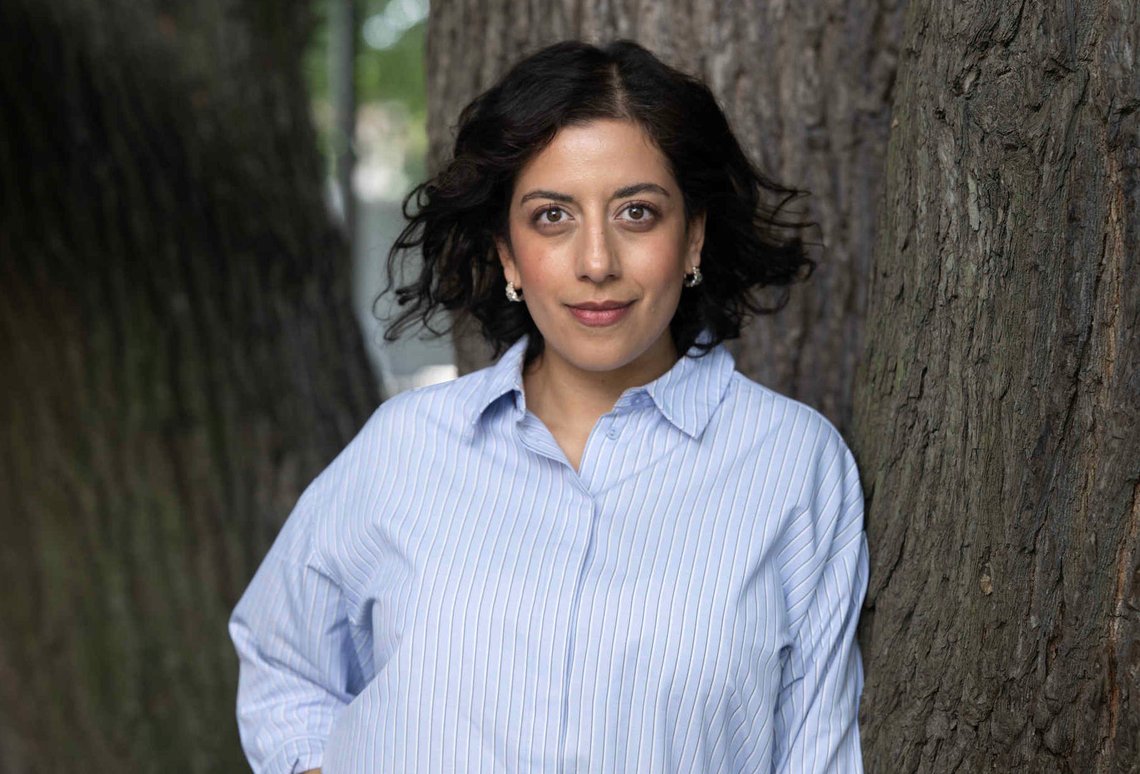


“Mohamsson’s Star of David became a clear act of solidarity with Sweden’s beleaguered Jewish community. She chose to wear precisely the symbol that many Swedish Jews now fear to display.” (Daniel Schatz)
On Sunday, 13 September 2026, Sweden will hold its parliamentary election. During the party leaders’ debate on 17 August, antisemitism on the left became a central issue – a debate that, in the Norwegian context, has so far been conspicuous by its absence. Perhaps this is because a corresponding discussion at home would force critical scrutiny of ties to Islamist actors, the one-sided approach to Israel and the extensive budgetary funds channelled into a policy that is perceived as directly hostile towards Israel.
The situation was recently documented by journalist Inas Hamdan in the newspaper Expressen. Her investigation revealed the views of 25 candidates affiliated with Vänsterpartiet – the third-largest opposition party according to the opinion polls. As early as June, Hamdan revealed that some of these members, who were either standing for election or had held elected office, had used social media and demonstrations to praise terrorist organisations and express support for Hamas’s killing of Jews during the 7 October massacre, denied the Holocaust and spread conspiracy theories about Jewish world domination. Furthermore, some of them had expressed support for Iran’s leadership and Hezbollah, shown sympathy for Putin and promoted Islamist views on women’s role in society. The thorough report led to 22 of these 25 people being removed from the party lists. One may, however, wonder whether the exclusions were not necessarily due to their ideological positions, but rather to the fact that their views became publicly known.
Around two weeks ago, further revelations emerged: Members of Parliament from Vänsterpartiet had sent letters of support to terrorists convicted and imprisoned for the murder of Israelis. Some had sent letters to Ahmed Mughrabi, a commander of the al-Aqsa Martyrs’ Brigades, convicted of having ordered several suicide attacks in Israel. Shortly afterwards, it also emerged that a leading figure in the party had sent a similar letter to Ibrahim Abu Mokh, who was involved in the abduction, torture and murder of the 19-year-old soldier Moshe Tamam in 1984. The letters formed part of a party campaign conducted in December last year. It later emerged that all of the party’s Members of Parliament had participated. Vänsterpartiet’s Ilona Szatmári Waldau herself praised a local leader of the al-Aqsa Martyrs’ Brigades and wrote a letter of support to the imprisoned terrorist. When the matter was exposed, she claimed that:
“None of the prisoners who received letters were supposed to have engaged in violence against civilians or to have human lives on their conscience. Here there was an error in the fact-checking, which is not acceptable. I have taken down the post. Terrorism and violence against civilians are not something I support or encourage.”
Against this backdrop, the party leaders met for a televised debate last Monday, where antisemitism, Holocaust denial and the glorification of terrorism could no longer be ignored. The contrast between Swedish and Norwegian political culture was further reinforced when the leader of Liberalerna, Simona Mohamsson, arrived at the debate wearing a Star of David. Mohamsson was born in Hamburg to a mother from Tripoli in Lebanon and a father from Haifa in Israel. The family immigrated to Sweden when she was a child, and later changed their surname from Mohammed to Mohamsson. She was elected party leader in June last year and has since served as Minister for Education and Integration in Ulf Kristersson’s government.
During the debate, she sharply criticised Vänsterpartiet:
“Tonight I am wearing the Star of David. We know that antisemitism has increased dramatically in our country. Right now, schools are starting up across our country. But for many Jewish Swedish children, it is not butterflies in their stomachs, but a knot in their stomachs when they go to school, because they are met by high security and possibly also by people demonstrating outside. I am Minister for Integration, but above all I wear the star because of my background. Perhaps it is more important than ever to show that someone with my background can also stand up and show solidarity with Jews in Sweden. I think all the party leaders here today should promise that they will stand up for the security that Swedish Jews deserve. And promise that they can keep their own parties clean. That is what is at stake. Children who today do not dare to live out an important part of their identity. Because antisemitism has been used to terrorise an important minority in Sweden.”
During the debate, Minister for Energy, Business and Industry, Deputy Prime Minister and leader of Kristdemokraterna, Ebba Busch, walked over to Mohamsson, placed her hand on the Star of David, addressed the leader of Vänsterpartiet, Nooshi Dadgostar, directly and said:
“I mean that it is not Swedish to think that a five-year-old in Gothenburg who wears this Star of David that Simona Mohamsson is wearing today, that this five-year-old deserves to hear threats, hatred and, moreover, to die. And you are unable to keep your party clean of the Islamist antisemitism that flourishes among legislators in your parliamentary group. That is not Swedish.”
Dadgostar chose not to respond to the specific accusations, instead accusing the coalition parties of incitement and division:
“Do you know, Ebba Busch, what frightens people? When you repeatedly set one person against another.”
The Swedish-Jewish journalist Daniel Schatz wrote on X that Mohamsson’s background gave the gesture particular weight:
“Mohamsson’s Star of David became a clear act of solidarity with Sweden’s beleaguered Jewish community. She chose to wear precisely the symbol that many Swedish Jews now fear to display.”
Unsurprisingly, Mohamsson was subjected to a wave of abuse. One egregious example came from a political scientist with a background in work on the City of Malmö’s action plan against Islamophobia, who wrote: “May she burn.”
The political reality in Norway
Unlike in Sweden, where there are increasing attempts to learn from previous political mistakes, the Norwegian political landscape is characterised by an absence of actors displaying the same fearlessness as Mohamsson and Busch, or investigative journalists of Hamdan’s calibre. In Norway, the majority of politicians and mainstream media actors appear bound by the same ideological frameworks. Few dare to challenge the established consensus, seemingly for fear of breaking with prevailing norms of political correctness.
The discourse of certain societal actors can, in some contexts, be perceived as legitimising organisations such as the PLO and Hamas. At the same time, the Jewish people’s historical right to the State of Israel is challenged, which may contribute to Norwegian Jews experiencing the public sphere as more challenging. One illustrative example is the incident in which a journalist from TV 2 revealed that then Foreign Minister Jonas Gahr Støre had not been truthful regarding his conversations with Hamas leader Khaled Meshaal. When the claims that there had been no contact were disproved, Støre attempted to have the interview conducted again, so that he could adjust his explanation.
This was not, however, the only “informal” channel between the Labour Party and Hamas. As early as 2008, NOREF, the Norwegian Centre for Conflict Resolution, was established during Støre’s tenure as Foreign Minister. Senter mot antisemittisme (SMA) has on several occasions highlighted the role of NOREF.
Through NOREF, the Ministry of Foreign Affairs has for years maintained covert contact with organisations that appear on international terrorist lists. Leaked material from internal Hamas documents, translated and presented by NGO Monitor, documents that NOREF has held secret meetings with Hamas with the aim of improving relations between the terrorist organisation and the EU. According to NGO Monitor, the recently uncovered documents indicate that Hamas explicitly regarded NOREF as a strategic channel for influencing EU policy and breaking Hamas’s international isolation. The material also shows that NOREF’s activities extended beyond occasional mediation; they included at least one undisclosed joint project involving EU-listed terrorist organisations.
NGO Monitor concludes its report as follows:
“That a Norwegian-funded organisation provided a platform for Hamas officials to discuss influencing European policy, and directly coordinated projects involving members of several EU-listed terrorist organisations, raises serious questions about the Norwegian government’s role in legitimising Hamas across Europe.”
At these meetings, NOREF was represented by Marte Heian-Engdal and Frida Nome, while Hamas was represented by Bassem Naim and Abdullah Walid. Marte Heian-Engdal is married to Lord Chamberlain Olav Heian-Engdal; the couple were once recruited together to work in Lebanon for Palestinakomiteen. According to information from Dagbladet in 2023, it was Olav Heian-Engdal who received the correspondence from the Ministry of Foreign Affairs in which the Royal House was advised against sending condolences to Israel following the 7 October massacre.
According to calculations carried out by Kjell Erik Eilertsen of Document.no, this activity has so far cost Norwegian taxpayers NOK 716 million. Since 2008, there have been few indications that the Storting has exercised oversight of how these funds are managed. There is scope for a more thorough debate about whether it is legally and ethically defensible for politicians to build networks such as NOREF that operate in the grey area of established diplomacy, particularly when this involves dialogue with terrorist organisations such as Hamas.
Taken together, this paints a picture of a reality in which the contrast between Sweden and Norway is striking. While Sweden reacted immediately by excluding 22 of the 25 identified Islamists and terrorist sympathisers, there are no political consequences in Norway when similar connections are exposed. Just as Terje Rød-Larsen and Mona Juul were able for several years to administer millions in taxpayers’ money without oversight, before the Epstein affair forced the government to halt the funding, it may be assumed that the NOREF channel can continue its activities until external circumstances force politicians to dismantle this “peace bubble”.
It is high time that Jonas Gahr Støre and the Storting as a whole give the Norwegian population, including Norwegian Jews, answers as to what underlies what appears to be a persistent irrational opposition to Israel, and why the Storting as a whole is so silent on such matters and, moreover, shows so little respect for taxpayers’ money.
The prerequisite for lasting peace between the Arab and Jewish populations of the region is that reconciliation efforts be rooted in historical realities rather than tendentious representations. Such a development, however, presupposes the marginalisation of, as well as an absence of support for, actors such as the PLO and Hamas.


