

There are many elephants roaming the streets of Arendal. They tend to congregate down by the harbour, around Pollen. No one sees them. No one wants to talk about them. No one wants to acknowledge them. They are not the same ones that trampled around Pollen 140 years ago. These are more numerous, and much larger.
The elephant that led to the Arendal crash of 1886 brought financial ruin to Arendal’s wealthy, and prolonged unemployment, great hardship and poverty to the rest of the population of Arendal and Nedenæs Amt.
The elephants roaming around Pollen during Arendalsuka have the potential to plunge the entire country into hardship and prolonged poverty. They are visible to those who are willing to see. But only a very few dare to speak openly about them.
Visitors to Arendalsuka are uncomfortably reminded that something is not as it should be when, on their way to an extended holiday week with an abundance of prawns and beer at the taxpayers’ expense, they have to pass the large and eerily empty Morrow building along the E18.
Like shipowner Axel Nicolay Herlofson, they talk about everything except elephants. As in 1886, the flight from reality and the charade are the same. The scale and consequences of the crash that we all understand must come are simply much, much greater.
The Morrow fiasco is merely a forewarning. Just over NOK 5 billion has gone up in smoke, most of it the state’s money, i.e. your money and mine. The people of Arendal can forget about the dream of a battery factory and 2,500 jobs (10,000 including all the knock-on effects that the municipality fantasised about). The 180 who had jobs there for a brief while are now on Nav, along with a quarter of the rest of Arendal’s working-age population.
The entire spectacle at Pollen – the self-glorifying platitudes, the endless panels on ‘colourful community’, ‘green transition’, ‘inclusive working life’, ‘sustainable growth’ and ‘vibrant democracy’ – may call to mind the spectacle and fraud that caused the Arendal crash in October 1886.
That was not merely an accident on the stock exchange. As ‘Roy’ pointed out in a comments section, it was the story of what happens when society’s leading strata wallow in other people’s money, lose themselves in their own false narratives and completely lose touch with raw physical and economic reality.
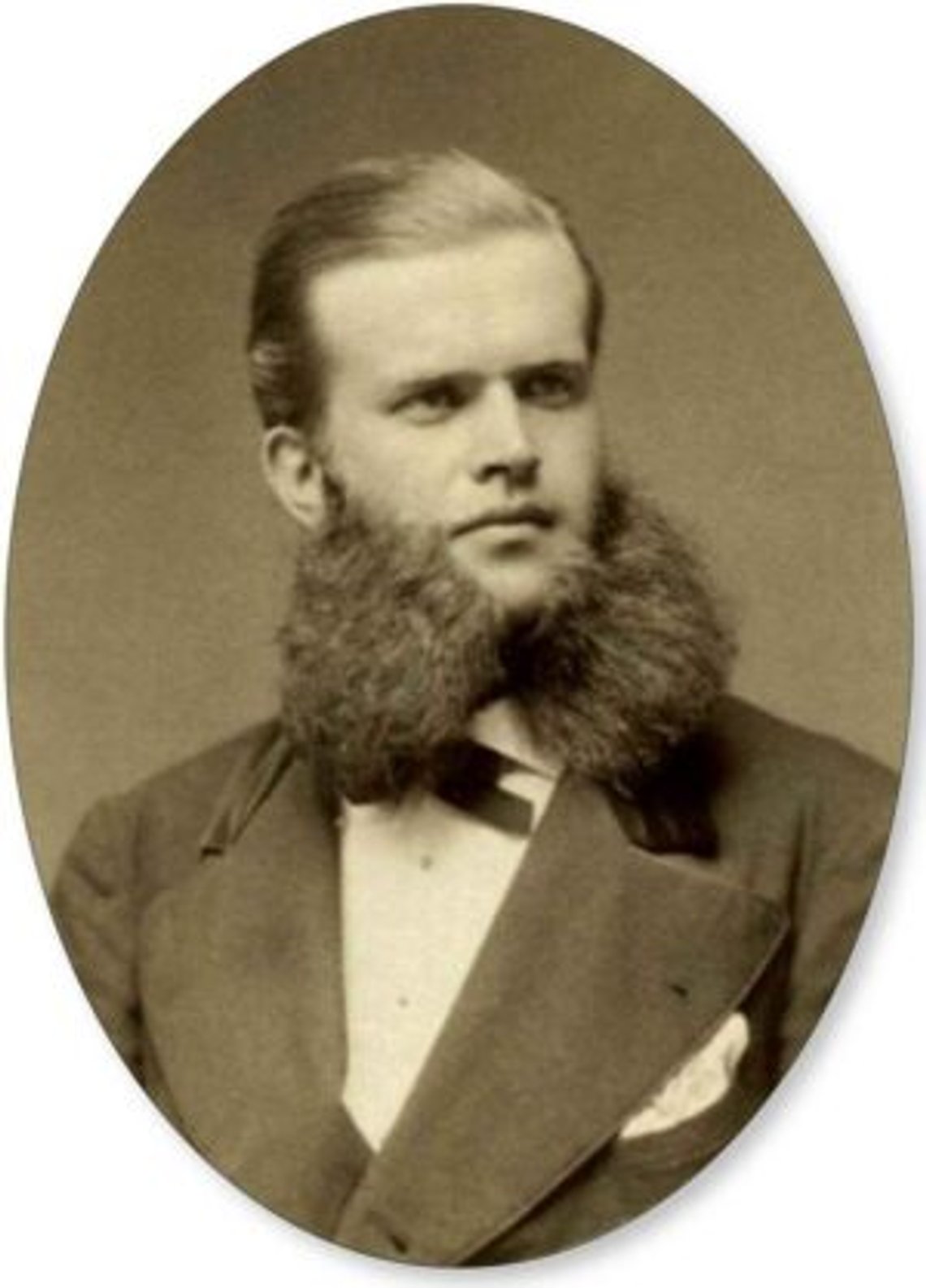
In 1886, Arendal was Norway’s undisputed shipping town, a bastion of power built on generations of coastal culture and shipowning. Bank manager and shipowner Axel Nicolay Herlofson ran Arendals Privatbank. He systematically falsified the accounts and ran a shady operation akin to a Ponzi scheme in order to plug the holes in his own megalomaniacal speculations.
He kept up the façade for years. When the house of cards collapsed, the bank was declared bankrupt. Herlofson attempted to flee, but was arrested on the quay in Kristiansand and sentenced to six years’ penal servitude as a fortress prisoner at Akershus. The shock was total. Hundreds lost their jobs, businesses went under, unemployment in the area exploded, and those who could moved away.
The crash marked the end of Arendal’s golden age as a shipping metropolis. It took generations to recover. There may be reason to ask whether Arendal ever truly recovered. Agder, and particularly the old Øst-Agder and the Arendal region, performs poorly on most socio-economic indicators.
New figures from Nav show that almost one in four people in Agder (23.2 per cent) of working age, between 20 and 66, are outside both employment and education. There are even more in the Arendal region itself. More people than the national average are outside employment, more are in the low-income group, more have low levels of education and more are on benefits, etc.
Of the just over 700,000 people who were outside the labour force in Norway in 2025, 457,000 received benefits from Nav. This represents enormous sums in lost value creation, lost tax revenue and increased social expenditure. Those who work have to make up for this in the form of higher taxes.
The many people who can work but do not are precisely one of the great elephants that no one dares to talk about in Arendal. For they are voters too. And there are many of them. Everyone understands that there is no reasonable explanation for Norway having twice as many people on benefits and twice as many on sick pay as our neighbouring countries.
The state of health is no worse in Norway. But no one dares to say that. That is why no one, from Rødt to FrP, dares to do anything about the sick-pay scheme. Nor does anyone dare to admit that we have concealed a large proportion of the real unemployment in an overstaffed, bloated and extremely expensive public sector.
Thirty-three per cent of Norway’s workforce now works in the public sector. If the proportion working in Norway’s public sector were the same as the OECD average (18.4 per cent), our unemployment rate would not be 4.3 per cent, but 18.9 per cent! But no one dares to say that either. It is one of the very largest elephants in Arendal.
And no one dares to say that non-Western immigration consumes the entire annual withdrawal from the Oil Fund, as a consequence of the low labour-force participation among these immigrant groups, the high consumption of social benefits, the low tax revenues and the additional burden they place on social infrastructure – such as hospitals, roads, railways and more.
That elephant is in the process of wrecking the welfare state. It cost us NOK 560 billion in 2025 and will cost society at large, i.e. those who work and pay taxes, increasingly more in the years to come.
Had we not had non-Western immigration, oil revenues could have covered all personal income tax. You and I could have spent the tax money on entirely different things. But no one wants to talk about that during Arendalsuka either.
And while preparedness is one of the main themes of this year’s Arendalsuka, no one dares to ask why PST has removed left-wing extremism from its threat assessment, or why VG rewrites Islamist terrorism as ‘violent extremism’.
That elephant is large enough for anyone willing to see. The incidence of far-right terrorism in Europe over the past decade is only a fraction of the incidence of Islamist and far-left terrorism. Yet it is presented as though the opposite were true. Not even the EU denies this in its statistics. But PST and VG do – in Arendal too!
The escapism and flight from reality at Pollen in 2026 bear many similarities to the lies and fraud that led to the Arendal crash of 1886. The consequences are simply going to be much greater. And nationwide.
The hardship and misery that followed the Arendal crash forced the establishment of the workers’ association Samhold, which in turn led directly to the founding of the Norwegian Labour Party in Barbu the following year, in 1887.
That is part of the irony. The Labour Party bears the principal responsibility for the many elephants no one dares to talk about at Arendalsuka, by now ably supported by Høyre and the other parties represented in the Storting.
But in the founding of the workers’ association Samhold lie both hope and despair. A crisis leaves wounds that do not heal, but it can also create political reorientation. In 2026, the accounts are falsified and reality distorted in a more sophisticated, but no less reality-denying and socially damaging, manner.
Støre and the Labour Party – and large parts of the political and bureaucratic establishment that flock to Pollen – talk about green jobs, industrial renaissance and social sustainability while pouring billions in public money into projects such as Morrow.
The result is bankruptcy, lost government loans and guarantees amounting to billions, a region that, despite Arendalsuka, continues to struggle with structural exclusion, and a country that is simultaneously being driven into the ditch in several important sectors of society.
The crash of 1886 was brutal, but local. Today’s version is more diffuse, spread across several sectors and politically legitimised, but the consequences for those left outside may be equally brutal, and far more people will be affected. It is the nation’s future that the political elite has put at stake.
The question worth asking is whether this will have political consequences, or whether the spectacle will simply continue. Will FrP take over as the principal party of government? And if so, will FrP expose the elephants and do something about them once it comes to power? Or will it succumb to the same illusions as the Labour Party and Høyre before it?
Or will an entirely new political movement be required – one founded on the same sober scepticism towards elite narratives that Samhold displayed in Barbu outside Arendal in 1887?
Can the population of the region once again become the cradle of a political awakening that puts reality before platitudes, truth before deception and political honesty before political fraud?
If one takes a trip to Sørlandssenteret, there is little reason for optimism. If one looks at the experience of FrP entering government in 2013, there is even less reason to be optimistic. And if one looks at the programme for Arendalsuka, there is little reason to believe that anything will change.
Arendalsuka has become an annual ritualisation and affirmation of the status quo: a temporary blossoming of talk, networking and self-affirmation in a town that, for the rest of the year, bears the marks of the structural problems that the same elite would rather not discuss.
Visit Arendal in October. You will not see much in the way of results from all the talk during Arendalsuka, but rather a town the size of an average American cemetery, only twice as dead, to quote another southerner who is finally dead himself.
The Arendal crash of 1886 reminds us that when the leading strata lose their grip on raw economic reality, ordinary people have to foot the bill. But also that political renewal is sometimes born out of precisely that pain. In that sense, 1886 represents hope.
In the meantime, there is every reason to feel sorry for the people of Arendal. First they were duped by the freeloaders at Morrow. NOK 5 billion straight out of the window.
Then they were duped by their own politicians. Ten thousand jobs became zero: 0!
And every year, for one week at the beginning of August, they are duped once again by the political elite who come all the way from Oslo to Arendal expressly to eat prawns and drink beer at their expense and that of other taxpayers.
Just as they were duped by shipowner Axel Nicolay Herlofson in 1886.


