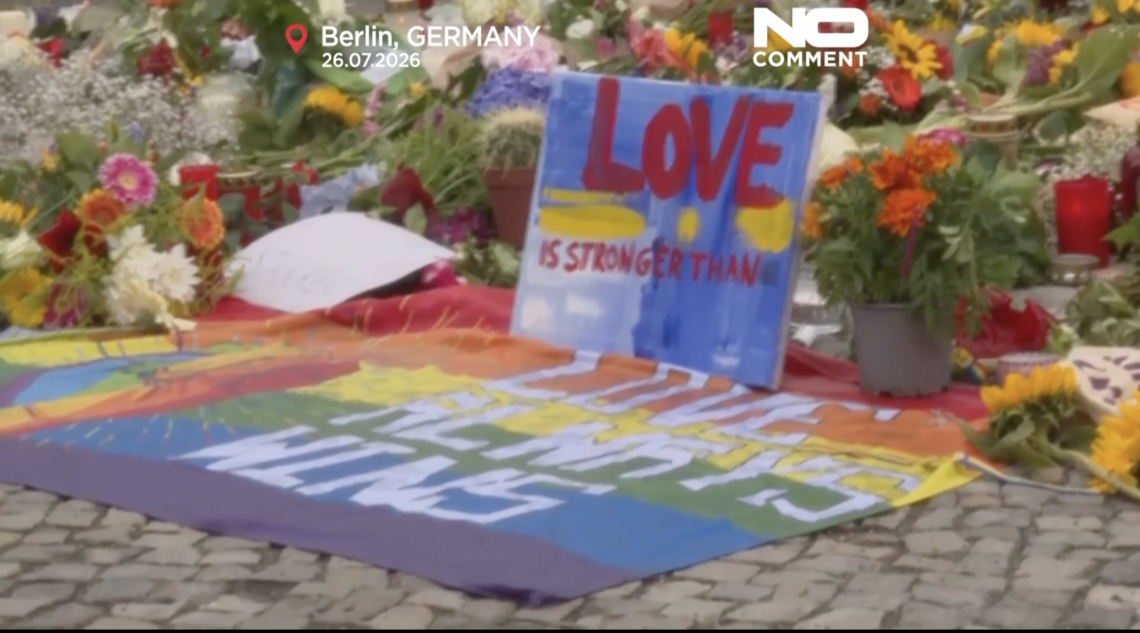
The victim killed by a terrorist at the Pride parade in Berlin was a Polish mother. For many Poles, this fits into a bleak picture of Germany.
A 65-year-old woman from Warsaw was killed when IS supporter Abdul Ballout (21) drove a minivan into a group of people in Berlin’s Tiergarten park on Saturday evening.
He injured 31 other people, some seriously, including the deceased woman’s daughter. Both had reportedly travelled from Poland to celebrate Berlin’s version of the Pride parade, Christopher Street Day (CSD).
Terror fanatic Abdul Ballout (21) lived 100 metres from the Pride parade
Poles perceive it as though public order in neighbouring Germany is crumbling – from disturbances at public swimming pools to terrorist attacks. In fact, there have been more Polish victims of Islamist violence in Germany than in Poland, writes Die Welt.
Following the terrorist attack, various proposals are now being discussed to prevent further acts of Islamist violence. Just days after the attack, new political proposals have been put forward on how to improve the monitoring of the 410 individuals currently classified as Islamist threats.
But Die Welt questions how realistic these proposals really are. The problem is a classic one, and self-inflicted.
Perhaps the most far-reaching proposal comes from Bavaria.
“For me, it is clear that anyone considered a threat cannot permanently retain dual citizenship,” said CSU leader Markus Söder.
Sven Schulze (CDU), Minister-President of Saxony-Anhalt, expressed a similar view:
“I no longer want people to hold dual citizenship – German and that of their country of origin – if they are living here as a threat.”
Both Söder and Schulze believe that those classified as a threat should lose their German citizenship and be deported immediately.
However, this measure presupposes dual citizenship and applies only to a proportion of potential terrorists. The problem is that Ballout holds only German citizenship.
The German Basic Law (Grundgesetz) prohibits the revocation of citizenship; only its “loss” is possible. This applies only if a person actively renounces allegiance to the German state in favour of another, thereby clearly demonstrating disloyalty.
Historically, this has been the case, for example, when someone joined a foreign armed force. Since 2019, dual nationals may also lose their German passport if they fight abroad on behalf of a terrorist organisation.
“It is recognised under international law that one may lose one’s passport if one turns away from one’s own state,” Daniel Thym said in 2023.
Thym is an expert in immigration law.
“I consider such a turning away to exist when someone fights for another state or entity. However, it remains an open question whether one can speak of turning away if someone simply behaves criminally.”
Following the attack, Federal Interior Minister Alexander Dobrindt (CSU) proposed, among other measures, an expansion of preventive detention.
“We need rules that apply throughout Germany to remove potential threats from circulation,” he told BILD.
Even now, state police forces may impose far-reaching measures, including the short-term detention of individuals deemed dangerous. However, this measure is used primarily for short periods. According to LTO, there were approximately 5,800 cases of preventive detention in Bavaria during the first half of 2026, but more than 99 per cent lasted for less than one day. Only four detentions lasted longer than 14 days.
“A state governed by the rule of law can never say: ‘When in doubt, we simply arrest someone on the slightest indication of a possible crime,’” a source in a federal ministry stated.
That would mark the “end” of fundamental freedoms. Preventive detention should therefore be considered only in a limited number of cases – and only for very limited periods. As a result, the German authorities have effectively placed handcuffs on their own ability to protect the public by countering Islamist terrorism.
Technological measures, such as electronic ankle tags, have also been proposed. But here, too, the constitutional obstacles are considerable. Because such measures significantly restrict fundamental rights, they are generally limited to a period of only a few months.
In summary, one is left with the impression that both Germany and other European countries have imposed so many legal constraints upon themselves that it is becoming impossible for the authorities to combat the threat posed by Islamist terrorism and violence. One example is the age of criminal responsibility, which many believe has outlived its usefulness in a situation where immigrants barely into their teens are committing serious acts of violence, gang rapes and murder.
This is also why academics such as Professor David Betz of King’s College London predict an imminent civil war in Europe, perhaps beginning first in the United Kingdom. Ireland is also experiencing a similar threat.
The Norwegian authorities will probably keep the problems under control through financial inducements. But this is likely to last only until the Government Pension Fund Global (Oljefondet) is exhausted. Mass immigration, combined with a welfare state available to everyone who manages to reach the country, threatens to become Norway’s version of Dutch disease.
Konferanse i EU-parlamentet: Kontinentet «på vei mot borgerkrig»