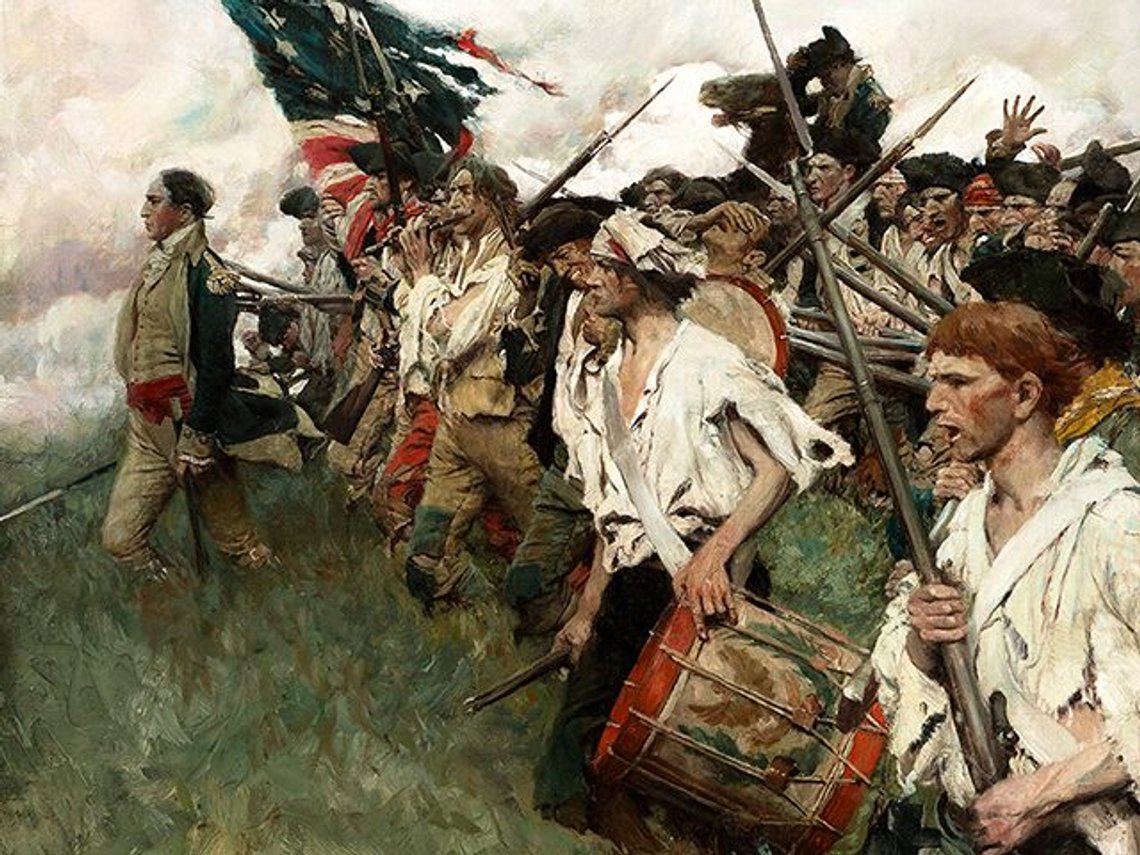


“We hold these truths to be self-evident: that all men are created equal, and that they are endowed by their Creator with certain unalienable Rights. Among these are the right to Life, to Liberty and to the pursuit of Happiness. We hold that governments are instituted among men to secure these rights, and that they derive their just powers from the consent of the governed. Whenever any form of government becomes destructive of these ends, it is the right of the people to abolish it and to institute a new government, founded upon such principles and organised in such forms as to them shall seem most likely to effect their Safety and Happiness.”
From the United States Declaration of Independence
Congratulations, everyone, on yesterday’s occasion. The United States’ national day, their celebration of the Declaration of Independence and the subsequent Revolution, was of decisive importance for the cause of liberty in Norway as well. The American Revolution inspired France’s liberals to abolish the feudal order, and without the French Revolution and the subsequent Napoleonic Wars, we would not have received our Constitution in 1814.
I therefore wish to take this opportunity to dwell on the core of the Declaration and let it serve as the starting point for today’s article. Few political declarations bear such powerful witness to the political relevance of Christianity as the United States Declaration of Independence. And this from an era which our historians maintain saw the ideas of the Enlightenment de-Christianise both science and politics.
America’s Founding Fathers understood that the idea of mankind’s innate rights makes sense only within the framework of the Judeo-Christian faith. In antiquity, such ideas would have been regarded as absurd, and the notion of universal human dignity was foreign.
Although philosophers such as Socrates, Plato and especially Aristotle regarded man as a rational being capable of seeking truth and living a moral life, it was still a long way from the idea that all human beings should possess any unalienable rights.
Women were regarded as less developed than men, and slavery was taken for granted. It is difficult for us to comprehend how revolutionary the Christian message was when missionary work began, but it was this message that laid the foundation for a civilisation which, right up to our own time, understood itself to be unique and worth defending and dying for.
One of the most influential thinkers behind the political developments of the seventeenth and eighteenth centuries was John Locke. His ideas provided the English Revolution of 1689 with its theoretical and moral foundation. He explained why the king’s power had to be limited, why it had to rest upon the consent of the people, and why the people had the right to depose a king who violated their fundamental rights.
John Locke grounded mankind’s fundamental rights theologically: human beings are God’s property because they were created by God. No human being therefore has the right arbitrarily to take another person’s life or liberty. This line of thought proved decisive for the revolutions in England, the United States, France and Norway. In France, the atheists won the struggle for power, and we know the result.
What we ought to notice is how John Locke reverses the understanding of the state’s role. This is stated explicitly in the American Declaration of Independence: the state exists for man’s liberty and security, not the other way round. It also grants the people the right to overthrow a government that fails to fulfil these duties. All of it rooted in the Christian faith.
Now it is as though we are returning to the pre-Christian era. Our democratic leaders no longer take the liberty, security and happiness of their citizens as their point of departure. They cannot even define who their own countrymen are.
The country’s inhabitants have increasingly become a toolbox for political parties that regard the population as instruments for advancing their own ideological convictions. Whether the issue is radical gender theory, immigration, cultural diversity, religion or the green transition, the liberty, security and economic well-being of the people have become irrelevant.
The United States, however, is a country where John Locke’s ideals remain very much alive. The nation’s Republicans look with apprehension at what is taking place in Europe because, unlike us, they understand what is at stake. They see a political development that attacks the very core of Christianity’s view of mankind and thereby also the foundation of their freedom.
America’s Republicans understand that their liberty is built upon the Christian faith and that it is a prerequisite for a free world. To most of Europe’s leaders, that same faith appears to be a threat, and they fail to see where government without God leads.
Buy The Dying Citizen by Victor Davis Hanson as a paperback or as an e-book!