

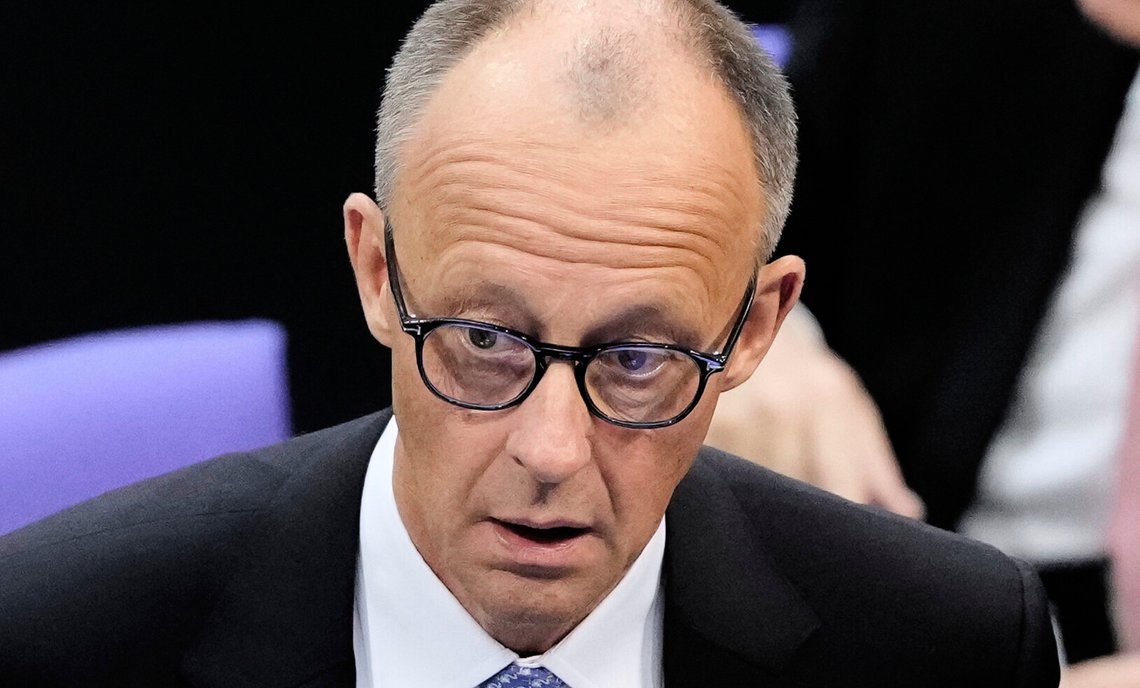
The government in Berlin has agreed on a major economic reform intended to stem the advance of the far right. As usual the reform will be characterised by “redistribution”.
This means tax cuts for the low-paid, while the richest must pay more. It looks quite clear that government leader Friedrich Merz and the union parties CDU/CSU have given in to the Social Democrats (SPD).
Tax cuts for the low-paid amount in total to 10 billion euros (112 billion kroner). They are to be financed first and foremost by raising the tax level for the richest, including higher wealth tax, as well as changes in the pension system. (NTB-Reuters-AFP)
Today it is already the case that low-paid people hardly pay any income tax, but they are not exempt from charges. This is probably the reason why charges are rarely a topic when European politicians discuss tax.
High-earning Germans pay far more in income tax, both in percentage and of course in pure euros. But they do not experience the charges as equally suffocating, since charges make up a smaller percentage of their income.
If income tax becomes high enough, dissatisfied Germans can move a short car journey to one of the neighbouring countries in the EU where both the tax level, charges and general costs are lower. Many affluent Germans have already moved to countries such as Poland, Hungary and Switzerland, and the middle class is also on the move.
The tax relief for those with low incomes will amount to up to 600 euros per year, writes Die Welt. Up to five hundred kroner a month, in other words. “A significant amount,” says Merz.
This “significant amount” will only cover a small part of the massive increases in expenses that German workers have experienced under Merz’s government, as a result of climate measures, increased energy prices and a violent increase in social costs that largely go to immigrants.
It has previously been decided that the pension age shall be gradually raised to 67 years by 2031. The government will also introduce stricter rules for sick leave.
“The number of sick days in Germany is too high,” said Merz.
The government therefore proposes a “set of tools” to correct this, which transfers large parts of the responsibility to employers and workers.
“What they make of them is up to the companies and the employees.”
The Labour government has proposed the same, and in addition includes new requirements for GPs to get more people on sick leave back into work more quickly.
– Sickness absence does not start with the GP, but the GP is important in the work to reduce sickness absence, said Health Minister Jan Christian Vestre (Labour) in a press release early in June.
At the same time the authorities are making it increasingly difficult for both healthcare workers and patients to get in contact with each other, since the climate in a hundred years seems to be considered more important than life and death today.
Ordinary Germans (and Norwegians) who work and pay tax must increase their effort without experiencing any improvement in their private economy, in order to help all those who lack the ability or will to contribute, a well-known trend that politicians across Western Europe follow.
Housing construction
Many years of mass immigration, combined with low housing construction, have created a persistent housing crisis in Germany and in large parts of Europe.
The construction of more cheap housing is among the changes that are to get ordinary people’s economy moving before the election to the new national assembly next year, says Chancellor Friedrich Merz.
– We want to get Germany back on track, he said when the reform package was presented on Thursday.
That the EU constantly introduces new complicated regulations and climate requirements slows down the pace of housing construction while prices are pushed up.
Nevertheless no European politicians appear to choose the simple and obvious solutions to reduce the housing crisis.
What about an immigration stop, a halt to subsidised housing for foreigners already in the country, as well as a sharp reduction in the sea of regulations and ineffective climate measures?
Why not a sharp reduction in public expenditure that in no way serves German industry or workers, something the catastrophe in the proud German car industry is a good example of. The German working class and middle class, who still work and pay tax, are hit hard.
The simple is often the best, says REMA 1000 in its advertisements, with great success. Few European politicians think along such lines, it seems.
However, the Merz government is to be praised for at least saying that they plan a law that shall attempt to reduce the massive bureaucracy.
“We abolish all reporting obligations to public agencies in general. If a ministry wants to retain reporting obligations, it must justify them anew and fight to continue the old reporting requirements,” said Merz.
The principle of reversed burden of proof will be followed – only reports that are truly necessary will be required in the future.
The right in favourable wind
The government parties CDU/CSU and SPD are constantly losing support, and must witness the Alternative for Germany (AfD) experiencing steadily increasing support in the opinion polls.
AfD is approaching 30 per cent support, and lies far ahead of the government parties. This frightens virtually all the other German parties, which compete with each other in the hunt for the worst descriptions of the AfD.
Terms such as “far right” and “extreme right” are often used. Several parties believe that Germany’s most popular party should simply be banned. This is how one is to secure a “democracy” that has zero respect for voters’ wishes and opinions. At the same time AfD experiences real threats from a radical and violent left.
Norwegian News Agency (NTB) has several times used the term “anti-immigrant” about the AfD. But one is not necessarily anti-immigrant even if one wants reduced immigration, and that criminal and illegal migrants should be sent out of the country.
In fact there are many immigrants who also support such a policy, particularly the well-established ones who are in work and able to support themselves and their families.
Tysk politi frykter bråk ved helgens AfD-konferanse i Erfurt
In an Insa poll from June, AfD received support from 29 per cent of voters. The union parties ended on 21 per cent, and the SPD was all the way down on 12 per cent. Even though different polls show some variation in the results, the trend is the same across the board.
Dissatisfaction with the job Merz is doing as Federal Chancellor is growing.
As many as 77 per cent of those asked say that they are dissatisfied with the Federal Chancellor’s performance, an increase of 6 percentage points from April.
Only 15 per cent believe that Merz is doing a good job, a decline of 4 percentage points from April.
Asks for the people’s support
Merz asks for the German people’s support for the reform package that has been agreed by the black-red coalition.
“We know that you, ladies and gentlemen, the citizens of our country, want decisions, and you do not want conflict. And that is exactly what we have delivered. Get involved, support us in the reforms that are now necessary.”
The Federal Chancellor said that he already perceives an enormous willingness among the public “to leave stagnation behind and now embark on a new beginning.”
In a time of great uncertainty in the face of international tensions and new technology, he understands a longing for the old ways.
“But we cannot hide in the past.”
It is not possible to turn back time and return to the past. But one can go far by allowing oneself to be inspired by the periods in the past when Germany was Europe’s locomotive, a prosperous, well-functioning, safe and admired country.
Then came Angela Merkel, who opened the borders and declared “Wir schaffen das”.


