

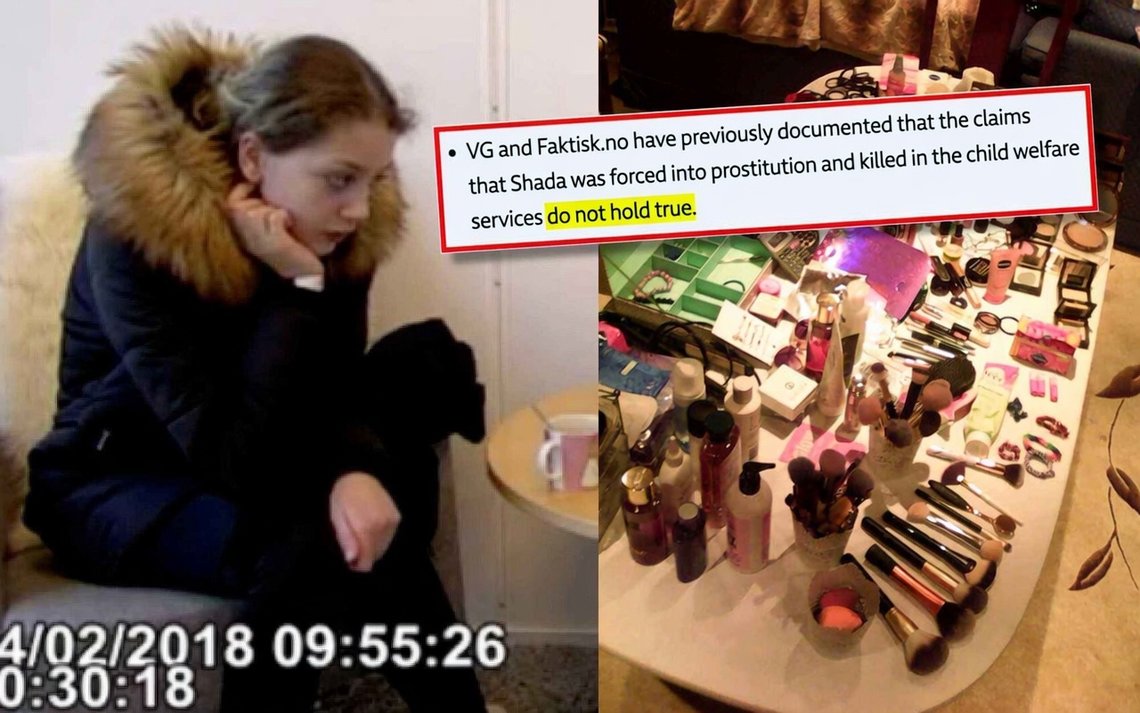
NRK writes fiction when they in a fact box come with untruths about the Shada case, which appears to have the aim of establishing a factual basis and a final conclusion that does not exist.
The claim is made in NRK’s article about a complaint against county council politician in Vestland, Bente Spissøy.
In the article’s fact box NRK claims the following:
VG and Faktisk.no have previously documented that the claims that Shada was forced into prostitution and killed in child welfare do not hold.
But the hypothesis of human trafficking has never been disproved. Further down in the article more of the same is poured on. The error is not coincidental:
VG and Faktisk.no have documented that the claims that 16-year-old Shada was forced into prostitution and killed in child welfare do not have any basis in reality.
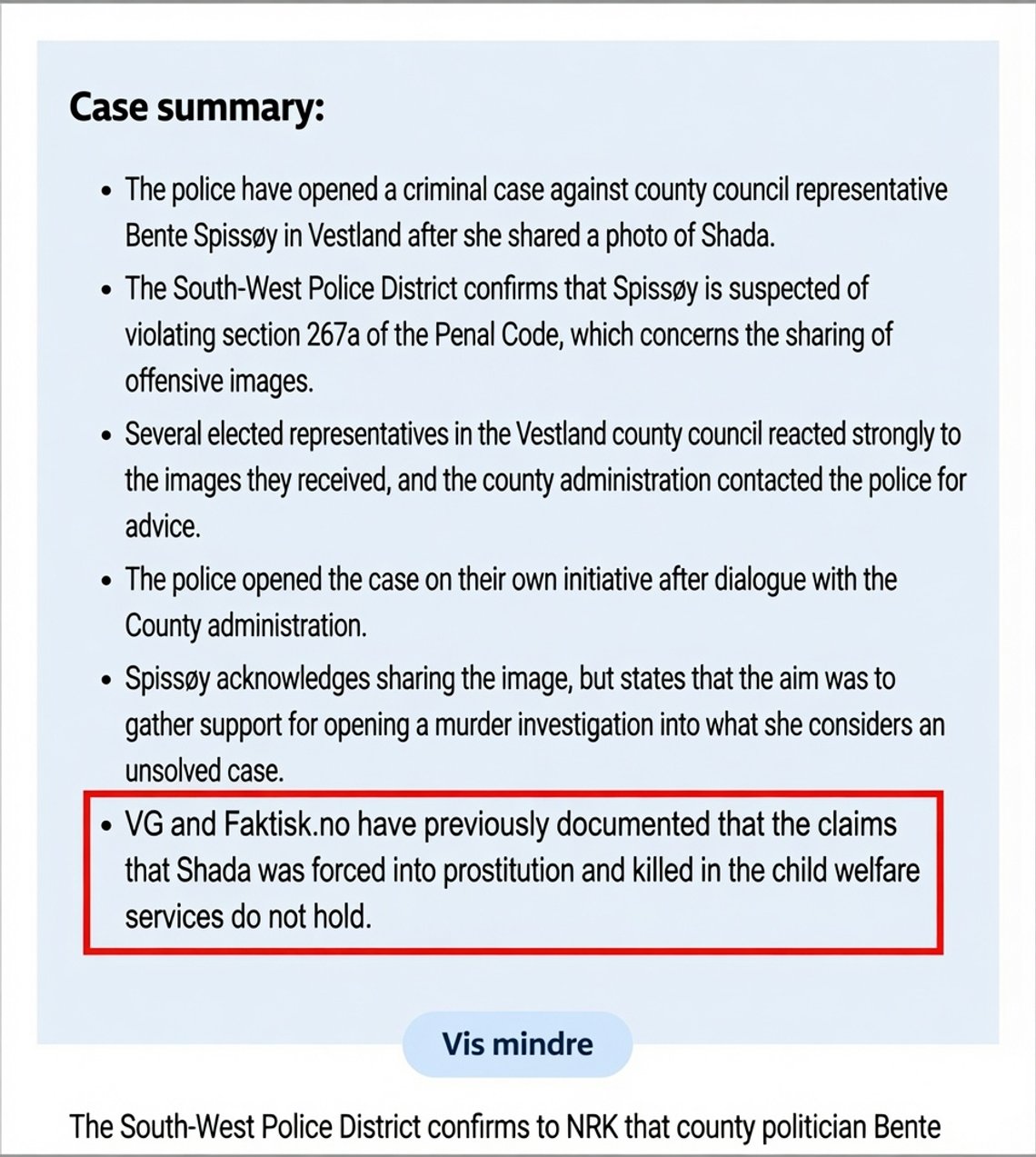
NRK’s article was published on 24 June, but the error has still not been corrected.
In a previous article published by NRK and VG’s subsidiary, Faktisk.no AS, an attempt is made to create an association with the same effect.
The headline is “They say that Shada (16) was exploited and killed – the evidence does not hold”.
But what does evidence that “does not hold” look like? In what way does it not hold?
Evidence simply is. It either supports or disproves an event, action or theory.
The article’s ingress is as follows:
For several years the doctor and his team have spread the story that a 16-year-old girl was exploited for prostitution in child welfare and killed. Now Faktisk.no and VG have investigated the evidence and the claims.
But the article does not go further into whether Shada was exploited for prostitution. It simply repeats once again, without documentation, that “claims and evidence” “do not hold”.
After the investigations VG and Faktisk.no can document that a number of the most central claims and evidence that Shada was subjected to human trafficking and murder do not hold.
The documentation is missing.
Press ethics breach
The ingress thus gives the impression that the people working to get Kripos to investigate the potential murder case have made claims about forced prostitution (trafficking) that do not hold, but there is no support for this in the article text.
The publication therefore constitutes an open breach of Norwegian media’s own ethical rules, point 4.4:
Ensure that headlines, references, ingresses and in- and out-announcements do not go further than what is covered in the material. […]
To find the actual analysis of the claim about prostitution, which Faktisk and VG have prepared together, we must either go to VG’s extensive series of articles or to a fact check that Faktisk has published.
What VG, Faktisk and NRK present as a final conclusion that Shada was never subjected to human trafficking and forced prostitution is a conclusion that cannot be drawn, no matter how much they insist that it is true.
They demonstrate at best that the hypothesis they are trying to disprove lacks documentation. But to turn this into the opposite being proven is a conclusion that does not hold.
Judge for yourself, based on what Faktisk writes. Note that the hypothesis here is reduced to concerning “equipment for prostitution”:
Claim: Shada had equipment for prostitution
After Shada died in 2019, her parents were sent several of her things from the child welfare institution where she lived.
Vinsrygg [Rodgeir Vinsrygg, doctor and the bereaved’s legal representative, ed. note] has stated that he was shocked by what he saw. He has described that the parents were sent enormous amounts of exclusive make-up.
He laid Shada’s make-up brushes, intimate soap, nail polishes and eyeshadows on the parents’ living room table and took photographs.
Make-up and a calculator are among the items Shada’s family received after her death, and which Vinsrygg photographed.
– There are clear indications that the child was used in prostitution. There is all the equipment needed, a calculator – everything needed.
In addition to Vinsrygg believing that make-up and a calculator indicate that Shada was subjected to human trafficking, he claims that a name change can also be connected to prostitution.
So far there is nothing that disproves Vinsrygg’s hypothesis that prostitution and human trafficking across borders has taken place (cf. an alleged trip to England under child welfare auspices and Shada’s passport that is said to have been destroyed).
Faktisk continues:
Shada’s name was changed to a new and more “marketable” name by child welfare, the doctor has claimed in another video.
Rodgeir Vinsrygg says that he reacted to the name “Lise” being on a mobile charger Shada had had.
– Together with the documentation I have, I can only draw one conclusion, says Vinsrygg:
– Shada has been used in prostitution in the Norwegian system.
The documents VG and Faktisk.no have gained access to show a different explanation for the name change: Shada lived at a secret address, under code 6. She was encouraged to change her name for the sake of her own safety.
The names she used towards the other pupils at school and on social media were Lisa and Lise.
Regardless of what the name was and what justification child welfare gave, it does not disprove Vinsrygg’s hypothesis.
The calculator in the picture is a Staples Genie model.
Rogaland county municipality had a purchasing agreement with Staples, and the company confirms that the purchasing agreement included the Staples Genie mini model for use in teaching.
No matter how far-fetched this point is, it must for the sake of order be mentioned that a tool’s primary area of use does not exclude that it may also have had other uses. That it is included in the fact check at all indicates that Faktisk is grasping at straws.
Faktisk.no has not responded specifically to the criticism, but Silje Førsund, news editor and head of fact-checking, points out that the assessments made, the premises, and the documentation are clearly presented in the series of articles published by VG and Faktisk.no.
NRK’s journalist Håvard Nyhus has also responded to Document News’ inquiry, but without commenting on the criticism of the state broadcaster’s reporting.
No preponderance of probability
In VG’s own six-part series of articles, the newspaper’s “investigation” about the prostitution theory boils down to the following, which can be read in part 4:
VG and Faktisk.no have investigated the claim that Shada was exploited for prostitution and human trafficking, without finding anything that can document it.
There is still nothing that suggests a preponderance of probability in one direction or the other. Has something happened, or has it not happened?
The factual basis is equally thin on both sides of the central claim. Since it can be established that prostitution, sexual abuse and human trafficking have previously occurred with child welfare children, it becomes nothing other than claim against claim.
The list of abuse cases involving child welfare is as long as a bad year.
Only a week ago it became known that a 17-year-old youth, an unaccompanied immigrant from “a country at war”, was subjected to sex trafficking under a nationwide human trafficking network while he was in the care of child welfare in Norway.
Child welfare did not take the police’s concerns seriously, and contributed to the youth being drawn into prostitution and himself being charged with pimping.
In January this year it became known that child welfare repeatedly failed to protect a 14-year-old girl from sexual abuse by adult men. Some of these abuses took place in Stavanger. It was thus under the same child welfare and in the same municipality where Shada died. See also the fact box below.
Several commentators have argued that the mainstream media’s rather helpless attempts to establish an indisputable factual basis about Shada’s death are now being used in politics, by institutions and by the media itself as if it had the same weight as a NOU (Norwegian public inquiry), or a report from an independent investigation commission.
The state, the police and politicians cannot relate to such deficient journalistic work as has so far been presented, despite the Ministry of Culture via NRK, VG and the subsidiary Faktisk.no’s attempts to establish a historical conclusion based on wishful thinking.
Nevertheless we see that actors resort to free fiction as if it were factual information carved in stone tablets.
It is serious. The result is that the story of Shada is now being rewritten by powerful actors, without basis in verifiable facts.
The natural question then becomes:
Why?
Sexual abuse cases in connection with the Norwegian child welfare services (Barnevernet)
In Bergen the child welfare services broke the Child Welfare Act when they were aware that a teenager sold sex, but did nothing about it.
The police were notified of abuse that occurred while she sold sexual services in the centre, but dropped the case, Fagbladet writes.
In May 2025 a man in his 50s from Sweden, who worked at a child welfare institution for drug-addicted youth, was sentenced to prison for abuse of a 14-year-old girl and sexual advances towards three other teenagers. He continued to work in child welfare in Sweden after breaking the law in Norway.
In 2017 and 2018 two other employees from the same institution were convicted of similar offences.
In 2024 NRK wrote about reports of 33 possible sexual abuses committed by employees against children at child welfare institutions.
Already in 2006 the then Ministry of Children and Equality saw itself obliged to issue a circular (PDF in new tab) to child welfare with information about human trafficking of minors, where the international and organised aspect was also focused on.
In 2011 Adresseavisen revealed that 52 child welfare children had been subjected to serious abuse since 2000. 42 state-appointed “care persons” were at that time convicted in connection with these cases.
Read more:
https://www.document.news/news/2026/06/case-against-norwegian-politician-over-sharing-shada-photo-dropped


