

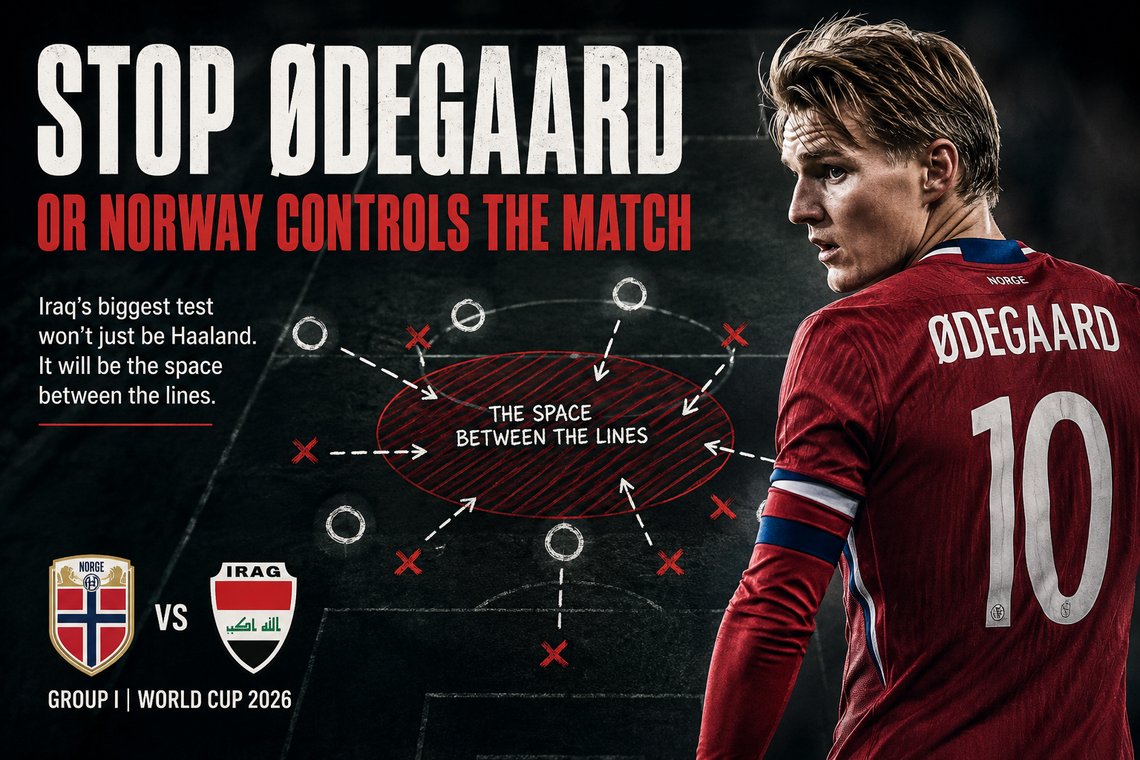
The obvious challenge facing Iraq is Erling Haaland.
He scores goals at a rate few forwards can match, attracts defensive attention almost constantly and has built a career around punishing small mistakes. Every opponent begins preparations with him somewhere near the top of the scouting report.
That does not mean Haaland is Norway’s most important player.
A strong case can be made that Martin Ødegaard occupies that role.
The reason has less to do with statistics and more to do with geography.
Norway’s attack becomes far more dangerous when Ødegaard receives possession in the space between midfield and defense. Those areas are difficult to defend because they force opponents into decisions. A defender who steps forward risks creating room behind him. A midfielder who drops deeper can leave space elsewhere.
Elite playmakers spend careers looking for those moments.
Ødegaard’s value comes from recognizing them quickly.
Arsenal’s attacking structure often depends on his ability to receive possession, draw defenders toward him and change the direction of an attack before opponents can reorganize. Norway uses him differently at times, but the underlying principle remains similar. The team is more difficult to defend when the captain is facing the opposition goal rather than receiving the ball with his back to it.
That raises an important question ahead of Iraq.
Where will those receiving opportunities come from?
One possibility involves Haaland himself.
Opponents frequently devote additional attention to Norway’s striker. Centre-backs stay tighter. Midfielders become more cautious about leaving defensive positions. The effect is not always visible, but it can alter the shape of an entire defensive block. When defenders become preoccupied with Haaland’s movement, space can appear elsewhere.
That is often where Ødegaard becomes influential.
The challenge for Iraq is that preventing those situations requires collective discipline rather than an individual solution. Modern international football offers few opportunities to assign a single player to shadow an opponent for ninety minutes. Defensive organisation depends on spacing, communication and timing.
A team can make life difficult for a creative midfielder.
Completely removing him from a match is another matter.
The opening stages may reveal Iraq’s intentions. A compact midfield would reduce room in central areas and encourage Norway to attack from wider positions. A more aggressive approach could produce turnovers higher up the pitch but also create gaps if the first line of pressure is beaten.
Neither option is risk free.
That is why this matchup deserves attention.
The discussion before kickoff will naturally focus on goals. World Cups tend to encourage that. Yet many matches are shaped much earlier in the sequence. A pass into space. A midfielder turning under pressure. A defensive line forced to adjust its position.
Those moments rarely appear in headlines.
They often decide games.
If Norway establish control in the areas where Ødegaard is most effective, Iraq will spend long periods reacting rather than dictating.
For a team opening its World Cup campaign, that is not a comfortable place to be.


