

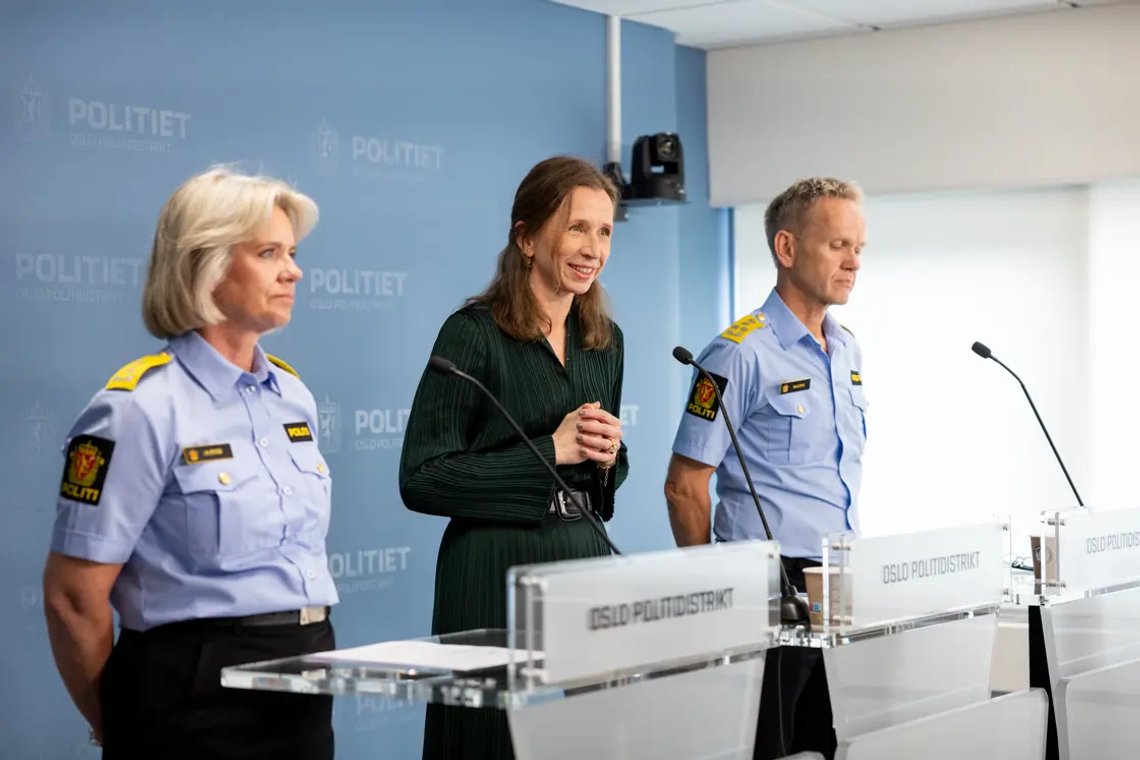


Following *Documents*’ coverage of the brutal home robbery in Oslo, in which the robbers were not remanded in custody and were not summoned for questioning, there have been reactions. It is claimed that the police force has been undermined due to paralysis caused by forces within the National Police Directorate, the police leadership and the police’s strategic staff.
The initial reaction was:
«This system you’ve started to poke at really needs to be exposed and put on display. Nothing that can withstand the light of day, and it has led Norway into a hell from which it will be hard to escape»
The source requests anonymity to avoid difficulties. The person in question has years of experience with the Oslo Police.
On 16 November, we summarised the case of the brutal home robbery in Ullern, Oslo, where the victims were subjected to deprivation of liberty and violence in their own home, whilst the robbers, who were arrested the same day thanks to a vigilant neighbour with a camera, were released from custody and have not yet been brought in for police questioning.
– A compliant press
There were more:
“The police and the way things are done in 2026 are so far beyond comprehension. And one of the reasons is an obedient press that never asks the questions you do. They’ve only focused on domestic violence, sexual abuse, racism and hate speech. They haven’t bothered about any other crime. Identity politics. If this is to change, the whole swamp must be drained. Everyone in the civil service must be replaced. The Progress Party won’t be able to achieve anything unless they set up a criminal policy think tank that conducts its own research capable of dismantling the established ‘truths’ on which the left relies in every context. After all, these are falsehoods and nothing more than commissioned works that are easy to debunk. But no one has the time or resources to do so. We have the truth, but the lies simply need to be exposed.”
Behind the Iron Curtain
Over time, Document has received several enquiries from public sector employees. They paint a picture of a culture where people no longer dare to voice open criticism for fear of reprisals.
Where once there were lively discussions during lunch breaks, there are now certain taboo subjects that should be avoided – immigration, Islam and climate change. Apparently, it takes next to nothing to be labelled a climate denier, Islamophobe or racist simply by pointing out the facts. And the police force is no exception.
This mentality is reminiscent of that which characterised Eastern Europe throughout the post-war period until the fall of the Berlin Wall in 1989 and the dissolution of the Soviet Union in 1991.
Document believes that what the sources have to say should be brought to light. The protection of sources is sacrosanct and, in this case, entirely obvious.
– The police force is completely ruined
– Every time we resort to coercive measures, lawyers turn up on behalf of the suspects to challenge the legal basis for using such measures. This is extremely resource-intensive. That is why it is being deprioritised. For example, in situations where it used to be natural to use pre-trial detention, says another source who believes the police force is completely ruined.
In day-to-day life, the person in question puts on a brave face and tries to the best of their ability to deliver the services expected of a police officer.
– Gang criminals just laugh at this. The worst are Swedish Arabs who just laugh right in our faces, without us being able to do anything about it,” the person adds.
– In this way, it becomes a game that the criminals win. They collude and coordinate their statements because they know they are protected by the system.
Another person agrees and believes that the minimum requirement for avoiding remand is to give a statement.
This is nothing new. As early as February 2019, the following opinion piece was published in the online newspaper Resett, the predecessor to iNyheter: “The state prioritises criminals’ ‘rights’ over the Norwegian people’s demand for safety”, written by a police officer.
Permeated by left-wing ideology
– The entire police force is, unfortunately, permeated by left-wing ideology.
The officer in question has been with the force for many years and believes the trend has been negative throughout. This is explained as follows:
– Every time you question something, you risk being asked in return, ‘Are you denying the research, then?’. Then you’re labelled a conspiracy theorist and pushed into a corner. The whole culture within the police force has been ruined. If only people had known.
Priorities and use of resources
– The priority is given to planned projects such as state visits and visits by delegations of important figures. In such cases, no expense is spared, says the source.
– Otherwise, priority is given to all forms of abuse against so-called vulnerable groups. In such cases, there’s no limit to the resources that are mobilised. But if the perpetrators belong to a minority group, they get off more lightly, as you show in the case of the five robbers at Ullern, he adds.
Fear of the ‘racism card’
– This mentality paralyses police officers, who are afraid that someone will play the ‘racism card’. If you’re accused of that, you’ll be put in the doghouse. It’s absolutely appalling.
He finds it difficult to see how this can be rectified and raises concerns about the gender balance within the force.
– The majority of students at the police academy and on criminology courses are women
Furthermore, specific fingers are being pointed at where the responsibility for this development lies.
– We are heading towards a more violent society, thanks to the police’s paralysis caused by forces within the National Police Directorate, police management and, not least, the police’s strategic staff.
In this context, Document was tipped off about the opinion piece ‘The activists in the Oslo Police’s strategic staff have been making a mockery of the authorities and the Norwegian people”, written by a police officer and published by Resett in March 2019.
– Not natural to comment
Document has presented this account of events to the police. Rune Alstadsæter, Director of Communications at the Oslo Police District, replies:
– It is not really appropriate to comment on anonymous sources, and I refer to my previous reply, which you have promised to publish in full.
His previous response was to Document’s questions regarding the home raid in Ullern, where the police issued the following statement (see the attached article further up):
“One of the suspects has indicated that he wishes to attend an interview, and the police will endeavour to arrange an interview as soon as practicable. The four others who have been charged have indicated that they do not wish to attend an interview at this stage.”
Document asked
As the police’s response was unclear as to whether the individuals in question were suspects or those charged, and as to who decides when those charged are to be summoned for questioning, Document asked the following questions to clarify the facts:
- Is it correct that there are five people who are suspects and charged in the case, of whom one is a suspect and four are charged?
- If the answer to (1) is yes, what is the reason why only one is a suspect whilst four have been charged?
- Who decides whether a suspect or a person charged should attend a police interview?
- Who decides when a person charged is to attend a police interview? You write: …, but the police wish to interview these individuals at a later date.
- Is the questioning of those charged in criminal cases something the police wish to do, or something they are obliged to do, and to determine the timing of?
- Why have the police allowed six weeks to pass since the arrest without the suspects and accused persons having been brought in for police questioning?
- Have the police considered applying Section 172 of the Criminal Procedure Act regarding remand in custody in this case?
- 8: If not, why not? In light of the fact that police prosecutor Mari Bystrøm Julnes has been removed from the case.
- Do the police see any reason to investigate whether her political involvement could create a conflict of interest or undermine confidence in her impartiality?
– May interrupt the collection
Document received the following response to these questions from Alstadsæter at the Oslo Police District.
“The case you raise is a priority for the police, and all five have the status of suspects. Work is continuing on tactical investigations and the examination of digital devices.
It is the investigation team that decides whether anyone (and when) should be summoned for questioning, cf. Section 230 of the Criminal Procedure Act. Alternatively, a party may contact the police and request to be interviewed.
The police are working to carry out interviews as soon as possible. As a suspect, you have the right to remain silent, see Section 232 of the Criminal Procedure Act. The investigation does not depend on the accused making a statement, but is also based on other evidence.
The police wish to interview people who can provide information about the case. It is the police who assess who should be summoned. A person summoned for questioning is obliged to attend, cf. Section 230(3) of the Criminal Procedure Act. If you fail to attend, you may be brought in by force. However, the Supreme Court has stated that: “Arrest pursuant to Section 230(3) of the Criminal Procedure Act may only take place to ascertain whether the person concerned is willing to make a statement to the police, and is not permitted if it is already clear that the person in question does not wish to make a statement; see Parliamentary Bill No. 66 (2001–2002), page 93. Furthermore, a suspect or witness may halt the bringing in of a person there and then by making it clear to the police that they do not wish to make a statement», see HR-2017-1677-A, paragraph 24.
We have already stated that the prosecution service within the police assessed that the conditions for remand in custody were not met. We have no further comments on this assessment.
There is no conflict of interest or other circumstances that give rise to doubts regarding the prosecutor’s impartiality.The case is under investigation and it is not appropriate to provide details of the investigation, not even as background information.”
Criminals can choose where
The right not to make a statement to the police remains in force.
The police’s response highlights an important nuance. A person charged in a serious criminal case – such as the brutal home invasion in Ullern – who is not in custody may choose where to exercise this right: behind their own front door or in an interview room confronted with evidence.
Document does not need to seek out sources or documentation to show that the first option – behind one’s own front door – is the most comfortable.
If you are summoned for questioning and fail to attend, you may be picked up. However, if, upon being picked up, you make it clear to the police that you do not wish to make a statement, the police must turn back.
This bears similarities to the more familiar ‘threshold hurdle’, which can be difficult to overcome when you’re heading out for a run.


