

It is often assumed that anyone who writes for a newspaper shares some of its views, at least on the surface. But it is precisely the surface that can be the most effective camouflage.
I do not know how true it is that Youssef Siher is the mastermind behind the 17 October movement linked to the clashes in Milan. My liberal understanding of the rule of law makes me sceptical of legal hypotheses.
But let us imagine that we accept the findings of the Milan public prosecutor’s office at face value. They have, in other words, arrested this researcher, who is of second-generation Moroccan descent. The offences with which he is charged are serious: incitement to crime, terrorism and organised violence during public demonstrations, pursuant to Article 420-2 of the new decree-law.
Bachelor’s and Master’s degrees, collaboration with prestigious institutes for geopolitics such as ISPI, assistant librarian at the University of Milan, organiser of Milan’s first public iftar (the evening meal that breaks the fast during Ramadan), contributor to *Il Fatto Quotidiano* and *Il Foglio* – the latter being my newspaper, in which he has published an article.
This was in 2022, and Siher wrote an article about Pakistan. What is the most serious thing about this? That I don’t even remember this Siher.
I don’t know how he ended up at *Il Foglio*, who recommended him, who he worked for, what he was after in Italy’s most pro-Western and pro-Israeli newspaper (to make it change its mind?), or what his agenda was.
Is it possible that the same Siher who celebrated 7 October, who has written ‘Allahu Akbar’ and ‘the day will come when we break the glass wall you are hiding behind’, could have published something in my newspaper?
This extraordinary lack of clarity is a symptom of a system of trust that has ceased to function.
Second generation, bachelor’s degree, master’s degree, collaboration with prestigious think tanks, newspaper articles – all of this is obviously good enough as a passport.
There is no need to operate in secret when institutional credibility provides cover.
The Spectator this week describes ‘the left’s comfortable violence’ as
‘the result of ideological terror from far-left groups and Islamists who oppose Western civilisation, its values, its economic system and its institutions.
The freedoms we enjoy in the West rest on increasingly fragile foundations. And they are under ever more sustained attack. The consequences triggered by this ideology struck France last week.”
All of this has been explained by Yuri Bezmenov, a former KGB agent who worked on communist subversion abroad, and who defected to the West in 1970, when he’d had enough of the Soviet system. In 1983, Bezmenov explained that a form of subversion must take place gradually in order to create ‘demoralisation’. It takes a generation to achieve this.
The model is based on four phases: demoralisation, destabilisation, crisis and normalisation. Anyone with the eyes and the mind to see and understand will be fascinated by just how effective it is.
Let us now look at six examples of ‘entrism’ in Italy, which demonstrate the Islamists’ ability to infiltrate the political and academic intelligentsia.
The rector of the University for Foreigners in Siena, Tomaso Montanari, awarded – during a live broadcast from his living room on the La7 television channel – an honorary doctorate to Suad Amiry, a Palestinian activist who says that Hamas must be recognised for ‘the great historical achievement of having put the Palestinian question back at the centre of the global agenda’.
Last month, the Scuola Normale Superiore in Pisa awarded a professorship to Judith Butler, the woman who, on on 7 October described as ‘armed struggle’ and defended Hamas and Hezbollah as ‘part of the global left’.
The region of Tuscany is hosting Dyab Abou Jahjah, head of the Hind Rajab Foundation. He was granted a visit to Palazzo Panciatichi, the seat of the regional council, and subsequently attended a conference. But isn’t this the same Lebanese activist whom the British Home Office (the Home Office, under Home Secretary Jacqui Smith) has refused entry to the UK?
A year ago, an opening ceremony was held at the University of Magna Grecia in Catanzaro to mark the opening of a new Muslim prayer room on the university campus. The initiative is unprecedented in Italy.
A delegation of Italian professors has visited Beirut. “We are very pleased with this meeting with Hezbollah,” said Rosella Castellano, a lecturer at Sapienza University in Rome.
I wonder: what sort of academic exchange is this supposed to be between these professors and a terrorist organisation that is holding Lebanon to ransom and threatening Israel? Academic Eurabia?
The Palestinian author and activist Alae Al Said has been invited. On 7 October, she wrote: ‘One autumn morning you wake up and realise that history has taken up its pen and decided: “Today I shall write the most beautiful chapter of all: that of the Palestinian rebirth”’.
The problem isn’t them; the problem is us taking them seriously.
In her study ‘Le Frérisme et ses réseaux’, Florence Bergeaud-Blackler has shown that European universities are ‘the primary targets for the Muslim Brotherhood’s infiltration through the Islamisation of the knowledge sector’.
At the university building on Piazza Brunelleschi, right in the centre of Florence where humanities studies take place, it reads: ‘Long live Hamas, eternal glory to Nasrallah. With our fighter jets, we’ll bomb Tel Aviv’.
Frankfurter Allgemeine Zeitung reports that Professor Susanne Schröter, head of research at GoetheUniversity in Frankfurt, has revealed that a young researcher’s political stance on Islam now plays a key role in his future career. “If he speaks positively about Islam, he will have a career; otherwise, he won’t.” Schröter has condemned the ‘cancellation culture’, which seeks to banish politically or morally uncomfortable views from universities. She has spoken of PhD students whose theses were not approved because they had addressed the ‘wrong’ topics. For example, ‘honour killings’ in Islam. ‘If an anthropologist researches Islamism, his career is over,’ said Schröter.
Samuel Paty, the teacher who was beheaded by a Chechen terrorist on 16 October 2020 outside his secondary school in France, was an Islamophobe according to Pierre Jacquel, a researcher at the Sorbonne. “Without Islamophobia, this tragedy would never have happened,” Jacquel wrote.
These are the people we educate at our universities.
This Siher had mastered the rhetoric of the elite to perfection and used it as a tool. The risk in the West today is not otherness, but the ability to camouflage oneself.
In an essay on Substack, Siher writes:
‘The revolution, when it comes, will not be a revolution in the West, but a revolution against the West.’
‘In this context, the diasporas of subjugated peoples situated at the heart of the empire’s metropolises represent one of the most profound and potentially subversive structural contradictions to the Western order.’
How can this be achieved? By turning liberal society against itself.
The mechanism is not new, but its effectiveness increases in line with the symbolic vulnerability of the Western elites.
This also happened with the Red Brigades: Renato Curcio was a sociology student in Trento, as were Margherita ‘Mara’ Cagol and Giorgio Semeria. Enrico Fenzi was a lecturer in Italian literature at the University of Genoa (an Italianist and scholar of Dante and Petrarch). Giovanni Senzani was a criminologist who taught in Florence and Siena and served as an adviser to the Ministry of Justice, whilst Gianfranco Faina was a professor at the University of Genoa.
Today we have university professors who are hailing the murder of Charlie Kirk, several dozens of academics who justify the killer, the professor at Rutgers University who claimed that one ‘must drive the whites away’, the psychiatrist at Yale who has said she dreams of ‘eliminating white people’, the lecturer at the prestigious Cornell University who explains to students that Hamas’s terrorist attacks are ‘uplifting’ and ‘energising’, and the academic at Cambridge who has written that ‘white lives don’t matter’.
Those with the right credentials – titles, contacts, a vocabulary that oscillates between the geopolitical and the postcolonial – no longer need to justify their presence: their very presence becomes proof of legitimacy. In this sense, Islamic entryism operates not through covert self-substitution, but through an apparent adherence to a shared norm of respectability. Suspicion is immediately attributed to prejudice, and prejudice to a remnant of internal colonialism.
At our universities, the trend for ‘postcolonial studies and gender studies’ – the very flagship of ‘woke’ ideology – is rife. The Oriental University of Naples has its own study centre, the University of Bologna offers courses and programmes, the University of Milan-Bicocca has organised a series of seminars entitled ‘An Introduction to Decolonial Thought’, and at the Catholic University of Milan (which is now Catholic in name only) has hosted a series of lectures in support of Black Lives Matter.
This case therefore shows just how little we know about those who move in our most protected circles. And that is far more frightening than a newspaper article.
Douglas Murray writes in The Free Press:
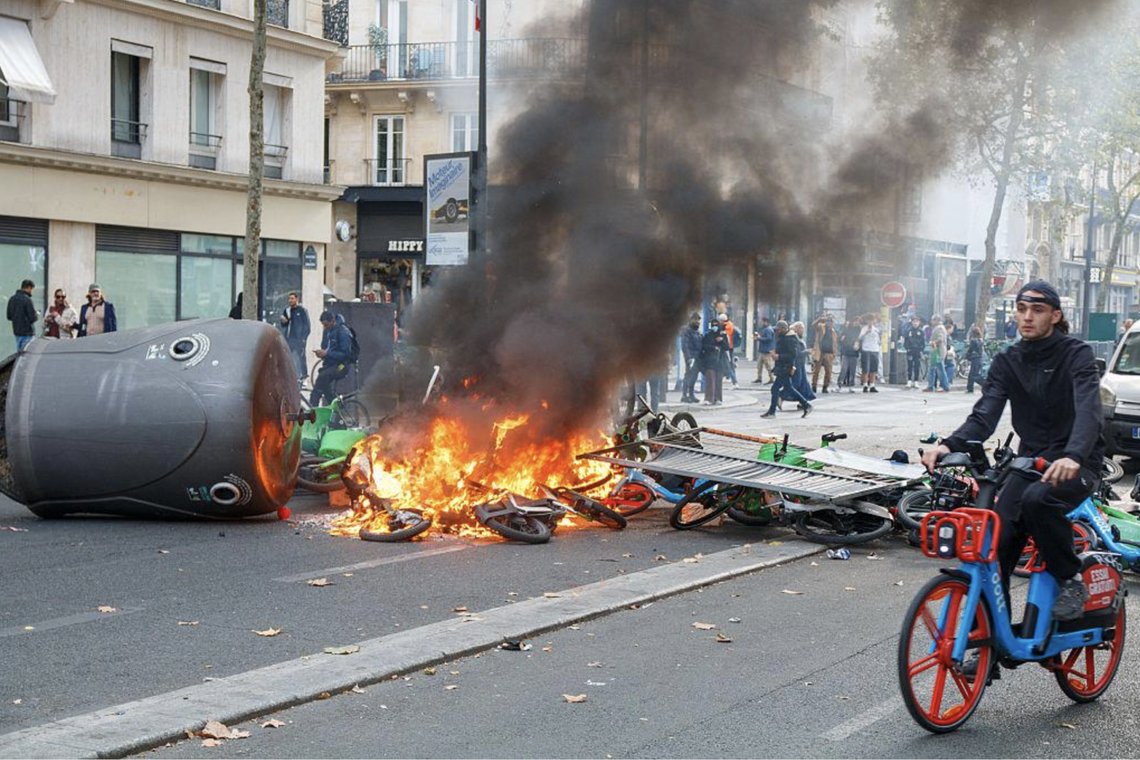
‘Why on earth would a crowd of demonstrators on the streets of Milan start vandalising buildings simply because Giorgia Meloni’s government had not recognised this Palestinian entity? In the great war – the war for our civilisation – we are on the verge of defeat”.
Liberal societies have erected barriers against external threats and lowered them for anyone who can speak their own languages.
And as Roger Scruton had understood, the seed of nihilism lies within the fruit.