

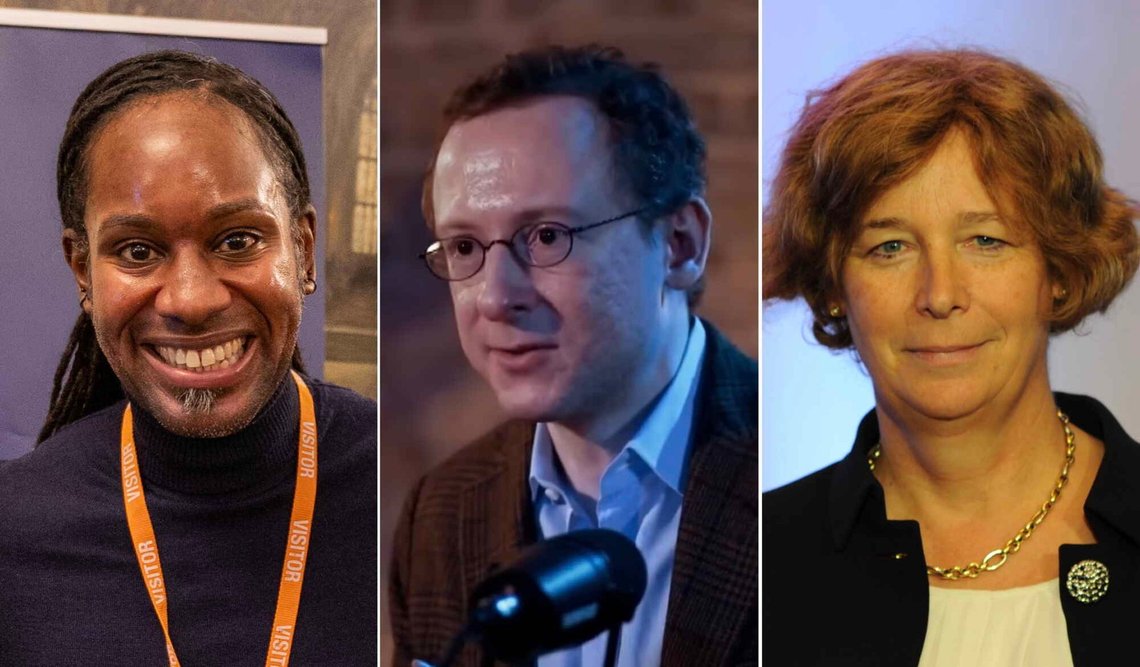


Postdoctoral researcher Nathan Cofnas at the University of Ghent in Belgium, who exposed the recently deceased Cambridge professor Jason Arday’s plagiarism in his doctoral thesis, is being suspended from his post, the Belgian university announces.
Cofnas is to be investigated for possible discrimination against Arday, reports the Daily Mail.
In a post on X on Thursday he said: “I am under investigation by my university for having discriminated against Arday.”
In a separate post Cofnas added: “I was just suspended by Ghent University. They will almost certainly fire me.”
Ghent University confirmed the suspension after having stated that Professor Arday’s death “ought to give occasion for reflection”, and added that the institution “distances itself from discrimination, hatred and racism”.
The Belgian university stated that although it supports academic freedom and open academic debate, “this freedom is not unlimited” and goes “hand in hand with responsibility”, at the same time as it announced that it is implementing unspecified measures against Cofnas.
The suspension of Cofnas was announced by Ghent University’s rector Petra De Sutter and prorector Herwig Reynaert. In a joint statement from the two it is said:
“Ghent University stands for respect for human dignity and distances itself from discrimination, hatred and racism.
We attach great weight to academic freedom and open academic debate, even when the viewpoints are controversial. This freedom is, however, not unlimited.
It goes hand in hand with responsibility and may be limited in order to protect the rights of others.
For this reason the university takes the recent public statements by a postdoctoral researcher at Ghent University about this matter very seriously.Ghent University has decided to implement appropriate measures within its powers and the applicable regulations.”
The university has since specified that it concerns a disciplinary investigation against Cofnas, who conveniently enough is disliked by many colleagues for what they regard as politically incorrect work.
The comic element in this tragic case is that rector Petra De Sutter herself committed plagiarism during her opening lecture at the beginning of the academic year on 19 September 2025.
It was the Belgian investigative website Apache that in January was able to reveal that De Sutter’s speech contained a series of untruths that had been plagiarised directly from artificial intelligence (AI).
In the speech, for example, quotations were incorrectly attributed to Albert Einstein, Hans Jonas and Paul Verhaeghe, writes Michael Shellenberger, who discusses the case at Public, where he refers to the trans woman De Sutter with the pronoun “he”.
Einstein never said “Dogmas are the enemy of progress” at the Sorbonne in 1929. His appearance there that year consisted of a specialist lecture on the unified field theory. De Sutter called the philosopher Hans Jonas “rector at the University of Munich” and claimed to have quoted from a “rectoral address in 1979”. But Jonas was never rector in Munich and delivered no such address. The third quotation, which De Sutter attributed to the Ghent psychoanalyst Paul Verhaeghe’s essay on wisdom, does not occur in his essay.
It belongs to the story that De Sutter herself in her rectoral election campaign had admonished critical AI use. Since then attempts were made to erase the traces:
Ghent University did not correct the information when it discovered the problem, but instead quietly edited the text online in October 2025 after students had raised questions. They removed the worst errors, but left the invented sentences in quotation marks and published no notice of this. Only after having received questions from Apache in January did the university add a disclaimer and reformulated the quotations into paraphrases.
Shellenberger suggests that De Sutter has political motivations for the suspension of Cofnas:
Before he became rector, De Sutter was Belgium’s deputy prime minister for the Greens, and before that a member of the European Parliament. He led the Greens’ 2024 election campaign as the party’s “front figure”. De Sutter, a gynaecologist who previously headed the department of reproductive medicine at Ghent University Hospital, is a man who identifies as trans and is Belgium’s most prominent trans politician. Trans activists across the world have repeatedly demanded and obtained online censorship.
The Public editor links this directly to efforts to get more minority persons into academia:
It is worth noting that De Sutter has been critical of meritocracy. “We are making insufficient progress with regard to inclusion and gender equality”, he said in the same speech. He pointed out that women constitute around 20 % of the professors. “This figure does not reflect our society … If we wish to be a university where everyone is welcome and is given equal opportunities, it is not enough merely to open the doors.”
It is precisely this way of thinking that created the Arday tragedy, Shellenberger concludes.
The sacrifice of academic standards on the altar of identity politics is only one part of the mischief that today has turned large parts of academia in the West into a farce.
What is needed, in short, is a rescue operation, something Trump has initiated in the USA with initiatives that among others Petra De Sutter has condemned.
One needs no crystal ball to understand that the USA will remain at the academic world summit, while Europe is to struggle to stay there.


