

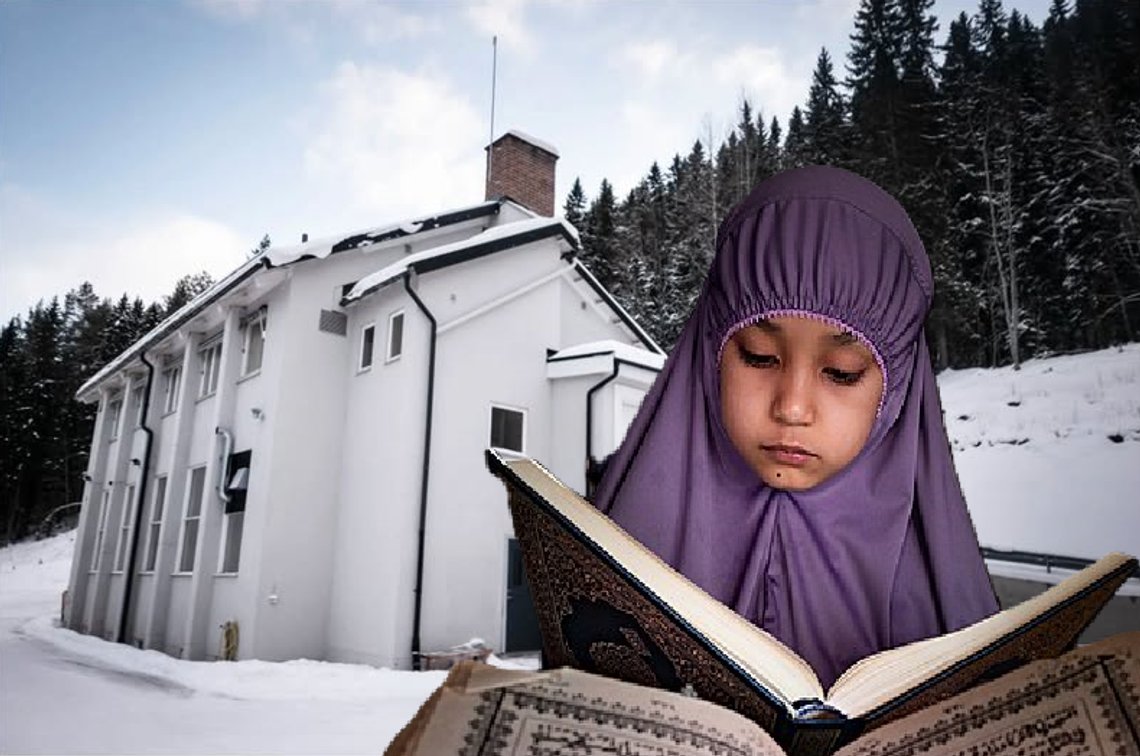
Plans to establish a large mosque on Frösön, just outside Östersund, have sparked debate in the local community. The municipality has now confirmed that questions regarding the project’s financing have been referred to the Swedish Security Service (Säpo): “There are connections here that could be of extreme significance. This could involve Salafism or Islamism.”
According to information from the municipality, Säpo was notified after questions arose about the project’s financing and potential contributions from external sources.
The municipality emphasizes that this does not necessarily indicate suspicion of illegal activity, but that it is natural to inform relevant authorities when questions arise regarding the financing of large projects.
Property Purchased on Frösön
The mosque project is planned on a property in the upscale area of Frösön, just outside downtown Östersund. The purchase contract for the property was signed on December 3 last year, with a deposit of one million Swedish kronor paid upon signing.
The local association Centrum för Fred (Markaz as-Salam; Centre for Peace) is behind the initiative and has simultaneously launched digital campaigns on social media to finance the remaining five million kronor. According to the association, they have already raised nearly 4.9 million SEK (approximately 480,000 USD) through the national campaign “Vi mår bra” (“We Are Well”).
– “We are Well” is probably not so well
However, after receiving information that the “Vi mår bra” association has connections to extremist environments, Östersund municipality has now reacted. Initially, the municipality chose to contact both the Swedish police and Säpo, but on Friday they also submitted a report regarding a so-called security-threatening incident.
– The chances that we can pursue the concern further are very small. Therefore, we have contacted both the police and the Security Service and asked questions, said Östersund Social Democratic municipal councilor Niklas Daoson in an interview with SVT Nyheter on Friday.
– We haven’t received many answers, so what we have done today is submit a report on what is called a security-threatening incident, stating that we are aware of this, we don’t feel this is right, and we need your help — your expertise — to investigate. What is this? What is this phenomenon? Where does the money come from? Advise us on how to act, and above all: how do you intend to act?
– There is, no matter how you look at it, a connection to something called “We are Well”, and we understand that “We are Well” is probably not so well.
Radical Muslim Influencer Behind Fundraising
One of the individuals behind the fundraising campaign is Ramsis “Moosa” Assal, a well-known Muslim influencer from Järva with 67,000 Instagram followers and over 72,000 TikTok followers.
Assal studied at the ultra-conservative Islamic University of Medina in Saudi Arabia. On social media, he goes by the name “Medinastudenten” (The Medina Student) and is considered to represent a very strict interpretation of Islam.
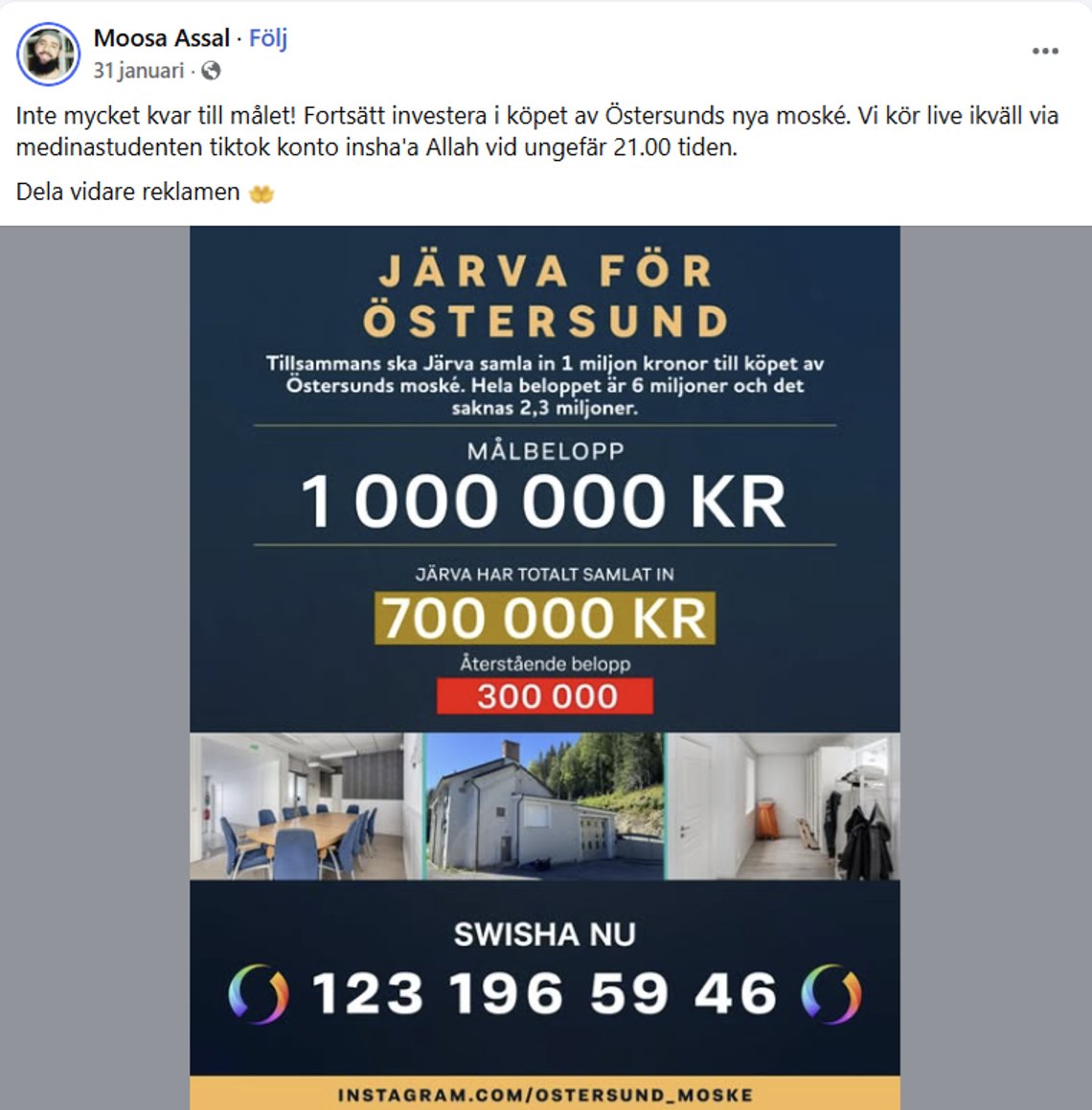
On his Facebook page, Ramsis Assal encourages his followers to fund the new mosque on Frösön. Screenshot from Facebook.
He has also visited the building and recorded a video in which he says that the property will be perfect as a mosque.
– There are connections here that could be of extreme significance. This could involve Salafism or Islamism, said Niklas Daoson.
Salafism is a conservative branch of Sunni Islam that emphasizes a literal interpretation of the religion and has strong connections to Saudi Arabia.
Researchers Urge the Municipality to Monitor Financing
Several researchers have now called on the municipality to investigate the project’s financing more closely.
– It is clear that the actors behind this are Salafists, the most fundamentalist and reactionary tendency within Sunni Islam in Sweden. Saudi Arabia is known for its ambitions to spread Islam worldwide, including in Sweden and other European countries, says Aje Carlbom, researcher and anthropologist at Malmö University.
Terrorism researcher Magnus Ranstorp at the Swedish Defence University also believes the municipality should pay attention to the source of the funds and question the financing.
– Saudi Arabia has financed many mosques in Sweden, but I cannot say today whether there is foreign financing in this project because there is no transparency, Ranstorp told Jämtlands Tidning.
– However, there is a Salafist campaign currently ongoing nationally, with mosque construction in several places, including Östersund, aimed at establishing influence.
Risk of Religious Indoctrination
The municipality and Niklas Daoson emphasize that Sweden guarantees freedom of religion, and that the establishment of religious meeting places is not inherently controversial if laws and regulations are followed.
However, Ranstorp is highly critical of the municipality’s handling of the case.
– There is extreme political and religious ignorance regarding such matters. It does not necessarily mean this mosque is Salafist-oriented, but financing is key. If foreign funding is involved, follow-up questions are needed.
Aje Carlbom also describes Saudi influence on mosque construction in Sweden as highly problematic:
– “The risk is that Muslim children are indoctrinated into a religious worldview that is far from integration-friendly. This concerns young people being influenced by a doctrine that politicizes their religious faith. Islamic jurisprudence differs slightly; they intend to teach children Sharia, a parallel legal system to Swedish law.”
Increased Focus on Foreign Financing
The debate in Östersund is part of a broader European discussion about the financing of religious institutions.
In recent years, several countries have introduced stricter regulations to ensure transparency regarding financial contributions to religious organizations, particularly if the funds come from abroad. Säpo has previously warned that extremist environments may attempt to use religious organizations as a platform for influence or recruitment.
Initiators: Aiming for a Community Center
Supporters of the mosque project have emphasized that the goal is to establish a stable religious and social gathering point for Muslims in the region. According to the initiators, the project is intended to strengthen the Muslim community locally and contribute to a more organized religious environment in Östersund.
In an Arabic-language document, Markaz as-Salam describes an extensive and growing youth program planned for the new building:
“We have around 140 students, boys and girls, divided into 15 teaching groups receiving weekend instruction in Arabic, the Quran, creed (aqidah), interpretation (tafsir), Islamic jurisprudence (fiqh), and the Prophet’s biography (sira). Students range in age from 4 to 20. We thank God for dedicated teachers of faith, some of whom have formal religious education and teach our children according to correct principles. The number of students has increased over the past year, and this year we also offer advanced levels in faith.”
The document also states:
“Around 30 sisters/mothers are committed to raising their children in a healthy Islamic faith and participate in study circles in faith, Islamic jurisprudence, and interpretation.”


