

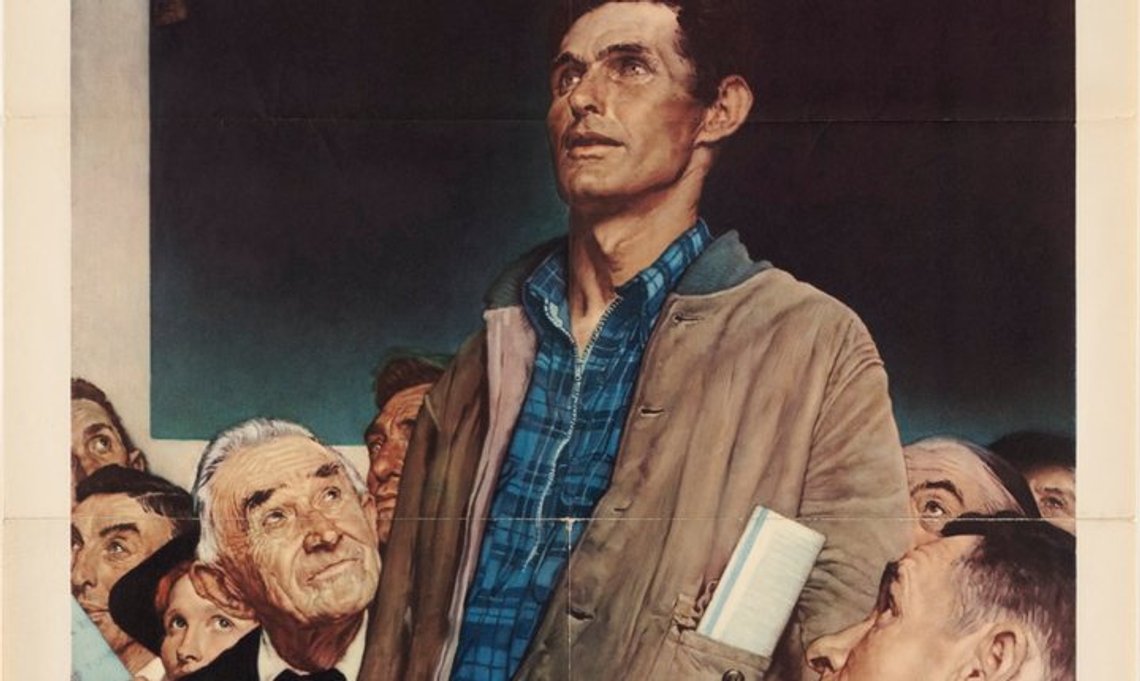


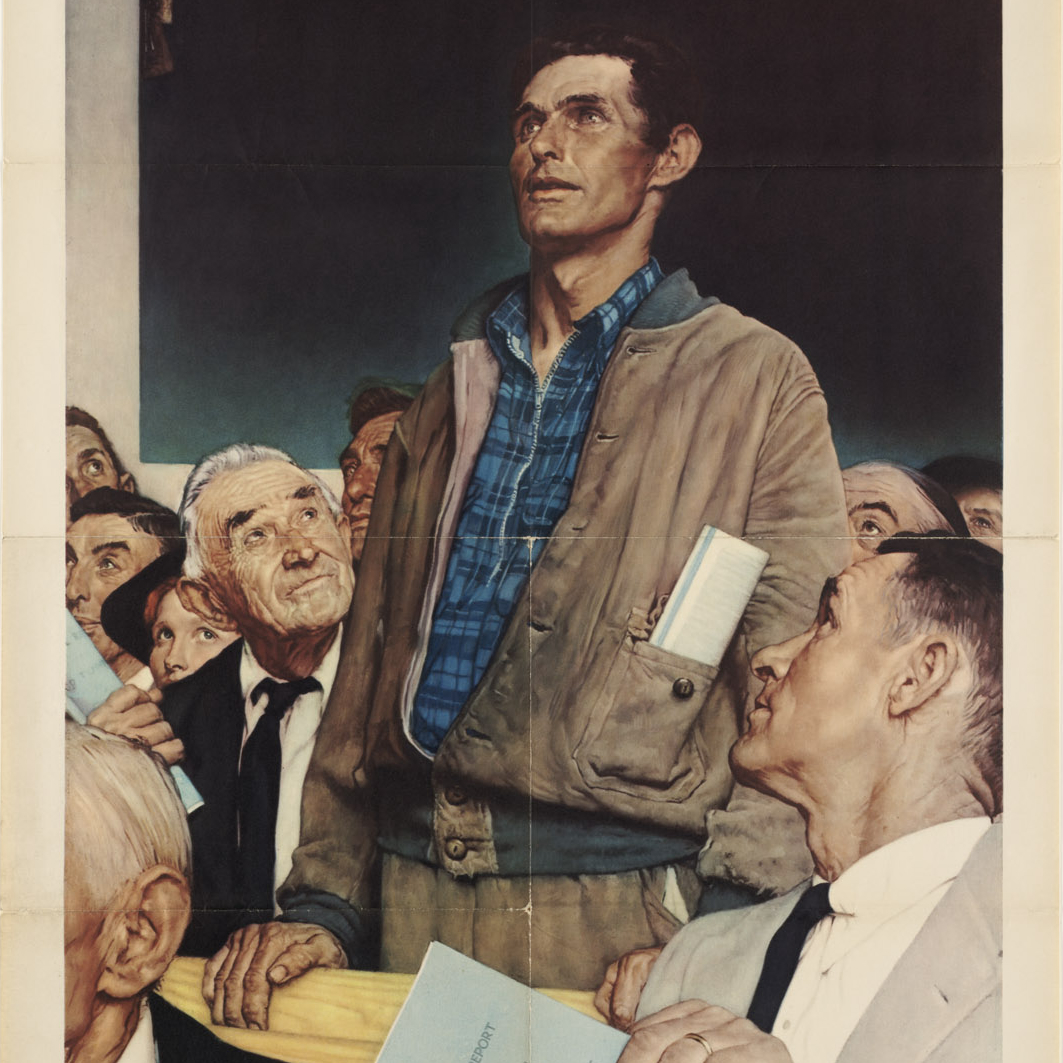
Norman Rockwell (1894–1978), ‘Save freedom of speech’ (1943). Photo: Office of War Information cc by 2.0 / Wikimedia Commons.
Above all other freedoms, give me the freedom to know,
to express myself and to argue freely
as my conscience dictates.
John Milton, ‘Areopagitica’ (1644)
Freedom of thought and expression is enshrined both in the UN Universal Declaration of Human Rights (Article 19) and in the Norwegian Constitution (Section 100). These provisions also safeguard the right to information, the pursuit of truth and the free formation of opinion.
The concept of freedom of expression recognises the ability to express oneself and communicate freely with others as a fundamental human need, and as crucial to the individual’s sense of freedom, self-respect and autonomy. Freedom of expression can be justified both on the grounds of respect for the individual and on the grounds of its benefit to society. In a democracy, these considerations are interlinked.
Freedom of expression is necessary if we are to defend ourselves against injustice and abuse, and to safeguard other democratic rights. Independent media, open communication and free speech make it more difficult to abuse power – and easier to expose abuses when they occur.
Freedom of expression and democracy
Democracy is based on the notion of the citizen as a rational being, capable of forming independent opinions. It is also based on the citizen’s right to express and argue for these opinions. As a so-called meta-right, freedom of expression is both a fundamental prerequisite for democracy and a condition for the exercise of other democratic rights.
Under the citizen-led democracy of ancient Athens, two forms of freedom of expression were practised:
Parrhesia denoted the general freedom to think and express oneself.
Isegoria was the citizen’s right to address their fellow citizens in the ekklesia, the popular assembly. Citizens with full rights were to be able to express their opinions publicly, offer advice on governance and administration, and safeguard both their own and the community’s interests.
The conception of human beings as rational beings, capable of forming well-considered opinions, is a sine qua non – a necessary prerequisite for democracy. If this premise is rejected, the justification for democracy also falls away. Attacks on freedom of expression therefore undermine not only the right to speak freely, but also the notion of human rationality and democracy as an idea.
Freedom of expression and society
Free exchange of views is the modus operandi of democracy. Through freedom of expression, society can function as a ‘marketplace of ideas’, where different opinions are tested against one another. This gives the best ideas the opportunity to be heard and to prevail. At the same time, a diversity of perspectives and arguments helps to keep different societal interests in balance and promotes creativity, initiative and the sharing of knowledge.
Without freedom of expression, society becomes closed, uniform and stagnant. When criticism is suppressed, society loses a crucial self-correcting mechanism and risks becoming trapped in complacency and self-deception.
Freedom of expression is of less value if it is used merely to repeat established views. Its value lies precisely in the space it creates for diverse knowledge, criticism and new perspectives. It is therefore unconventional opinions that need the protection of freedom of expression the most. Historically, progress has arisen when new knowledge has corrected old errors and challenged dogmatic positions.
Responsibility for speech and democratic tolerance
Freedom of expression is often criticised for facilitating fake news and misinformation. But it is precisely an open exchange of views that makes it possible to test claims, uncover errors and correct them. Statements only become morally reprehensible when they involve deliberate falsification or are intended to mislead or cause harm.
Excessive moralising about freedom of expression can divide society into those who hold ‘correct’ opinions and those who express dissent or ‘controversial’ views and are therefore denied a place in the public sphere. Such a development makes constructive dissent difficult, even though dissent is a fundamental prerequisite for democracy.
The term ‘responsibility of speech’ is often used, but can also become a tool for restricting and controlling the exchange of views. It is therefore equally reasonable to emphasise a responsibility for freedom of expression: a shared responsibility to uphold the space for the free exchange of views. The fact that some people abuse freedom of expression is not a sufficient argument for restricting it for everyone.
The fact that statements may be perceived as offensive is an inevitable cost of an open democracy. Feeling offended involves an element of choice. Individuals may choose to let subjective reactions take precedence, but they may also adopt a principled stance: to prioritise freedom of expression and the best interests of democracy over their own feelings.
Censorship and propaganda
To control the flow of information and shape public opinion, those in power employ two opposing yet complementary means:
Censorship restricts the information and perspectives that are made available.
Propaganda promotes specific interpretations and patterns of reaction.
What these tools have in common is that they undermine the individual’s capacity for independent thought and action, and erect mental barriers against alternative viewpoints.
Censorship is a declaration of mistrust in citizens’ rational abilities and judgement. It expresses contempt and suspicion and contributes to the disempowerment of the population. At the same time, censorship functions as negative propaganda in several ways: it hinders scrutiny of the premises underpinning current policy, it stigmatises critics of the liberal consensus, and it stifles debate on alternative explanatory models, solutions, objectives and methods.
Governments devote considerable resources to controlling behaviour and shaping public opinion through extensive influence operations. In a democracy, however, citizens should be persuaded through empirical evidence and rational argument. Psychological conditioning, propaganda, censorship and manipulation render freedom of thought and the free formation of opinion ineffective. This distorts the very idea of democracy.
Consequences
A society is sustained through communication between its members. When the free exchange of ideas is weakened, the sense of community is undermined whilst the power of the state increases.
Information is the lifeblood of society, and the channels of communication are the arteries through which it flows. When communication is restricted and information is filtered, a communicative ‘blood clot’ arises that hinders the dissemination of potentially important knowledge.
The authorities’ control over communication also entails control over language. Words and concepts are turned into weapons. The language of authority is then used not to guide, argue, explain or admonish, but to mislead, manipulate, obscure and dictate.
When the free formation of opinion, research, investigation and the sharing of information are hindered, the possibility of rational discussion is also weakened. This development is therefore anti-intellectual. At the same time, it is anti-democratic because it undermines a democratic process that belongs to all citizens, not just politicians.
We are seeing that certain topics have become off-limits for the sharing of information and the free exchange of views. Others are permitted only within a narrow corridor of opinion. The result is that political thinking is reduced to individual issues and loses sight of the bigger picture.
Freedom of expression loses its meaning without both freedom of thought and genuine access to the means of communication. Without freedom of thought, freedom of expression will serve to reinforce conformity and dogmatism. And without the opportunity to express one’s own thoughts, or when dissenting opinions have serious consequences, freedom of expression becomes, in any case, a theoretical right: only enthusiastic support for the ideology and loyalty to the system are permitted. The result is widespread social, intellectual and cultural decline.


