



The money supply continues to grow (inflate). The Consumer Price Index (CPI) is not rising at the same rate. The remainder of the growth in the money supply – real inflation – is reflected in a further rise in house prices. This has been the case for a long time. If we want to change this, fiscal and monetary policy must be altered.
The daily economic news revolves around interest rates, inflation and wage growth. In this context, inflation means a rise in prices. This rise in prices is measured by the Consumer Price Index (CPI). Wage negotiations are largely about maintaining purchasing power relative to the CPI and being compensated for higher interest rates.
Wages, prices and interest rates influence one another. The social partners agree on this. When they reach a settlement, the central bank assesses the agreement and sets the key interest rate to reflect market rates.
In the book «The Country That Became Too Rich» by Martin B. Holte, Central Bank Governor Svein Gjedrem (1999–2010) was commended for ensuring discipline in wage negotiations by «threatening» with the stick behind the mirror in the form of higher interest rates should the social partners not see reason. By contrast, Gjedrem’s successor, Øystein Olsen (2011–2022), was criticised in the book for a lack of such discipline and for using interest rates to promote specific economic and climate policy objectives.
Inflation at 7 per cent
One thing is never mentioned: money supply growth. Statistics Norway’s (SSB) latest published figures show that the M3 money supply had increased by 5.4 per cent over the past 12 months as of August this year, with a projected rate of five per cent by 2027. The Consumer Price Index rose by just 3.2 per cent. But growth in the money supply is the true measure of inflation.
M3 consists of banknotes and coins in circulation, bank deposits and other liquid financial instruments such as short-term, negotiable debt securities and money market shares. This does not increase because the central bank prints money, but because banks issue new loans without a corresponding increase in deposits. In this way, households and businesses increase the money supply by taking out loans from banks that issue the loans without a corresponding inflow of deposits.
Annual money supply growth has stood at 7.0 per cent since 2000. It was particularly high in the four years from 2004 to 2007 in the run-up to the financial crisis (2008), with double-digit growth, and as high as 16.7 per cent in 2007, whilst the key policy rate was below 2 per cent in 2004–2005.
However, with Olsen as Governor of the Central Bank from 2011, the key policy rate averaged 1 per cent. Money supply growth returned and peaked during the pandemic with double-digit growth in 2020–2021, when Norges Bank set the key interest rate at zero.
The Consumer Price Index has shown an average annual growth rate of 2.5 per cent over this period. House prices, on the other hand, have risen by 5.5 per cent per year.
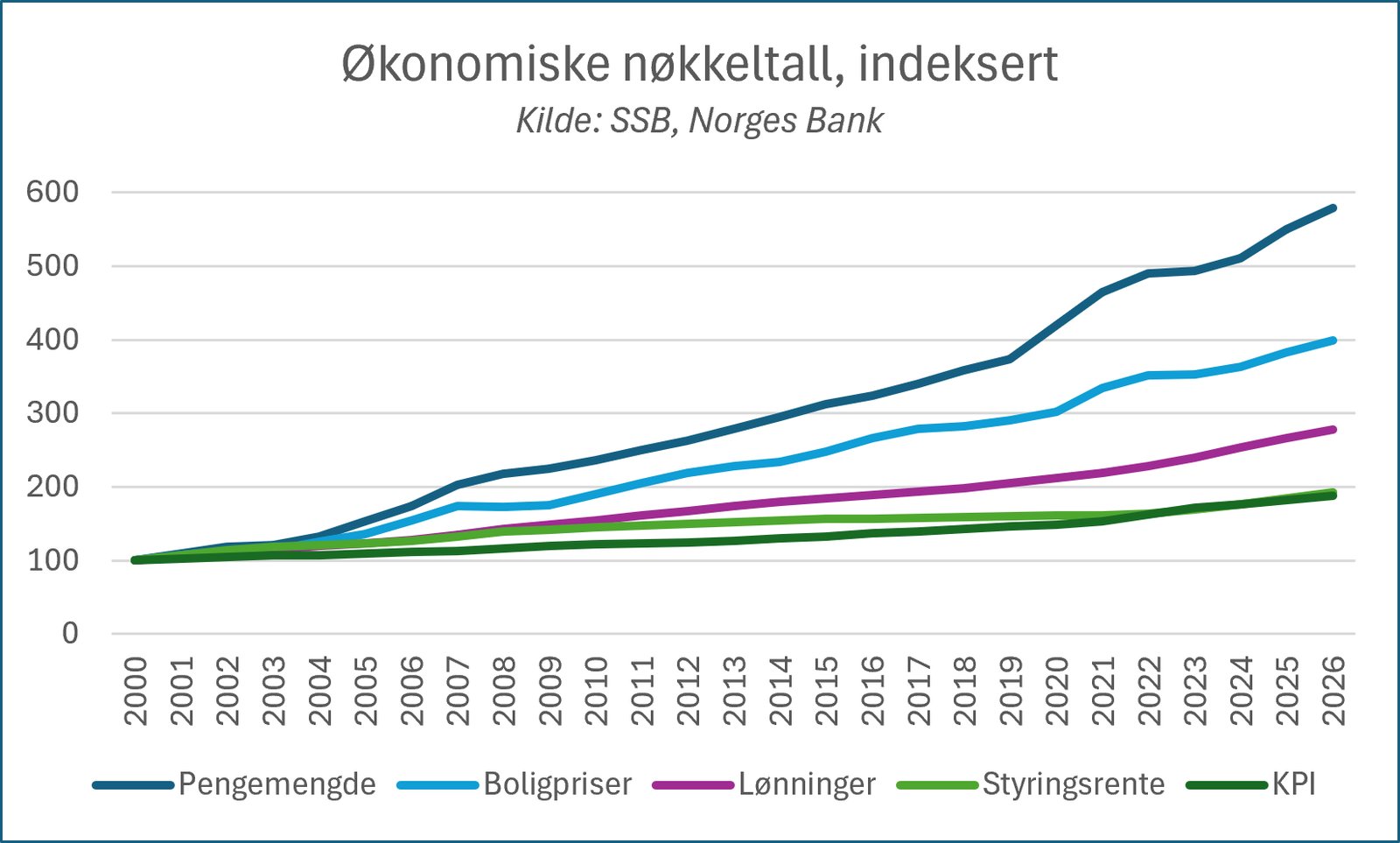
The following figure summarises key economic indicators, indexed since the turn of the century.
House prices and wages
Since the turn of the century, the money supply has increased by a factor of 5.8. No other macroeconomic or public finance factors have increased to the same extent. By comparison, the Consumer Price Index has risen by a factor of 1.9. In other words, this indicates that prices for consumer goods are 90 per cent higher than they were at the turn of the millennium.
Wages have increased by a factor of 2.8, thereby giving consumers greater purchasing power relative to the CPI. But has purchasing power actually increased? It depends on where you live and what you intend to spend your money on. This is because house prices in Norway have, on average, increased by a factor of 4 since the turn of the century.
This means that, in 2026, an average wage will buy 30 per cent less of an average home than it did in 2000. Or, if we turn the fraction around, an average home will cost 43 per cent more in 2026 than it did in 2000, relative to an average wage.
If we add to this the fact that interest rates are at their highest since the financial crisis, we will probably find the answer to whether households feel things are getting better or worse.
Inflation stems from wages
The trend shown in the figure above has been ongoing for a long time, and long before the turn of the century.
True inflation is the growth in the money supply. The word ‘inflation’ comes from the English word ‘inflate’, which means to grow. When the money supply grows, prices – all other things being equal – will rise accordingly. But this is not how it works in practice.
Challenges arise when prices develop differently across various products and services, and geographically. When the growth in the money supply is not distributed evenly either, differences emerge. Although these differences are a frequent topic of debate, money supply growth is never mentioned.
In the attached article, Document described how house prices are outpacing wages.
It showed an example where a new flat in Høvik, Bærum, was purchased in 1961 for a sum equivalent to the starting salary of a business graduate. Today, it is impossible to acquire such a property at a price measured in terms of the equivalent salary level.
This trend is not reflected in the consumer price index.
Money supply growth, or real inflation, has a centralising effect in that plots of land and homes in central areas are priced particularly high. In other words, whilst house prices have quadrupled since the turn of the century, this means that house prices in central areas have risen significantly more.
A change in trend
If this trend is to change, political action must be taken.
The parameter in Norway that has increased the most relative to the money supply is public expenditure. It has increased by a factor of 4.4, i.e. more than house prices. The following figure shows the money supply, GDP and public expenditure indexed since the turn of the century:
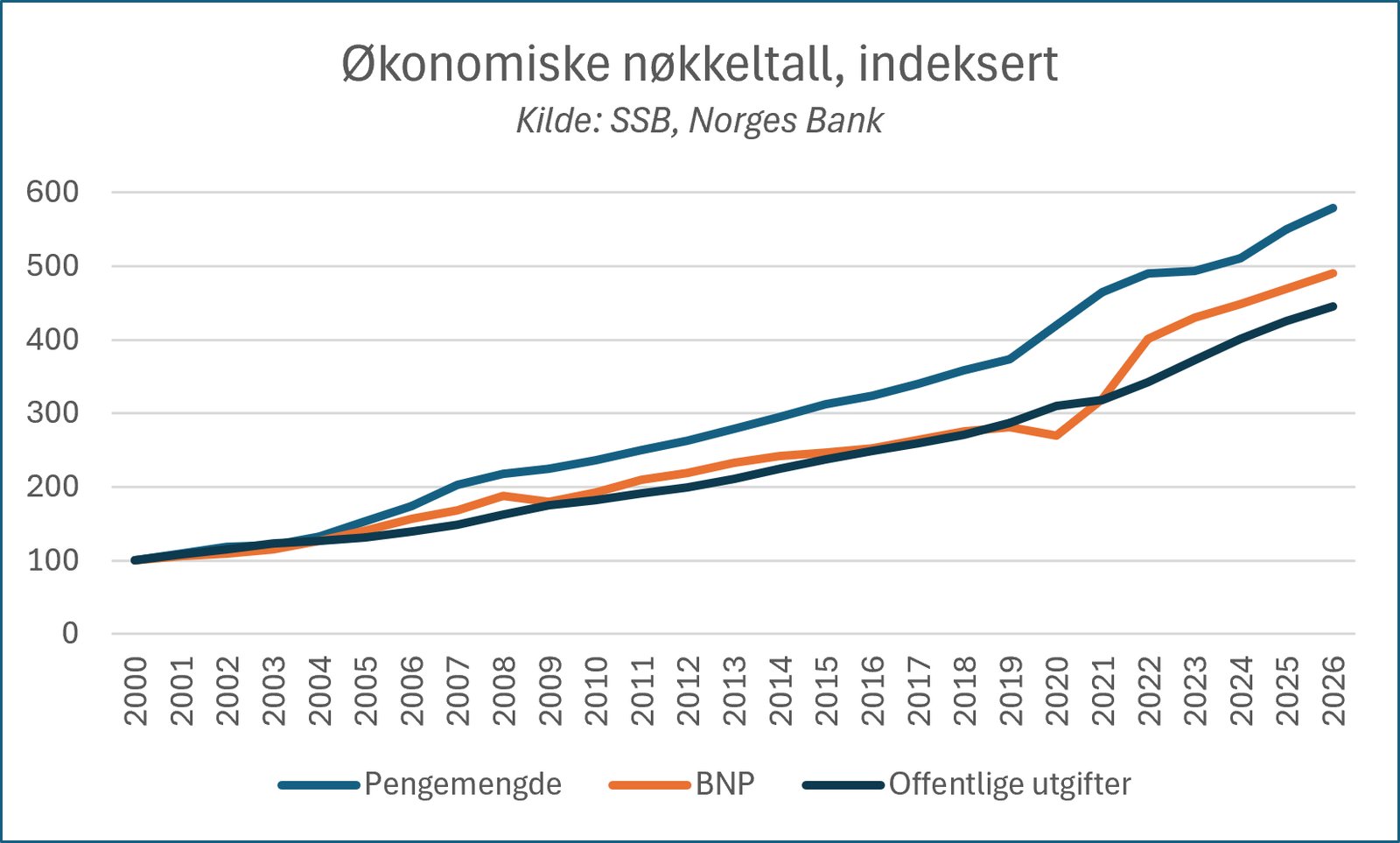
Public spending is a key driver of the Norwegian economy.
To avoid the negative long-term effects of real inflation, such as greater centralisation and wider disparities, money supply growth must be curbed. The most effective way to limit this is through higher interest rates.
This would require Norges Bank’s mandate to be changed from an inflation target based on the CPI to one based on money supply growth.
However, higher interest rates, even during a transitional phase, will meet with massive political resistance and are therefore impossible to implement without compensatory measures. Such a mandate requires households to be compensated through lower taxes. Consequently, such a shift also requires public expenditure to be reduced accordingly, in order to keep public budgets in balance.
That there is much that can be cut seems obvious when one reads the book «The Simplification General’s Testament», by Hans-Jørgen Blomseth. But one does not need to read books to see where public spending can be cut. In the areas of climate policy measures, development aid and immigration – along with their associated costs – several hundred billion kroner could be freed up annually.
The paradox is that those who would ultimately benefit most from such a change are probably the very ones who would protest most vociferously against it, led by parties on the far left.


