

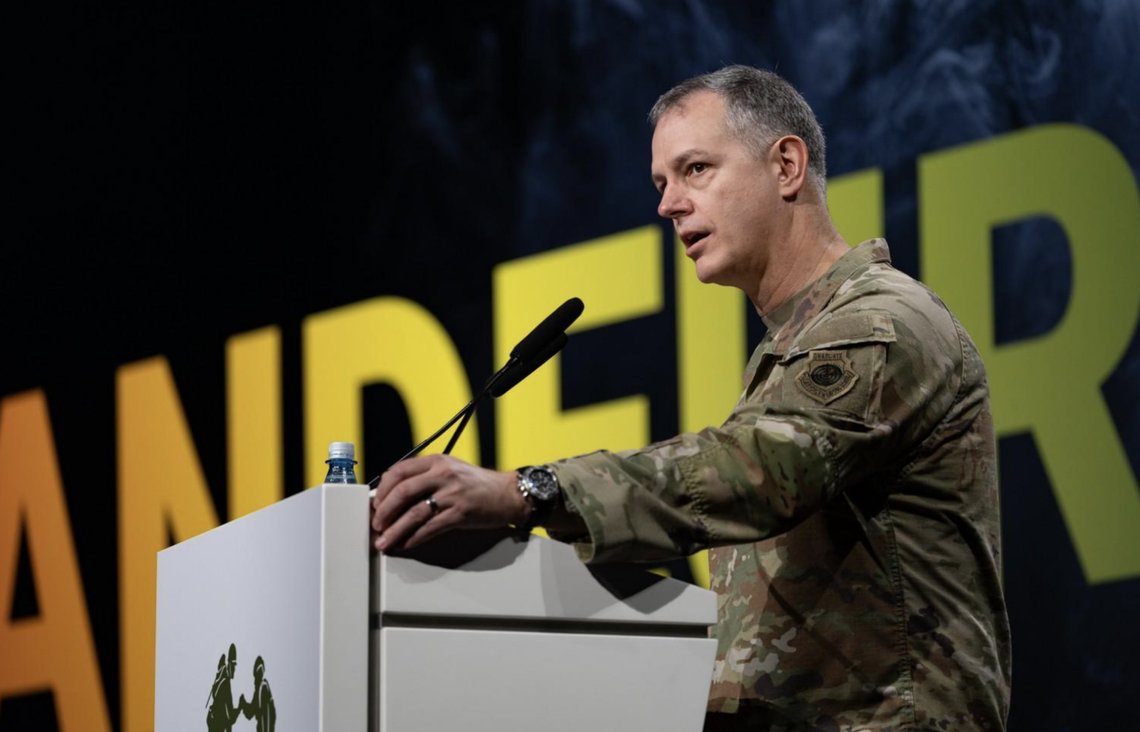


The annual Polish summit of the NATO Forum this week, which is taking place against the backdrop of the war in neighbouring Ukraine, gives the superficial impression of a military alliance brimming with the ability and willingness to present a united front against a threatening enemy. The reality is quite different. A NATO showing visible signs of internal strife and disintegration has gathered to salvage what it can. It is not a catastrophe that is being sought to be averted, but the signs of advanced senile decline within NATO are clear.
The reason this can now be stated in plain terms is that the more than obvious signs of the organisation’s long-standing decline are not only being discussed in hostile media and demonstrated by outspoken opponents in a key country such as France. It is a fact that has led to the Alliance’s most central and important member state, the USA, participating in the negotiations with nothing more than a seconded ambassador with limited powers. The US Ambassador to NATO, who is also the Alliance’s Deputy Secretary-General, has confirmed his attendance to deliver a speech at a panel debate on ‘How Europe can build the military strength it needs.’
In a situation where the European alliance partners are meeting at the highest government level in an attempt to give the outside world an impression of unity and strength under the slogan ‘United We Stand’, this is a clear diplomatic signal that NATO should perhaps no longer be accorded the realpolitik and military-strategic significance we have been taught to believe it has for nearly 80 years. At the very least, we must be able to conclude that, on this occasion, the US has made it clear that NATO no longer tops the list of priorities when it comes to a joint, solidarity-based defence of the Western world.
The US has good reasons to reassess its relationship with NATO. None of NATO’s European allies have shown any willingness to come to the US’s aid during its ongoing efforts to bring an end to Iran’s 48-year-old war against the US (and Israel), which has so far cost the Americans between 900 and 1,000 lives. When the US, with Israel’s support, launched a counter-attack in February – partly to prevent Iran from developing and using nuclear weapons against the US and Israel – not only did European NATO allies fail to assist the US in the expected spirit of solidarity. Several key European countries refused to assist their ally, the US, and actively sought to undermine US efforts by refusing to allow their alliance partner to use their European bases, which would have made US operations easier. The US is now responding by withdrawing military forces from a Europe that is not even capable of safeguarding its own immediate security.
But this is not the only disappointment the US has experienced from its allies in Europe. As it gradually became apparent in recent years that countries such as China and Russia were making clear moves to establish operations and a presence in Greenland, the US found that,a. on the European side, and not least from the Nordic countries and Canada, an active political front was forming against the US’s entirely legitimate concern regarding the complete lack of defence for Greenland, which geographically covers the entire north-eastern flank of the Americas.
The US found that when this problem was highlighted, Europe reacted together with the Nordic countries and Canada reacted very negatively to the US’s desire to have the obligations of the NATO Treaty applied to Norththe Americas, as the Atlantic Pact stipulates. However, we heard no more about this after the US, together with Greenland and Denmark, entered into a defence agreement that resolved both the US’s and Greenland’s military problems without any of the issues that the NATO allies in Europe had raised. The Greenland Agreement is exemplary because it addresses and resolves the real defence problems Greenland is grappling with.
A conclusion on these issues, as they must be perceived from the American perspective, must be that, when it comes down to it, the solidarity-based reciprocity that has for 80 years been the very cornerstone of NATO’s military credibility does not work. It demonstrably does not work when it is the US that needs or expects support and cooperation in defence measures from its European allies. This is the central point of President Trump’s latest diplomatic signals to his European allies.
However, it is not only Europe’s lukewarm attitude towards America’s defence needs and Europe’s long-standing tendency to shift the burden onto the US that raises questions about the continued effectiveness of the NATO Treaty. The Alliance itself is ageing. It came into being at a time when the experiences of the Second World War formed the yardstick for the pattern of response the pact prescribed in the event that joint action had to be taken against an aggressive enemy.
Even now armament and planning are still taking place in Norway for military operations that require months of preparation and the transport of troops and equipment from European countries. But are we facing threats that could materialise within such a timeframe, or do these activities belong to a bygone era? Do we believe that a second world war will recur, or that Russia needs ice-free harbours in Finnmark, as Norwegian experts from Halvard Lange to the man from Lebesby once feared?
With the Greenland agreement, President Trump demonstrated what needs to be organised in the High North today. However, that agreement covers only the north-western Atlantic. Norway’s Arctic defence needs lie in the sea area stretching from the Svalbard archipelago to Jan Mayen and Iceland. There is no possibility of organising a Western military defence of these areas without direct assistance from the US. The US is currently the only country in NATO that possesses a blue-water fleet and other necessary military assets. If Norway chooses to take the defence of the High North seriously, it has, like Denmark/Greenland, no one else to ally itself with other than the US, or possibly Russia.
European NATO countries, including the Nordic ones, would have virtually nothing of military value to deploy outside their own territory in the event of a large-scale European war. The EU has no military organisation or command structure that can be utilised. Creating political symbols, such as Støre’s newly coined ‘strategic partnership” with Poland, has no military value for Norway, nor indeed for Poland. This is political hot air for the media that simply costs money and misleads people. It has no defence value for Norway.
We have reached a historic juncture where, once again, it is the US and Russia that will determine our future military fate. When a peace agreement, brokered by the US, is soon concluded between Russia and Ukraine, international attention will once again turn to the High North, where Russia and China have made significant progress in the development of energy transport via the Northern Sea Route.
Norway, together with the US, stands to benefit greatly from this development. Our military defence requirements will then also look different from those that have applied until now. The worst thing we could do is – together with an expansionist EU – to provoke a situation in the High North that leads to Russian counter-measures and an escalating conflict. Together with the US, Russia and our Nordic neighbours, we share a responsibility to defuse and completely eliminate the possibility of international conflict in the Arctic regions.


