

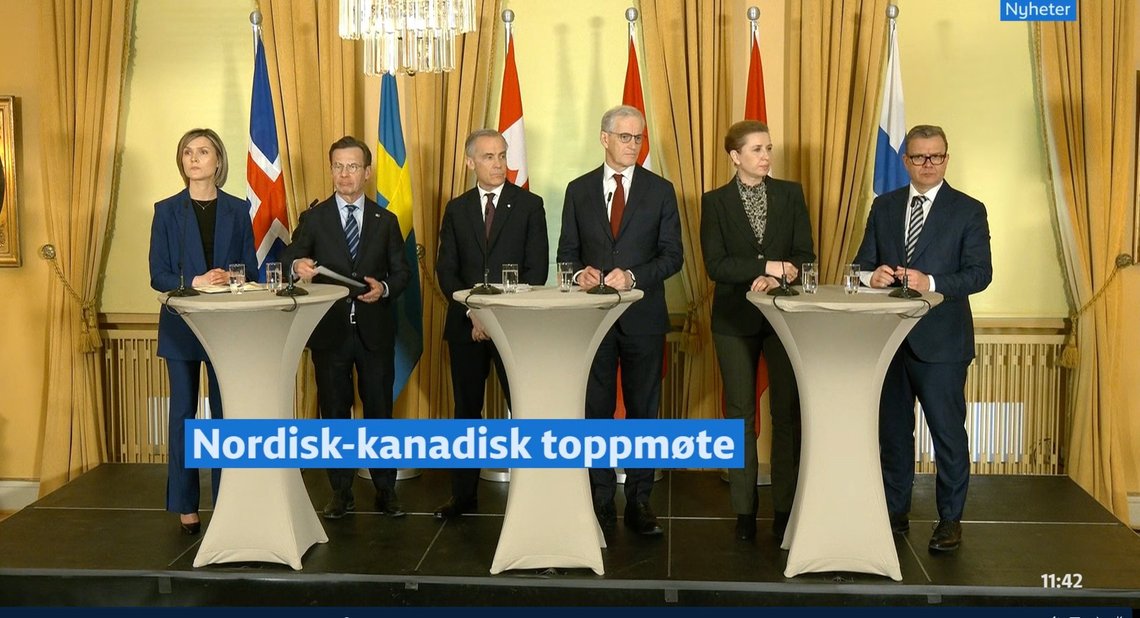
The faction meeting that the Nordic members of NATO and the Arctic Council held together with Canada in Oslo on 15 March was convened on the initiative of Prime Minister Jonas Gahr Støre. The meeting marks a formal turning point in the military and security-policy cooperation these countries have had under the North Atlantic Treaty, as well as in the civil regional cooperation that the same countries since the 1990s have maintained with the United States and Russia under the Arctic Council.
The press conference held by the participants after the meeting left little doubt that an important purpose of the meeting, apart from openly defining Russia as a common enemy in the High North (nordområdene), was to mark a united front against US President Trump. The one who went furthest in admitting what the purpose of the diplomatic process initiated from the Norwegian side was, was Denmark’s Prime Minister Mette Frederiksen, who declared that “… we must build something new, and it must be a world order based on the values that we represent.” This new “world order” appeared intended to establish the Nordic countries, together with Canada and the EU, as a security-policy alternative to NATO, possibly under the outer edge of a French nuclear umbrella, and in a lasting conflict with Russia and possibly China.
The entire initiative and the diplomatic process that follows from it bear the imprint of the political megalomania that has become characteristic of Prime Minister Støre. There are historical examples showing that it is possible to succeed in playing a high game, but what Støre has now set in motion amounts to staking high in poker without having cards to show.
At the same time that Støre assumes the United States and NATO will serve as guarantors of military security in the Arctic region, and refrains from inviting the United States to participate in the negotiations that are to lay down the conditions for the “new world order” that will form the security-policy umbrella over the High North, he already understands that Washington will react. The matter is so simple that we can be certain that this move was made deliberately. It does not help to point out that the initiative has the consequence that the Nordic countries, together with Canada, now intend to meet Trump’s demand for a military commitment in the North that will also benefit the defence of America. Such an initiative could have been undertaken with greater credibility within NATO’s Council, in understanding with the United States.
For us, the development has several possible consequences. The revival of the Cold War, which has thus far been most visible in the political and military expansion of the EU and NATO through Eastern Europe and Ukraine, has answered the cries for help from the “military-industrial complex” in Europe and the United States that became increasingly audible during the 2000s. But the consequence of such a policy is that we for the foreseeable future become dependent on waging war in order to keep our economic wheels in motion. The defence industry throughout the world is one of the heavy locomotives of the industrial economy.
This is how we have managed and made ourselves dependent on the East–West conflict and the Cold War ever since the Second World War and the formation of NATO. It is a theme that is rarely debated in public. The subject is delicate, yet it should nevertheless be kept alive. It ought to happen before political gamblers such as Jonas Gahr Støre attempt yet another grand slam. Sooner or later he will miss, and the rest of us will have to bear a catastrophic loss.


