

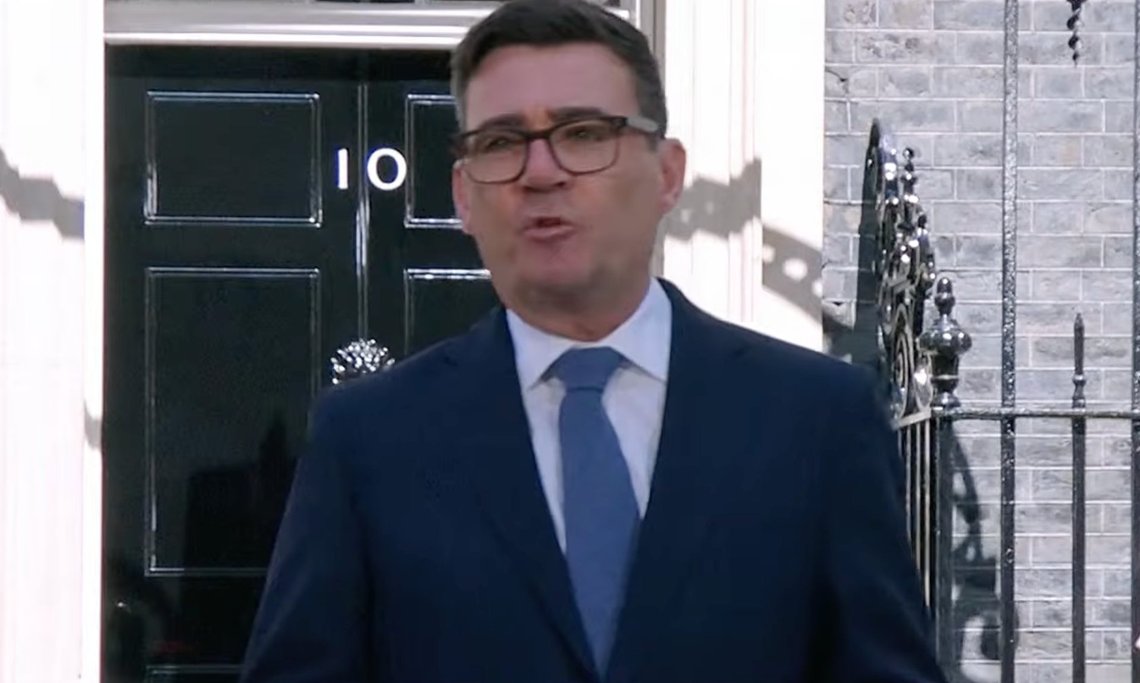


Andy Burnham has pledged to carry out a sweeping reform of social care so that it “operates on the NHS principle” and is “free at the point of need”.
Burnham is due to unveil his plans for social care next week in his first major policy speech as Prime Minister, promising to “face it and fix it”.
A report published by the Health Foundation on Friday estimates that the measure will cost £18.5 billion a year. However, this does not include the “daily living costs” associated with supported housing or residential care homes, such as laundry, food, accommodation and utility bills, writes The Times.
As a result, British recipients of social care living in residential care facilities could still face bills amounting to tens of thousands of pounds for such expenses under the proposals for a new National Care Service.
Residential care in England costs an average of £1,300 per week, or £67,000 per year. Almost two-thirds of this amount goes towards covering everyday living costs such as accommodation, food and utility bills.
If these costs are also to be covered for the approximately 400,000 Britons living in residential care homes and nursing homes, the bill will increase by a further £16 billion. This would raise the total annual cost of the social care initiative to £34.5 billion, equivalent to approximately NOK 445 billion.
Burnham nevertheless appears determined, stating on Monday:
“I am prepared to spend some of my political capital on this issue. I’ll be honest with you. I do not want to leave office having done the same as Westminster has done—not just for 15 years; in fact, I think we’re approaching 30 years… It is indefensible.
How many people have lost their homes and their life savings during that time? We have to face this and put it right.”
Burnham has championed the creation of a new “National Care Service” modelled on the NHS since 2010, when he served as Health Secretary in Gordon Brown’s government. At that time, he proposed a phased introduction of universal free social care.
Even then, however, it was specified that the state would not cover the costs associated with residential care, such as food and electricity.
This is no different from other European countries. A report published by the think tank Nuffield Trust last week examined social care systems in 11 affluent countries and regions and found that almost all required individuals to contribute towards their housing costs.
The report’s author, Camille Oung, argues that the Burnham government should be clearer about what would be included in any universal social care scheme and should draw a clear distinction between the state’s responsibilities and the individual’s responsibilities with regard to costs.
“People living in care homes receive care, but they also live there. You would not expect the state to pay your rent if you were living at home, or to pay for your food at home.
In England, accommodation costs are not currently separated from care costs. As a result, care home bills do not distinguish between personal care and items such as accommodation, food or utility bills.”
Oung pointed to other countries, including Denmark, Germany, France and Australia, where there is a clear distinction between care costs and housing costs. This provides a high degree of transparency, enabling people to know exactly what they are expected to pay for.
Norway likewise requires residents of nursing homes to pay an income-based co-payment for their stay, covering board, lodging, medication and nursing care, in addition to their own private expenses that are not included. Municipalities may charge between 75 and 85 per cent of income above a prescribed exempt amount.
Nothing suggests that Burnham’s Britain will be any different. It therefore appears that Burnham’s high-profile flagship investment in social care is, at least in part, little more than political theatre.
Opened office in the North
One promise, however, Burnham has already fulfilled. On Friday, the “King of the North” spent his first working day at his new Manchester office, “No 10 North”.
The office, conceived as a northern counterpart to Downing Street in north-west England, forms part of the Prime Minister’s ambition to shift power from Whitehall and Westminster to the regions.
Conservative leader Kemi Badenoch described “No 10 North” as a “gimmick”, adding that it “doesn’t improve decision-making, it just creates another branch of government somewhere else”.


