

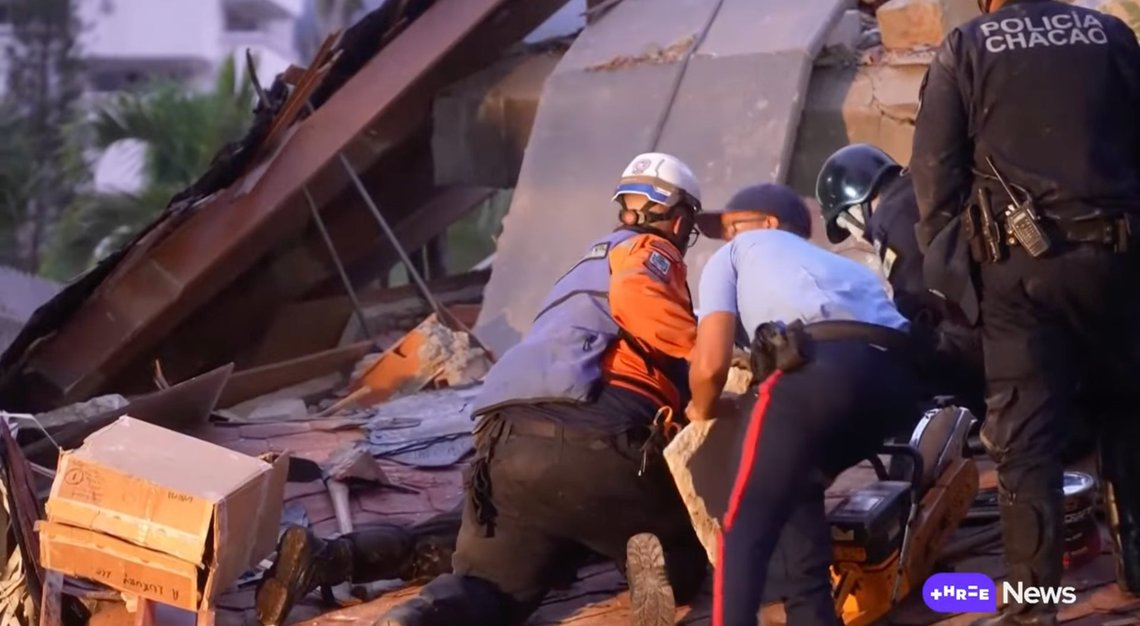
A state of emergency has been declared in Venezuela after two powerful earthquakes struck during the night leading into Thursday, causing multiple building collapses and widespread destruction in several areas near the capital, Caracas.
Two powerful earthquakes, the first measuring magnitude 7.2 and the second 7.5, struck Venezuela’s Caribbean coast 40 seconds apart. They were followed by at least 24 aftershocks.
“The death toll is likely to be high,” the United States Geological Survey writes on its website.
Venezuela’s interim president, Delcy Rodríguez, appeared on state television to declare a state of emergency. She called on healthcare personnel in the affected areas to report to hospitals to assist. Venezuelan hospitals are already severely run down and lack even basic equipment as a result of the many years of misrule under the socialist presidents Chávez and Maduro and the country’s all-encompassing economic collapse.
No official casualty figures have yet been released.
The material destruction appears to be enormous in the coastal city of La Guaira, just north of Caracas. Smoke from a number of collapsed buildings can be seen in a video filmed from the sea offshore.
A ten-storey hotel has been flattened. The Venezuelan Navy’s training centre in the city has also collapsed. La Guaira is Venezuela’s principal port and the capital of the state of the same name.
Many apartment blocks in the city have suffered extensive damage:
Additional footage of the major damage in La Guaira, Venezuela from the powerful earthquakes. pic.twitter.com/TuWjpBblnF
— AZ Intel (@AZ_Intel_) June 25, 2026
Reports on X at around 04:00 Norwegian time said that fires had broken out and that electricity and internet services were down across large parts of La Guaira. The newspaper El Nacional believes that Catia La Mar may be the location that suffered the greatest damage, describing it as the natural disaster’s “ground zero”.
Here we see how the damage to an apartment building becomes progressively worse as the resident moves closer to ground level (the location within the country is unknown):
A Venezuelan resident recorded himself running down the stairs of his apartment building as two powerful earthquakes struck the country. The video shows significant cracks in the stairwell. pic.twitter.com/9usqzAc2VQ
— AZ Intel (@AZ_Intel_) June 25, 2026
The earthquakes were felt as far away as central Colombia.
El Salvador’s President Nayib Bukele has made available 300 rescue workers and paramedics, together with 50 tonnes of medicines and first-aid supplies, which, according to the president, are ready to be flown to Caracas.
Chile has also offered assistance. However, Venezuela’s main airport is closed and appears to have sustained significant damage to its terminal buildings.
Passengers panic and run for cover at Simón Bolívar International Airport in Maiquetía, Venezuela, as the terminal shakes and power flickers, resulting from a massive 7.5 magnitude earthquake off the coast of Caracas. pic.twitter.com/uWN4ZqFjOZ
— OSINTdefender (@sentdefender) June 24, 2026
Footage from La Guaira:
Reporte #EnImagenes
Este video es de La Guaira 💔
Tras el fuerte terremoto de magnitud 7.5 que sacudió hoy Venezuela:
Datos principales:
– Hora: 18:04 (hora local)
– Epicentro: 28 km al noroeste de Montalbán, estado Carabobo (profundidad 13.2 km)¿Dónde se sintió?… pic.twitter.com/iold6VFJjf
— Bárbara Uzcátegui Sanz (@BarbaraUSanz) June 25, 2026
Other videos show rescue workers climbing through the ruins of a collapsed building in the capital as darkness fell. Distraught relatives pleaded for help for their loved ones, whom they feared were trapped beneath the rubble, NTB reports.
In Chacao, a municipality east of Caracas, two buildings have collapsed, and 16 people have been injured or killed, according to the mayor.
The epicentre of the first earthquake was located 168 kilometres west of Caracas, off the town of Morón on the Caribbean coast. It occurred at a depth of 13 kilometres. The second earthquake struck at a depth of 10 kilometres, with its epicentre 16 kilometres southwest of Morón. The first earthquake occurred at around 6 p.m. local time.
Venezuela’s Interior Minister, Diosdado Cabello, urged people to remain outdoors, as the aftershocks could cause further damage to some buildings.
BREAKING: Hotel Eduard’s building in La Guaira completely collapsed after Venezuela earthquake https://t.co/GGDZy6cNI6
— Insider Paper (@TheInsiderPaper) June 25, 2026
Yesterday was a public holiday in Venezuela, and many people were at home when the earthquakes struck.
Maria Romero, aged 80, who lives in the southern part of the capital, told Reuters that the earthquakes were even worse than the major quake of 1967.
The United States issued a tsunami warning for Puerto Rico and the Virgin Islands following the earthquakes, but the warning was lifted an hour later.
Scary videos coming out of Venezuela.
The earthquake was very powerful as can be seen in the video. pic.twitter.com/mGayXQsso1
— Visegrád 24 (@visegrad24) June 25, 2026
Venezuela: Video from fishermen off La Guaira shows dust blanketing parts of the coastline after buildings collapsed during the earthquakes.
Contributed by @AZ_Intel_. pic.twitter.com/zTwLk9CkQz
— Open Source Intel (@Osint613) June 25, 2026
Video from a neighbourhood in Caracas:
Así se vio el Terremoto en caracas VENEZUELA, La pastora se rumora que los temblores continuarán así que todos permanezcan en un lugar seguro y aseguren a sus familiares, DIOS TIENE EL CONTROL😖🙏🏽 pic.twitter.com/aeG9vB7oXT
— BAEZ👑 (@Baeztvshow) June 24, 2026
Facts about the earthquake disaster
The stronger of the two earthquakes in the so-called doublet sequence, measuring magnitude 7.5, had its epicentre southeast of Yumare, Venezuela, and occurred as a result of shallow strike-slip faulting where the Caribbean and South American tectonic plates meet.
Here, the Caribbean Plate moves eastwards relative to the South American Plate at a rate of approximately 20 mm per year.
Northern Venezuela has a history of major, destructive earthquakes. Within the immediate vicinity (a radius of 250 km) of these earthquakes, only seven earthquakes of magnitude 6.0 or greater have occurred over the past one hundred years.
The region experienced another earthquake doublet in September 2025, consisting of earthquakes measuring magnitudes 6.2 and 6.3 respectively. This caused at least one death, more than 110 injuries, and extensive structural damage in Zulia and Lara.
In September 2009, a magnitude 6.4 earthquake injured eighteen people and caused damage to buildings near Morón. A magnitude 6.0 earthquake in 1989 caused minor damage in the Valencia area of Venezuela.
Further west, a magnitude 6.1 earthquake struck the region in April 1975. The most destructive earthquake in recent history in this area was the Caracas earthquake of July 1967, with a magnitude of 6.6 and an epicentre approximately 131 km east of the capital. It caused around 240 deaths, hundreds of injuries, the collapse of several high-rise buildings, and widespread destruction.
There have been five earthquakes of magnitude 7.0 or greater in northern Venezuela or offshore since 1900.
Source: USGS


