

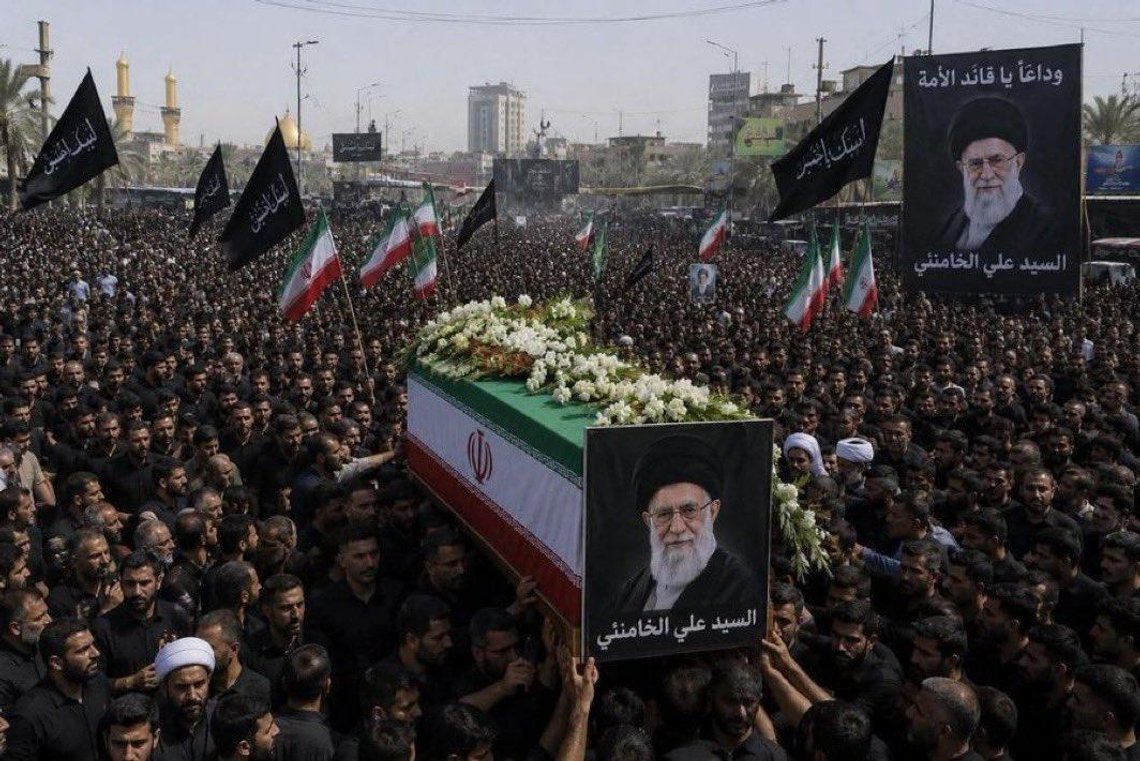


While the parents of thousands of young Iranians who were killed during the demonstrations or executed by the regime were not allowed to bury their own children or hold memorial ceremonies, the Islamic Republic staged an enormous state funeral for Ali Khamenei. The contrast could hardly have been greater.
For years, the families of slain protesters have been threatened, placed under surveillance and denied the opportunity to grieve in peace. At the same time, the regime devoted vast resources to honouring the man who, for decades, bore ultimate responsibility for a system that imprisoned, tortured and executed its own citizens.
The funeral was about far more than the death of one man. It was a demonstration of power and an attempt to show the world that the Islamic Republic still stands strong, that those in power remain united, and that Khamenei was a beloved leader.
The regime had hoped that between 15 and 20 million Iranians, together with a large number of heads of state, would attend. Free buses were provided, public-sector employees were pressured into attending, and participants were offered free transport, food and accommodation. Yet the millions failed to appear. Even the procession in Tehran had to be shortened because there were too few people lining the streets. No heads of state from Europe or North America attended, and several Arab countries also stayed away.
The regime spent enormous sums on the funeral while Iran’s economy is in deep crisis and millions of Iranians lack food and medicine. Instead of demonstrating strength, the funeral became a political humiliation.
Many Iranians chose instead to visit the graves of their own loved ones rather than bid farewell to the dictator.
The funeral also exposed the uncertainty surrounding the succession. Three of Khamenei’s sons appeared publicly, but Mojtaba Khamenei, long regarded as the most likely successor, was absent. This has strengthened speculation about a power struggle and uncertainty within the regime.
At the same time, the funeral demonstrated how fragile the ceasefires and any negotiations with the United States are. The regime’s most ideological supporters appeared carrying red banners of revenge, chanting “Death to America!” and holding placards reading “We Kill Trump”. This illustrates that the real power still lies with the Islamic Revolutionary Guard Corps and the ideological centres of power, not necessarily with the president or parliament. These circles derive their power from conflict, terror and confrontation.
Ali Khamenei did not die as a symbol of resistance to the West, as the regime seeks to portray him. He died as the leader of a religious fascist regime that, for decades, imprisoned, tortured and executed its own citizens. He leaves behind not a people in mourning, but a country marked by fear, poverty and millions of people longing for freedom.
The greatest humiliation was not that the world’s leaders stayed away. The greatest humiliation was that the Iranian people stayed away.
A regime can force people to turn up. But it can never force them to mourn.


