

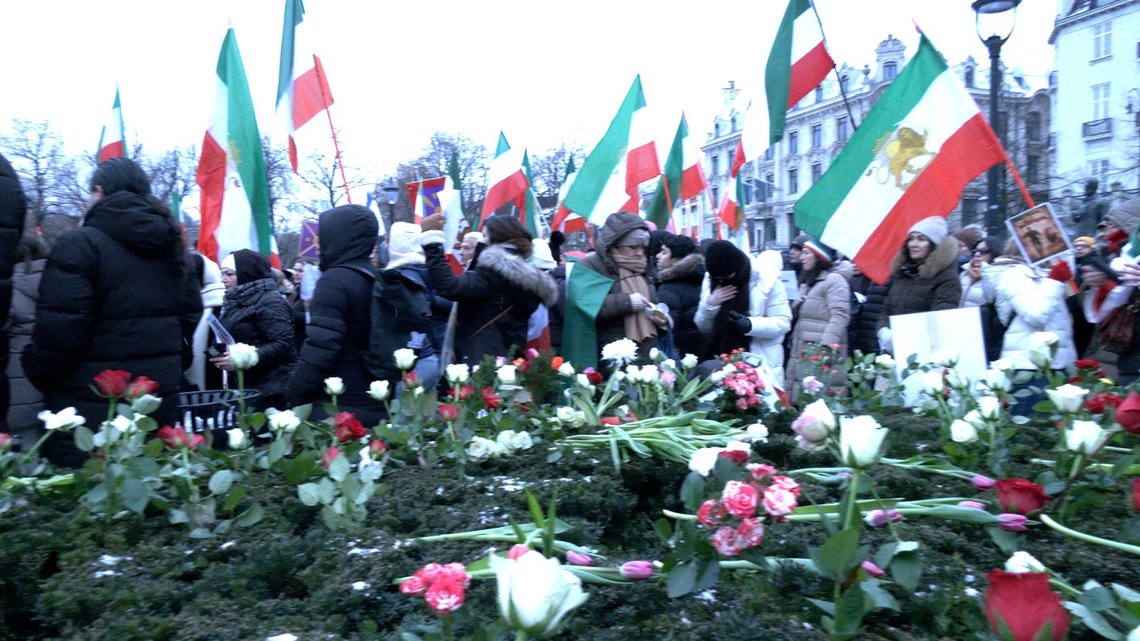
Let Iranians speak for themselves. They know what is happening. They are paying the price.
After 28 December this year, extensive demonstrations began in Iran as a result of extreme inflation. Within hours, this developed into nationwide uprisings against the Islamo-fascist regime. On 8 and 9 January, the regime responded with massacres against peaceful demonstrators in over 400 cities and villages. At the same time, the internet, telephone communications, and all contact with the outside world were cut off in order to conceal the crimes. This was not chaos. This was carefully planned.
A week later, when the internet was sporadically reopened in certain major cities, the truth emerged: tanks driving over people, the wounded removed from hospitals and disappearing, morgues full of dead bodies stacked on top of one another, parents searching for their children and having to pay in order to have their child’s dead body returned.
Nevertheless, Norwegian media, with a few exceptions, have been conspicuously silent. At the same time, panel debates and lectures about Iran are being organised. The halls are filled with Norwegians of good intentions. They wish to understand. They wish to help.
The problem is who is given the platform. The intentions are good, but the result is often analyses at a distance. Instead of Iranians, Norwegian politicians, academic philosophers, journalists based in Lebanon, or non-Iranian commentators are invited to explain Iran to Norwegians. The result is theory, analyses, and safe distance, while people are being killed.
This is like ignoring an acutely ill patient lying in front of you, crying out for help and able to explain what is happening, but instead asking the neighbour how the patient is doing. The patient screams. The neighbour says: “He will manage.”
Around 26,000 Iranians live in Norway. Many are highly educated, Norwegian-speaking, politically experienced, and have family in Iran. Many came here precisely because they fought against the regime. They follow the situation day and night, through Persian-language media, eyewitnesses, and direct contact with their families. It is these people who can tell the Norwegian people what is actually happening in Iran, through images, short videos, testimonies from their own families, and by explaining how Norway and Norwegians can contribute concretely in a situation which in brutality and scope can be compared with the Holocaust in Poland.
History shows that of the 1.7 million Polish victims of Aktion Reinhard, an average of 15,000 Jews were killed each day during the three worst months in 1942. In Iran, 36,500 people were killed in just two nights. According to doctors, eyewitnesses, and leaked reports from the Revolutionary Guard (IRGC), the figures are probably higher. 150 killed school pupils have already been identified. Over 30,000 have lost one or both eyes. The wounded die at home because treatment is denied. 15 doctors have been arrested for having helped them. This is an ongoing massacre.
In 2025 alone, the regime has executed over 2,000 people, four each day, according to Iran Human Rights in Norway. Now the regime is killing its own people for demanding bread, freedom, and dignity.
Iran today is an occupied country. The mullahs and the Revolutionary Guard are waging a war against their own population. For 47 years the people have resisted. The response has been imprisonment, torture, rape, and executions, and until now the West’s economic interests have weighed more heavily than Iranian lives.
Iranians can no longer manage this alone.
Norway received help from outside during the Second World War in order to rid itself of the occupation. Today, Iranians need help from outside in order to rid themselves of the mullahs’ occupation. If the world fails now, the mass graves in Iran will stand as testimony to the moral collapse of the West, as we have seen before – in Rwanda, Cambodia, and Sarajevo.
Therefore: Stop talking about Iranians. Begin to listen to them.
Let Iranians speak for themselves. Let Iranians say how Iran can be helped. Perhaps they are not theoreticians or philosophers, but they are Iranians. It is they who sit alone in the boat, on a dark night, fighting enormous waves in order to reach a safe land called freedom.


