

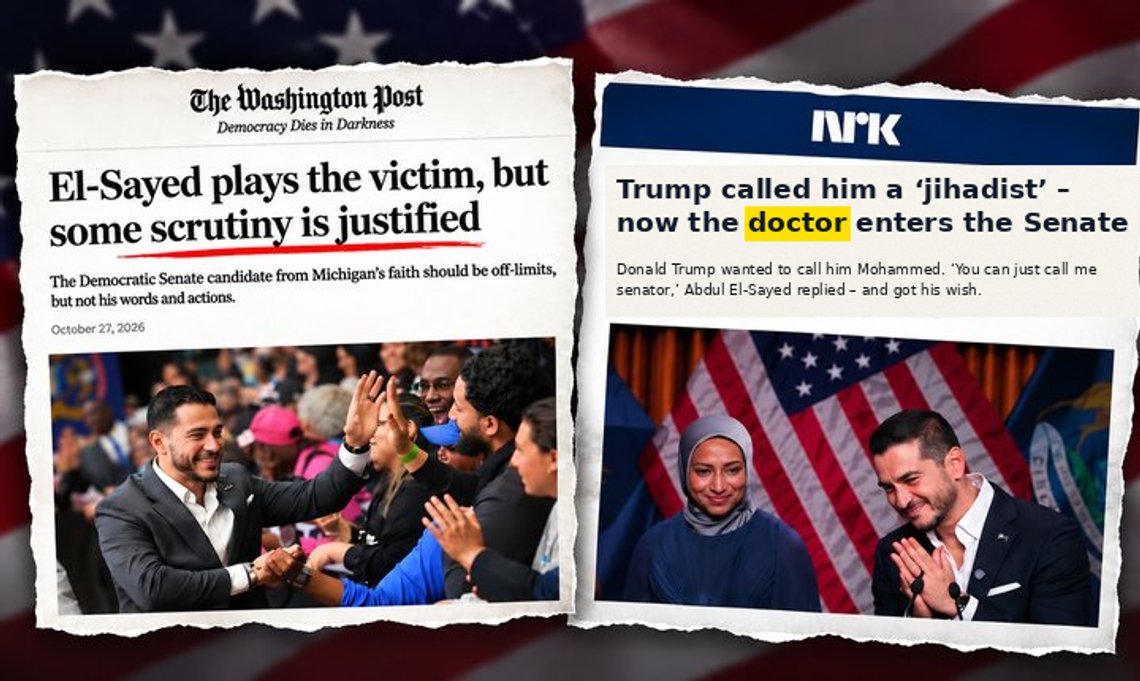


However, we should have avoided using the title ‘doctor’ in the headline, and we are rectifying this, writes NRK’s foreign affairs editor Sigurd Falkenberg Mikkelsen.
The Wikipedia page for the newly elected senator from Michigan, Abdul El-Sayed, has in recent months been quietly stripped of controversial information by a mysterious editor.
This included removal of a paragraph revealing that he has never held a medical licence, the deletion of information about several controversies linked to anti-Semitism, and a downplaying of his relationship with the radical influencer Hasan Piker, who believes that America deserved 9/11.
However far-fetched this may sound, we do not have to look far to find a similar whitewashing of Abdul El-Sayed.
But in this case, it was not a mysterious Wikipedia editor using the pseudonym ‘CopyLeftEverything’ who was behind an organised effort to alter the narrative in the US and influence the election.
Instead, it was Norway’s self-proclaimed news channel NRK, with the help of journalists Sidsel Wold and Anja Strønen.
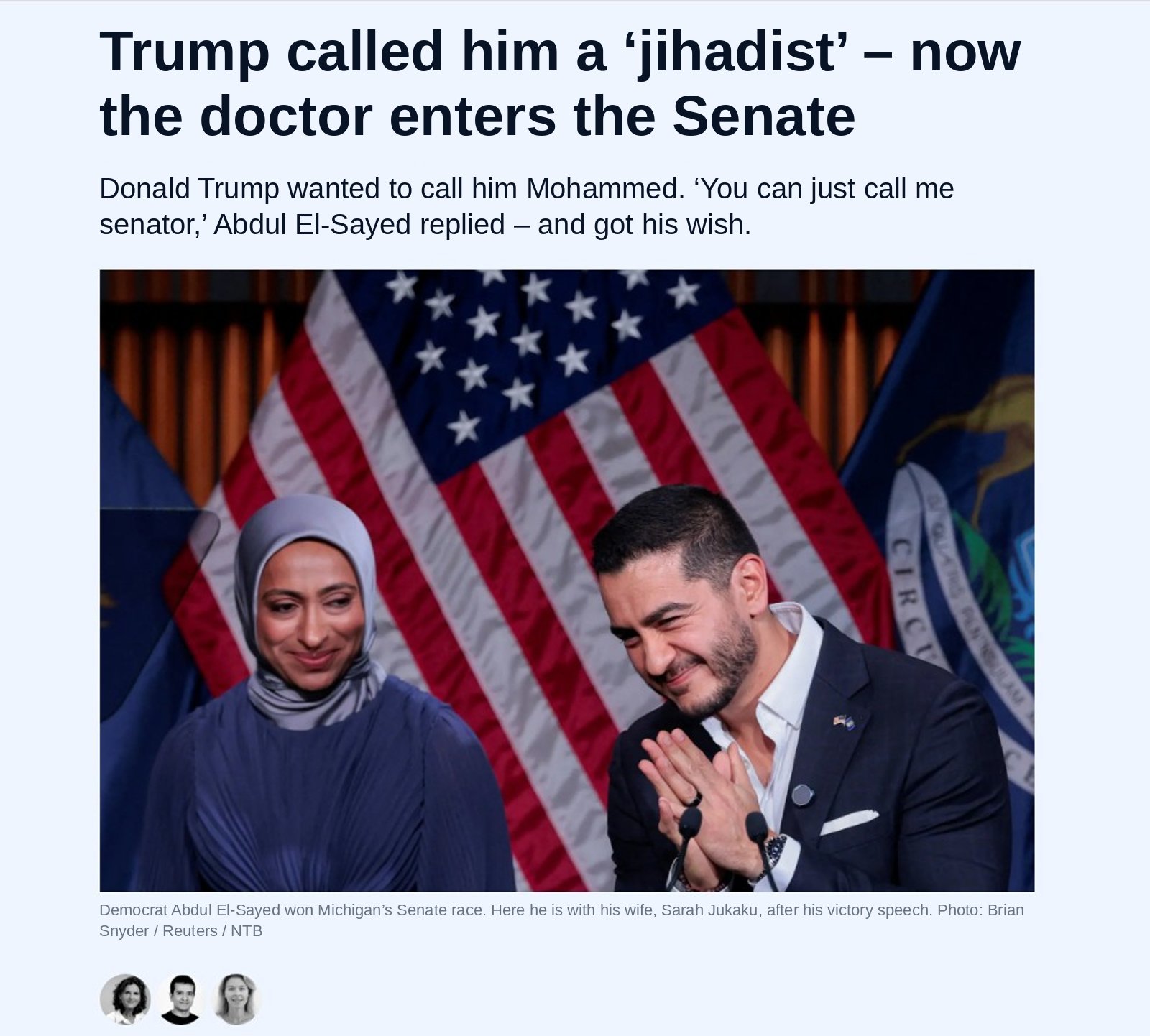
Facsimile with the text translated into English.
And with valuable assistance from a US expert who is helping to shape NRK’s narrative:
– It’s so good to see, because El-Sayed was subjected to one of the nastiest election campaigns in American history. It was extremely racist and Islamophobic on the part of the Republicans,” says Hilde Restad, associate professor at Oslo Nye Høyskole, to NRK.
And this from a woman who belongs to a Norwegian establishment that, for over ten years, has waged one of the most vicious witch hunts ever seen against an American president and his supporters.
NRK portrays El-Sayed as a historical victor who has overcome racism and Islamophobia, whilst his critics are portrayed exclusively as racists and Islamophobes.
Furthermore, it is a boundlessly admiring, unreserved and dishonest tribute, placing great emphasis on his opposition to Israel.
This is highly problematic, given that the American media had spent months investigating and exposing countless incriminating details about him. And it was not just conservative media outlets that were behind this.
CNN, Politico and The Washington Post published critical revelations which NRK completely ignored in its glorifying portrayal of El-Sayed.
I have also searched NRK’s website and used KI to investigate whether the channel has mentioned these controversies in other articles. So far, I have found nothing.
NRK admits mistakes, defends its coverage
Whilst working on this commentary, I sent a number of critical questions to the journalists and Hilde Restad.
I wanted to give them the opportunity to respond to the criticism before publication.
The reply came from NRK’s foreign affairs editor, Sigurd Falkenberg Mikkelsen:
The article you refer to must be viewed in the light of his and the Democrats’ sensational election victory. It is not a comprehensive review of his life and work.
However, we should have avoided using the title ‘doctor’ in the headline, and we are rectifying that.
I thanked Falkenberg Mikkelsen for his reply and for correcting the headline. I’d actually never expected that.
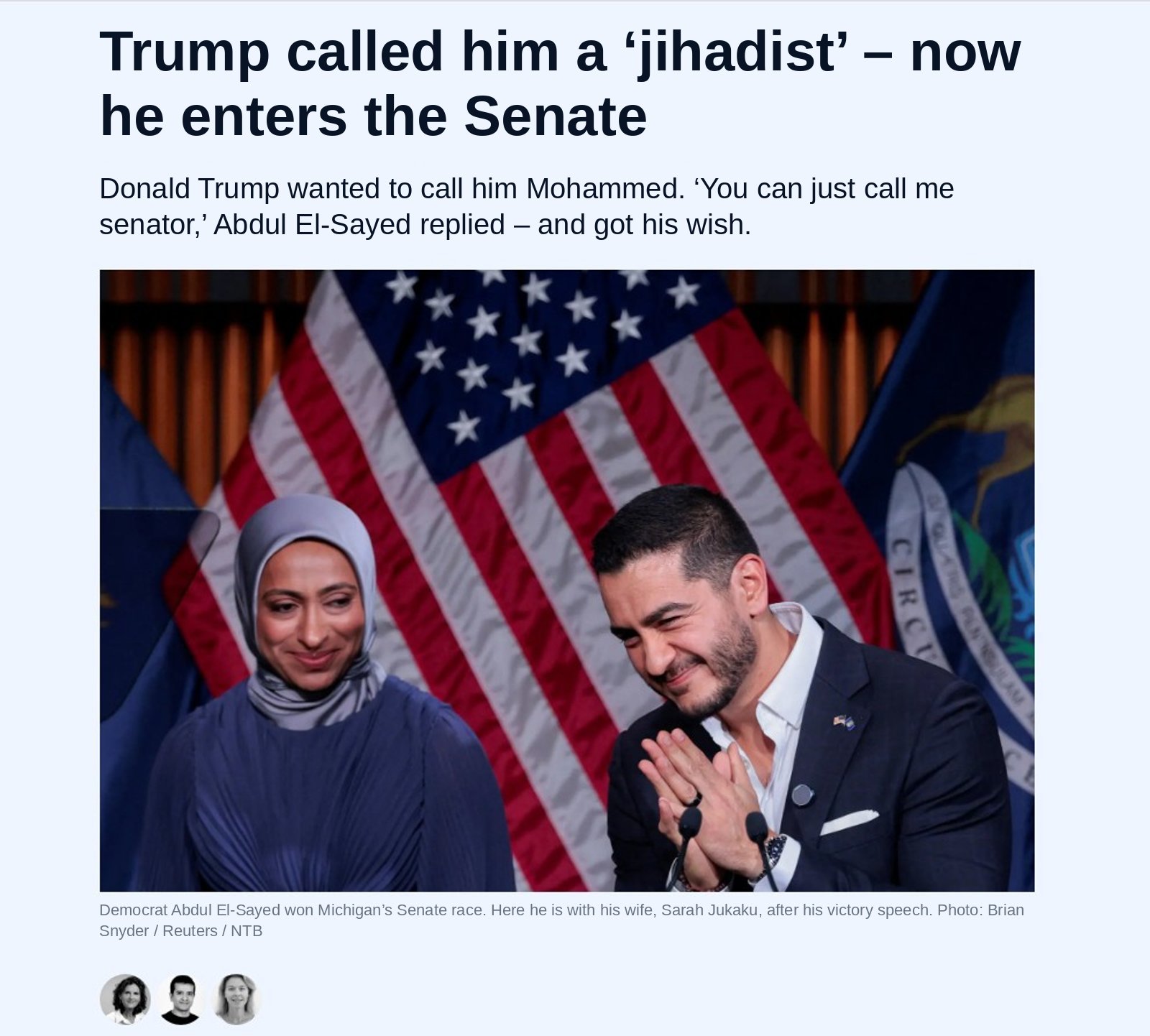
Facsimile with the text translated into English.
I wrote that I had hoped to receive a reply from the journalists and Hilde Restad as well, but that I greatly appreciated him taking the time to reply.
No one expects a comprehensive account of El-Sayed’s life and work. But what is written should be the truth, the whole truth and nothing but the truth. And that was certainly not the case.
In my view, NRK is once again showing its true colours and the attitudes that have permeated the channel for many years: the glorification of Islam and Muslim politicians, anti-Israeli attitudes and an extremely one-sided and unbalanced coverage of American politics.
The Democrats’ battle against El-Sayed
NRK’s journalists repeated Hilde Restad’s account to hammer home the message:
During the election campaign, he has had to endure vast amounts of racism, Islamophobia and accusations of sympathising with terrorists and the Muslim Brotherhood.
However, some of the harshest accusations against El-Sayed came from his own fellow Democrats, whilst he also faced strong criticism from Black and Jewish voters who have traditionally supported the Democrats.
If we follow the logic of Restad’s and NRK’s account, these Democrats must therefore also be racists and Islamophobes.
The Washington Post published a highly critical article about El-Sayed’s attacks on female Democratic politicians.
Congresswoman Hillary Scholten accused him of gross sexism following derogatory remarks about, amongst others, Haley Stevens and Michigan Governor Gretchen Whitmer.
El-Sayed rejected the accusations and claimed instead that the criticism played on racist stereotypes about men from the Middle East. An explanation NRK would probably have nodded in agreement with.
The conflict became so bitter that the Democrat Haley Stevens, who lost the nomination race to El-Sayed, withdrew her support for him just two days before the election and threw her weight behind the Republican Mike Rogers.
This was a political sensation that NRK completely omitted from its coverage of his election victory. And it didn’t stop there.
The Washington Post reported that El-Sayed was struggling to win the trust of Black voters in Detroit, who felt he showed too little interest in their local communities.
At the same time, the Michigan Democratic Jewish Caucus demanded that he address the damage the election campaign had caused to relations with the state’s Jewish community.
Both The Guardian and CNN reported on the criticism levelled at El-Sayed for ignoring Black and Latin American voters and their political interests.
The Guardian described how he did not even address Black voters’ concerns when he was directly challenged on them during a campaign rally.
CNN reported on Democratic leaders’ fears that he had alienated Black voters.
But perhaps most revealing was a live CNN interview on election day, in which a voter who had never before voted Republican explained why he chose Mike Rogers over El-Sayed: ‘Because I’m against hate.’
Given the state broadcaster’s focus on minorities, its glorifying support for a politician who ignores Black voters and is only interested in his own constituency is striking.
Politico revealed the story behind the medical title
In the original article, NRK devoted considerable attention to El-Sayed’s education and specialisation, writing, amongst other things:
The newly elected senator from Michigan is a trained doctor and knows how to stand her ground.
This has now been changed to: The newly elected senator from Michigan has a medical background and knows how to stand her ground.
However, the left-leaning Politico had already revealed how El-Sayed had repeatedly presented himself as a doctor and actively used the title of doctor during the election campaign, despite never having completed specialist clinical training or obtained a licence to practise medicine in Michigan or New York.
His clinical experience was largely limited to four weeks’ practical training during his medical studies. Several Democratic strategists criticised the portrayal as misleading, and Politico referred to legal provisions restricting the use of medical titles that give the impression of authorisation.
“It’s strange to highlight that as part of one’s background when one has never actually practised as a doctor,” Democratic strategist Adrian Hemond told Politico.
It is even stranger that a tax-funded news channel on the other side of the Atlantic is portraying him as if he had actually walked around in a white’s coat. But it’s not surprising.
Drag them through the mud and suffocate them
Whilst NRK portrays El-Sayed as a man who ‘knows how to fight back’ in response to attacks from Trump and the Republicans, Politico reported on his own violent rhetoric against political opponents.
El-Sayed faced fierce criticism from his own party colleagues after Politico publishedan audio recording from a closed-door donor meeting. In it, he threatened to challenge Democrats such as Senator John Fetterman in the primaries and stated that the ideal scenario would be to ‘put a monster on a stake’, so that the rest would get the message.
Congresswoman Hillary Scholten condemned El-Sayed’s violent and vulgar rhetoric. Gun control campaigners Shannon Watts and Fred Guttenberg also reacted strongly. The latter urged voters to support El-Sayed’s opponent, Haley Stevens. Several Democrats, including Neera Tanden, interpreted the statement as an attack on Stevens.
Politico reported that this was not the first time El-Sayed had used violent imagery in his political rhetoric. During a previous campaign rally, he declared: – When they stoop low, we don’t rise above it. We drag them down into the mud and suffocate them.
Deleted posts and YouTube videos
Then there is CNN, which revealed that Abdul El-Sayed had deleted thousands of old social media posts, including posts supporting the radical ‘defund the police’ movement. In 2020, he repeatedly called for police budgets to be cut and funds to be redirected to other public services.
He also described the police as “standing armies that we deploy against our own people”.
In 2025, El-Sayed claimed that he had “never, ever” called for cuts to police funding. However, CNN found audio recordings in which he explicitly stated that the police should receive less money. When CNN confronted him with the statements in 2026, he accused the channel of engaging in “clickbait”.
CNN’s KFile also revealed that over a hundred videos on Abdul El-Sayed’s YouTube channel were apparently set to private before he launched his election campaign. In one video, he floated the idea of replacing the constitutional right to bear arms with a right to healthcare. In another, he dismissed Republican concerns about security at the US southern border.
NRK uncritically repeats El-Sayed’s political mantra: His mantra has been: ‘Money out of politics, money in your pocket and healthcare for all.’
Behind these fine words also lies his support for defund the police, despite the fact that, according to CNN, 82 per cent of voters surveyed in Michigan had a positive view of the local police.
But the activists at Marienlyst seem more concerned with hailing their political favourites than with what their policies actually mean for Americans.
WP: A masterclass in playing the victim
But perhaps the most striking contrast comes, of all places, from The Washington Post, where the commentator Carine Hajjar challenges the very narrative of victimhood embraced by NRK.
Hajjar, a former columnist and member of the editorial board at the ultra-liberal Boston Globe, begins by describing the victim role as a powerful political tool, and El-Sayed’s behaviour as a masterclass in how it is exploited.
She then reviews some of the most damning and disturbing controversies surrounding El-Sayed.
Among them are El-Sayed’s links to the Muslim Brotherhood. When confronted with these or challenged to distance himself from the organisation, he dismisses the criticism as Islamophobia.
Hajjar rejects the notion that such questions automatically constitute Islamophobia. She points out that El-Sayed’s half-sister had previously spoken about the family’s links to the Brotherhood.
Even more damning is the revelation from the right-wing Washington Free Beacon, to which Hajjar refers. According to the newspaper, in 2012 El-Sayed supported Egypt’s Islamist president Mohamed Morsi in a letter calling for purges within the media and the police. Shortly afterwards, the Morsi regime cracked down hard on Egyptian journalists.
This was not about El-Sayed’s religion, Hajjar emphasises, but about his political judgement and support for an Islamist government.
She also addresses El-Sayed’s close relationship with the radical influencer Hasan Piker. In addition to stating that the US deserved 9/11, Piker has made controversial statements about Hamas, Hezbollah and American Jews.
Hajjar criticises El-Sayed for voluntarily associating himself with a person whose extremist rhetoric is so well documented.
Hajjar also highlights El-Sayed’s views on Israel, which he has described as an illegal apartheid regime, and his reluctance to recognise the country as a Jewish state. NRK, on the other hand, appears almost as a mouthpiece for his anti-Israel message:
El-Sayed campaigned against support for Israel and against the pro-Israel lobby AIPAC.
He believes that American taxpayers’ money “should not be sent to a foreign government that kills children and is guilty of genocide.” Instead, tax money should be invested in schools, public health and infrastructure at home in the US.
NRK also highlights Haaretz’s claim that El-Sayed’s victory shows that opposition to Israel is no longer an obstacle in American swing states, despite the fact that AIPAC reportedly spent nearly 40 million dollars on his opponents.
But perhaps the most serious controversy concerns El-Sayed’s reaction to the terrorist attack on the Temple Israel synagogue outside Detroit, where around 140 people, mainly children, were inside the building.
After a terrorist drove a car filled with petrol and fireworks into the synagogue, El-Sayed linked the attack to Israel’s military operations in Lebanon and stated that ‘wounded people wound others’.
Michigan’s Democratic Attorney General, Dana Nessel, accused him of excusing domestic terrorism, whilst Jewish Democrats reacted strongly. El-Sayed later apologised for the statement and claimed he was merely trying to put the attack “into context”.
On 7 April, however, El-Sayed repeated the message on a press conference alongside Hasan Piker.
But is it really necessary to put an attempt to massacre Americans into context? asks Hajjar. She concludes that these are legitimate questions for anyone wishing to become a US senator, and that religion has nothing to do with the matter.
An organised effort to change the narrative
The researcher who exposed the whitewashing of El-Sayed’s Wikipedia page warned of the consequences when Google and AI systems use Wikipedia as a source and rely on its content being objective and accurate.
Yehuda Teitelbaum told New York Post that this was indeed an organised effort to change the narrative in the US and promote specific narratives and ideas that are not truthful.
Similarly, the Norwegian people trust NRK to be objective and accurate. Instead, they are subjected to an organised effort to alter the narrative and promote ideas that are not truthful.
Ironically, the Wikipedia editor’s pseudonym, ‘CopyleftEverything’, fits NRK and large sections of the Norwegian media perfectly. They copy virtually everything from the US left-wing media.
But when the same media outlets expose El-Sayed’s controversies, NRK does what it does best: it lies by omission.
Questions for NRK and Hilde Restad
Before publication, I sent NRK and Hilde Restad a series of questions regarding their coverage of Abdul El-Sayed. They are reproduced here in abridged form. The background to this was revelations and critical coverage in left-leaning media outlets such as CNN, Politico and The Washington Post, which NRK had omitted.
Questions for NRK:
Were the journalists aware of the extensive revelations about El-Sayed in the American media? Why were none of the controversies mentioned?
Why did NRK refer to El-Sayed as a ‘doctor’ when Politico had revealed that he never completed his clinical specialisation or obtained authorisation to practise medicine?
Did NRK investigate the allegations regarding El-Sayed’s links to the Muslim Brotherhood, or were they automatically dismissed as racism and Islamophobia?
Why was his opposition to Israel and AIPAC given so much coverage, whilst criticism of his statements on Israel and his links to Hasan Piker was omitted?
Why did NRK choose such a consistently positive portrayal of a politician who has faced fierce criticism from both Democrats and Republicans? Do you consider this to be balanced journalism?
Questions for Hilde Restad:
You told NRK:
‘El-Sayed was subjected to one of the ugliest election campaigns in American history. It was highly racist and Islamophobic on the part of the Republicans.”
On what basis do you make the claim that it was “one of the nastiest election campaigns in American history”? Which election campaigns are you comparing it to?
CNN, Politico and The Washington Post have reported on countless controversies surrounding El-Sayed. Do you believe the criticism is justified, or is this also racism and Islamophobia?
NRK is repeating your strong accusations against the Republicans without explaining what the criticism was actually about. Do you think this gives readers a fair picture?
Final question for everyone:
Why does NRK portray El-Sayed’s election victory as a historic triumph, whilst keeping Norwegian readers in the dark about the countless controversies that have made him so controversial in the US? Why, instead, are they presented with what I consider to be a glorified and whitewashed portrayal?


