



Anders Magnus is a journalist I’ve always had a certain soft spot for, particularly since he retired and broke free from the state broadcaster’s stifling grip. He has flourished as a columnist for Nettavisen, producing many excellent and critical commentaries, and has occasionally – and quite unexpectedly – shown journalistic courage bordering on the politically incorrect. His recent contributions to the immigration debate are not hard to agree with, even though they come well past the deadline and bring nothing new to a debate we have been writing about for years on the pages of Document.
But when it comes to Donald Trump, Magnus, through his reporting as NRK’s UScorrespondent, so thoroughly laid bare how his own prejudices and inability to distinguish between the man and his politics obscure context, contradiction and objective journalism whenever it deviates from the official narrative. When it comes to Trump, he finds himself in the same sad, TDS-driven echo chamber as Tove Bjørgaas, Christina Pletten, Fredrik Græsvik, Kristoffer Rønneberg and Anders Gievær, and the army of self-appointed Norwegian US experts.
The unanimous consensus on just how morally depraved, stupid and dangerous Trump is has evidently bolstered journalistic self-confidence, for now bombastic claims are being hurled haphazardly in all directions about Trump, Putin, Xi and anyone else who might have objections to the narrative championed by the Democratic Party, the so-called liberal media and the political elite in Europe regarding the war in Ukraine, the war against Iran and the shifts in the balance of power between the superpowers.
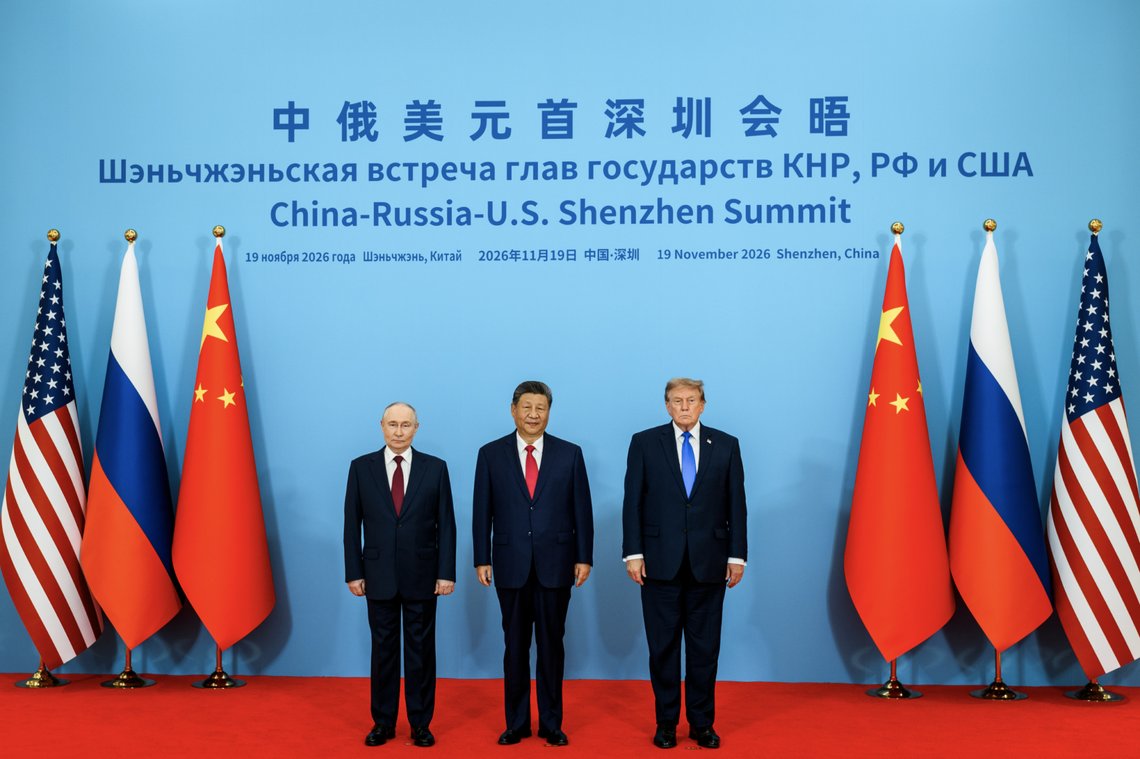
For Magnus now believes that Putin and Xi have plans to divide the world between them, and that their real agenda is to weaken the US as much as possible. In Nettavisen on Saturday, Magnus writes that the two have a willing accomplice in Donald Trump, who is so stupid that he is letting it happen.
“Donald Trump was supposed to defend democracy and the Western world. Instead, he has kowtowed to the dictators Vladimir Putin and Xi Jinping,” writes Magnus. The commentary is intended to express the writer’s ‘own opinions’, but Magnus has taken the story, cut and pasted it from ‘liberal’ American anti-Trump media outlets such as CNN, the New York Times and The Nation. Quick work, but cheap and poor journalism.
What Magnus writes is more or less a carbon copy of what Sasha Abramsky wrote in an opinion piece in The Nation on Friday, the day before Magnus’s commentary in Nettavisen. She described the summit as a foolish spectacle in which Trump “was bending over backward to stroke the egos of the genuine autocrats whose company he so clearly prefers, throwing away America’s remaining claim to lead the free world, and marketing it as a new Yalta for dividing spheres of influence.”
This is where Anders Magnus’s commentary on the Shenzhen summit completely falls apart. It collapses both because it is more or less pure plagiarism, and indeed plagiarism of something that appears first and foremost to be a political commentary on US domestic politics. And it collapses due to its lack of relevant context and coherence, amounting to nothing more than a newspaper column of unsubstantiated personal characterisations and assertions.
The story of the foolish president who allows two autocrats to divide the world between them is quite simply too ridiculous even for itself. Anyone who has taken the trouble to listen to Vice-President JD Vance’s speech at the Munich Security Conference in February 2024, and Secretary of State Marko Rubio’s speech at the same venue in February this year, will realise, from both form and content, that there are well-considered strategic assessments underpinning the Trump administration’s foreign policy.
Admittedly, they do not align with Europe’s policies on immigration, energy and globalisation, nor with its unrealistic faith in a liberal international legal order, but they reflect the US’s long-term realpolitik interests in a rapidly changing world where realpolitik prevails.
The summit was not a sell-out of the West, but a strategic response to the international institutions which, for decades, have proved to contribute neither to peace nor to development. The joint declaration focused on reforming the UN, keeping the politicised International Criminal Court (ICC) in check, securing the world’s energy supply, reducing the risk of nuclear war, ensuring that artificial intelligence is not used for military purposes, and contributing to economic stability.
These are all key policy areas in which the West’s globalisation policy – to which Europe continues to cling – has proved to be a failure. It was the three superpowers – which together possess the overwhelming majority of the world’s nuclear weapons and account for the bulk of technological development, and two of which are the main drivers of global economic development – that agreed to engage in dialogue and establish a framework. Engaging in dialogue is a prerequisite for diplomacy, and the opposite of ‘dividing the world’.
What is remarkable about the meeting, of course, is that Europe was not present. This is hardly surprising, given that Europe’s share of global GDP has fallen from around 29 per cent in 1980 to 14 per cent – less than half – in 2026.
This is hardly surprising given that economic growth and technological development are taking place in China and the US, whilst Europe is stagnating. A Europe that has painted itself into a corner with destructive immigration policies and ruinous climate, energy and globalisation policies, and which has exported large parts of its own industrial base and dismantled its own defence, whilst European leaders are adding fuel to the fire to allow the war in Ukraine to continue escalating. No wonder they think Trump is stupid!?
The fact that Anders Magnus has failed to grasp the context of the meeting is evident from his peculiar observations regarding China’s ambitions. These may be numerous, and they may be expansive. But when Magnus writes that ‘to weaken the US, China must also weaken Europe. Xi Jinping is exploiting the Russian attack on Ukraine’, he is clearly way off the mark. There is little substance to that line of reasoning. Even though Europe is in decline, it remains a very important market for China.
When Magnus writes that ‘Europe has been weakened both economically and industrially: by high expenditure on supporting the Ukrainians, by high energy costs, and by cheap, state-subsidised Chinese industrial products flooding the continent’, he is absolutely right.
But he skilfully omits to mention that this is a situation Europe has brought upon itself, both in terms of the energy crisis, the export of industry and jobs to China and other low-cost countries, and the expenditure on keeping the war in Ukraine going rather than helping to bring about a negotiated solution to the conflict.
And when Magnus criticises China for buying oil and gas from Russia, and claims that China is thereby helping to keep the war going, he overlooks the fact that China, the non-aligned countries and large parts of the rest of the world have a different view of the causes of the war in Ukraine, and are more than happy to buy oil and gas from Russia at 20 per cent below market price. And he ignores the fact that several EU countries have themselves continued to import Russian gas, and are in fact increasing their imports.
Context is important, but clearly not when one is pushing a predetermined narrative. The critics’ Yalta narrative is a misrepresentation, a whitewash and pure nonsense.
The fact that the summit lays the foundations for sovereign superpowers to engage in dialogue and cooperate for mutual benefit, without going through the international institutions that have proven ineffective, can hardly be described as anything other than pure realpolitik and a step forward.
The meeting in Shenzhen was, of course, more symbolism than substance. But it was a start. And symbolism is important in any diplomacy. And, after all, the three major nuclear powers are talking to one another. That must be better than them not doing so, surely!?
It is also not only entirely possible but likely that all three are trying to maximise their own interests. The great powers have always done so. It simply becomes more apparent when the struggle for interests and power comes to a head, as in the times we are living in now.
But to present this as a foregone conclusion about the stupid American who lets autocrats divide the globe amongst themselves is quite simply too silly. It’s a ‘newspaper hoax’: a fabricated or heavily distorted story that spreads because it fits the existing narrative.
Anders Avisand, this is too bad. Pull yourself together!


