



For decades, the British and other Westerners have been labelled as oppressors and have gradually also faced demands for compensation for the transatlantic slave trade.
One country sees things differently, and now the African nation of Malawi is planning to build a museum honouring the British Empire, because it put an end to the most extensive slave trade of them all: the Arab slave trade.
The Arab slave trade: 1,200 years
Malawi is one of the countries that suffered under the brutality of Arab slave traders. Its inhabitants were captured by rival tribes, sold to Arab slave traders and sent to the Middle East. This 1,200-year-long trade in human beings is often overshadowed by Europe’s transatlantic slave trade, even though the Arab trade lasted for nearly a thousand years longer.
The British were liberators
– The British were not colonisers; they were liberators. The historical monuments we have, which we preserve, are linked to the British. If you look at how the slave trade was ended in Malawi, it is thanks to the British, says Moses Mkumpha to The Telegraph.
Museum of the forgotten Arab slave trade
Mkumpha works on Malawi’s state-funded project to preserve colonial buildings. More specifically, a museum dedicated to the forgotten Arab slave trade, which includes buildings associated with this trade in human beings. These range from markets and mosques linked to the Arab slave trade to British forts built during the colonial era to protect Africans from marauding slave traders.
The major British newspaper has also spoken to the project leader, Dr. Oris Malijani, who told *The Telegraph* that Malawi’s plans would help to correct misconceptions about history, saying: “Slavery in East and Central Africa has been all but forgotten; it is not discussed. We must tell the world about it», he says.
Wants the British to apologise
Meanwhile, King Charles of the United Kingdom has recently been in the Caribbean, speaking about how he mourns that shameful chapter, transatlantic slavery. Prime Minister Andy Burnham followed this up by saying that he is “open” to the possibility of the UK formally apologise for its role in the transatlantic slave trade. However, he has so far rejected financial reparations. Calls for both an apology and reparations have come from both Caribbean islands and countries in Africa. Both the Church of England and the British Museum have publicly apologised for the transatlantic slave trade.
African slaves were captured by hunting parties, gathered in dusty palisades along the coast, and shipped as human cargo by the sultanates of Arabia. These sultanates not only traded with Europeans to send slaves across the Atlantic, but also, not least, engaged in large-scale trade with their own people. This entailed a perilous and extremely deadly journey across the Sahara.
David Livingstone wanted to put an end to the slave trade
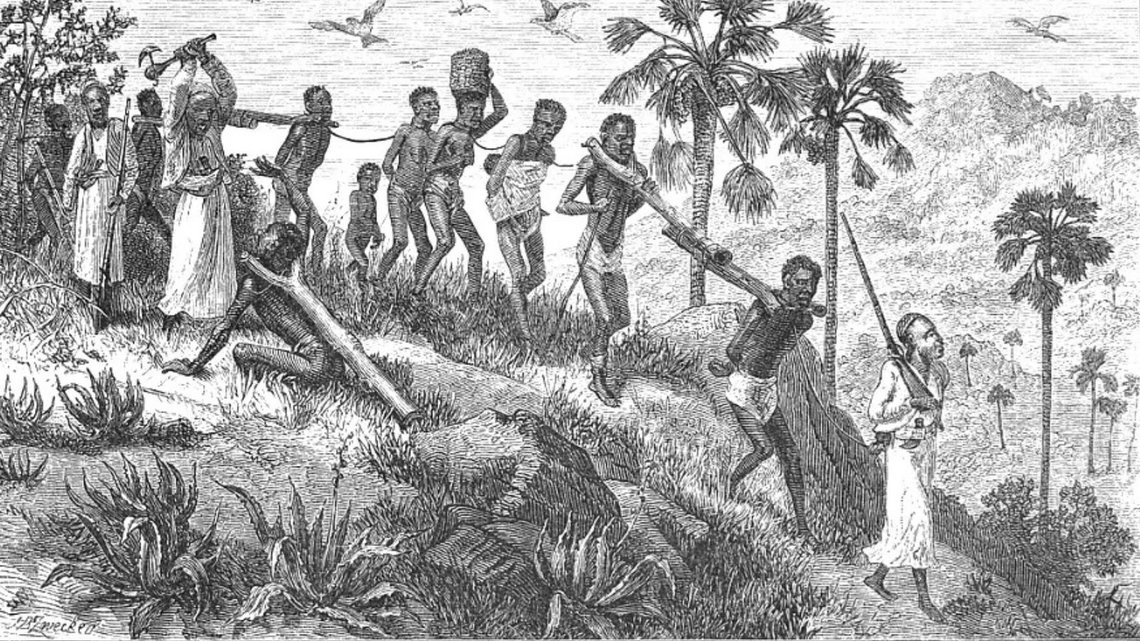
The Arab slave trade was described as the ‘trade of hell’ by David Livingstone, the Scottish explorer and missionary, who witnessed it at first hand. The image at the top of this article is an old engraving based on Livingstone’s own sketches. He also described the incident in his own words.
On 19 June 1866, Livingstone wrote:
‘We passed a woman tied by the neck to a tree and dead; the local people explained that she had been unable to keep up with the other slaves in a group, and her master had decided that she should not become the property of anyone else if she recovered after resting for a while… we saw others tied up in a similar manner… the Arab who owned these victims was furious at having lost his money because the slaves could not march, and vented his anger by murdering them.”
The Scotsman David Livingstone is often referred to as a missionary, but he is said to have converted only one person to Christianity – an African chieftain – who, in turn, did indeed convert many of his own people. Livingstone advocated the establishment of trade and Christian mission work in Central Africa, but his primary mission was the abolition of the African slave trade. His motto—now engraved on the statue at Victoria Falls—was ‘Christianity, trade and civilisation’, a combination he hoped would provide an alternative to the slave trade and give Africans dignity.
Among other places, Livingstone spent time in the Malawi region during one of his many expeditions in Africa. Malawi has a population of around 21 million today, the vast majority of whom—over 82 per cent—are Christians.
There is also a slavery museum in Zanzibar
The island of Zanzibar, just north of Malawi, was home to one of the very largest slave markets over the centuries, and now has its own museum. From a report:
“Slaves – men, women and children – were captured from the interior regions of Tanzania, Kenya, Malawi and even as far away as the Congo. They were forced to march for weeks towards the coast, enduring hunger, disease and extreme cruelty. Those who survived were crammed into boats and transported to Zanzibar, where they were sold at the island’s notorious slave market.
Most of the slave trade in Zanzibar was controlled by Arab merchants, mainly from Oman. Sultan Seyyid Said, the ruler of Oman, moved his capital to Zanzibar in 1840, turning the island into a powerful trading empire centred on clove plantations, ivory and the slave trade. Slaves were used to work on the spice plantations that made Zanzibar one of the richest islands in the region. Others were sold to buyers from Persia, India and the Middle East, where they became domestic servants, labourers or even concubines.»
Or sex slaves, as they are also known.
We have not yet mentioned the practice of castrating African men who were to become slaves in Islamic countries. This was an extremely deadly practice.


