

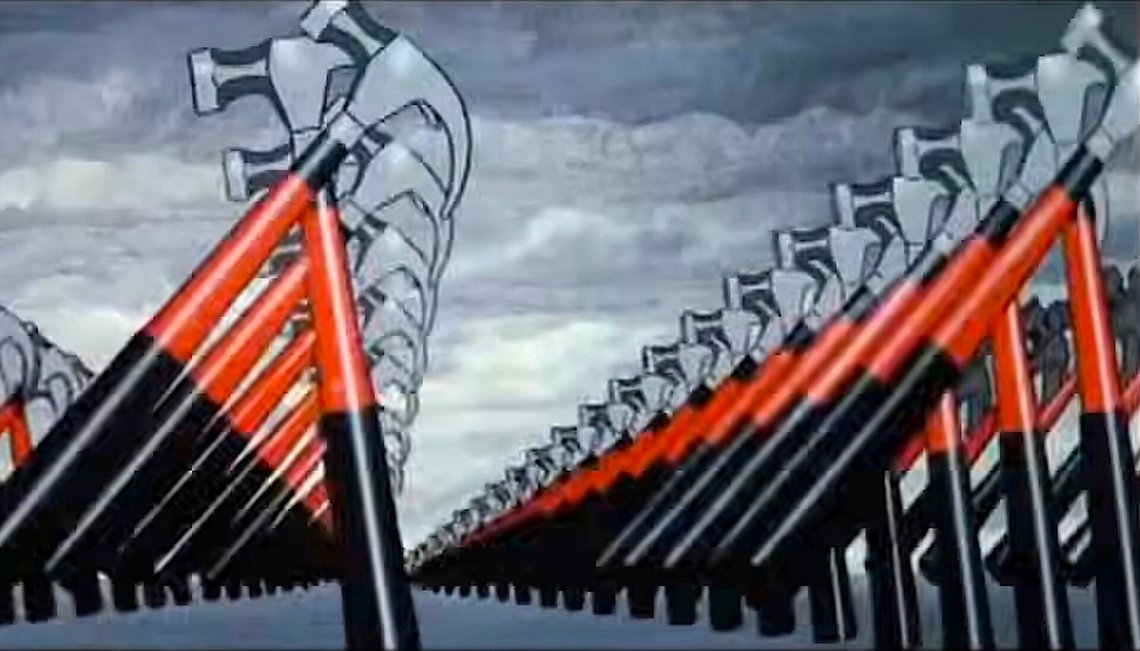


We now have a state that is increasingly keen to protect us from ourselves. The most astonishing thing is how well we seem to be coming to terms with this arrangement.
The Norwegian Public Roads Administration has come up with something new. Under the appealing term ‘zero-emission zones’ a general legal basis is proposed for the automatic monitoring and enforcement of traffic regulations. Other offences may also be covered at a later date through regulations.
That’s rather clever. First, you secure the legal authority. Then you can work out what else it can be used for.
The car’s owner can be held liable for payment even if someone else was driving. If you appeal against the fine, late payment interest can still start to accrue.
An absolutely splendid arrangement. Especially for the authorities, who can both impose the fine and collect the money.
There is something almost touching about the Norwegian state’s care for its subjects. It wants to protect us, bring us up, finance us, correct us and, ideally, also tell us what we should think about it all.
And we let it carry on.
We live in one of the world’s richest countries. Yet an ever-expanding apparatus of bureaucrats, inspectors, advisers and other publicly funded guardians is required to keep this little kingdom running. The OECD notes that public expenditure, measured against the mainland economy, is the highest amongst member countries.
One might think that such a costly administration would at least have made us exceptionally self-reliant.
The opposite, however, seems to be the ambition.
The state has, in fact, developed an almost biblical ability to hand out gifts it has not produced itself. First, the money is collected through taxes and duties. It is then distributed again as ‘support’, ‘grants’ and ‘aid packages’, often accompanied by a smiling minister explaining just how much the government is now giving.
Giving?
It’s our money, for goodness’ sake. Or assets derived from our shared natural resources and accumulated wealth.
The joy of giving is great. Especially when others are footing the bill.
And as if our domestic bureaucracy weren’t enough, we’ve enlisted the regulatory factory in Brussels to help us with the rest.
Norway has twice rejected EU membership. Nevertheless, thousands of EU legal acts have found their way into Norwegian law and public administration through the EEA Agreement. We have no voting rights when the EU adopts them, but we do get to help implement the EEA-relevant rules here at home.
That is, after all, a form of participation.
The 2024 public EEA report highlights a very low level of knowledge about the EU and the EEA amongst the population, whilst also describing a democratic deficit. Nevertheless, the agreement’s solid democratic foundation is emphasised.
Right. But how informed is this support, really?
We have developed a peculiar notion that any decision passed by the Storting is thereby an expression of the will of the people. The fact that the decision may be the result of horse-trading, the manoeuvring of minority governments and political compromises that hardly any voter recognises seems less significant.
Democracy is in order, formally speaking. So the people must be satisfied.
Gro Harlem Brundtland stated in 2018: ‘We are in the process of losing control over what people are being told.’
She spoke of ‘misinformation’. An absolutely marvellous word.
For who actually decides what is false? Provable untruths? Inconvenient facts? Divergent interpretations? Or views that have not yet received the seal of approval from those who currently administer the truth?
There is, of course, a difference between a lie and a difference of opinion. But when these are conflated, ‘misinformation’ becomes an exceptionally handy concept for those who would rather avoid being contradicted.
The press ought to be a natural counterbalance. However, in the 2026 Media Survey, 54 per cent of the journalists surveyed placed themselves to the left of the political centre, compared with 19 per cent to the right.
That does not automatically make them bad journalists. But one is entitled to wonder just how broad the diversity of opinion really is when those who select the news themselves represent such a skewed political spectrum.
The watchdog need not be bought and paid for. It is enough that it has found itself a cosy spot in front of the fire and has gradually come to think that the masters are actually quite nice people.
Meanwhile, we are raising a generation with access to more information than anyone before them, but not necessarily better equipped to understand it.
We have never had more educational plans, learning objectives and strategies for skills development. Yet Norwegian pupils’ reading and maths skills continue to decline. Perhaps we should try a little more knowledge and a little less attitude-building? Surely there must be limits to how many correct opinions one should learn to hold before one has learnt to read properly.
Outside the classroom, algorithms are taking over. We scroll, like, share and let ourselves be entertained to death. Complex questions are reduced to emotionally charged moments. And now we’ve got artificial intelligence to help us with our thinking as well.
It could become rather convenient.
But perhaps what is truly worrying is our own docility.
The more responsibility the state takes on, the less the citizen is expected to bear. And the less responsibility the citizen is used to bearing, the easier it becomes to justify new interventions.
We protest a little, shrug our shoulders and pay up. Then comes the next tax, the next regulation and the next well-intentioned intervention.
We Norwegians are proud of the Constitution, democracy and our tradition of freedom. We are the descendants of people who braved the sea, built this country and insisted on the right to govern themselves.
Today, we find ourselves in a situation where more and more of our lives are to be regulated, recorded, taxed and monitored. Often by people who assure us that it is all for our own good.
The state is no benefactor that hands out freedom on application. Politicians are our elected representatives, not our superiors. Bureaucracy exists to serve the citizens, not the other way round.
That should be self-evident.
But perhaps we do not need anyone to take our freedom away from us. We seem to be doing a rather excellent job of that ourselves.


