

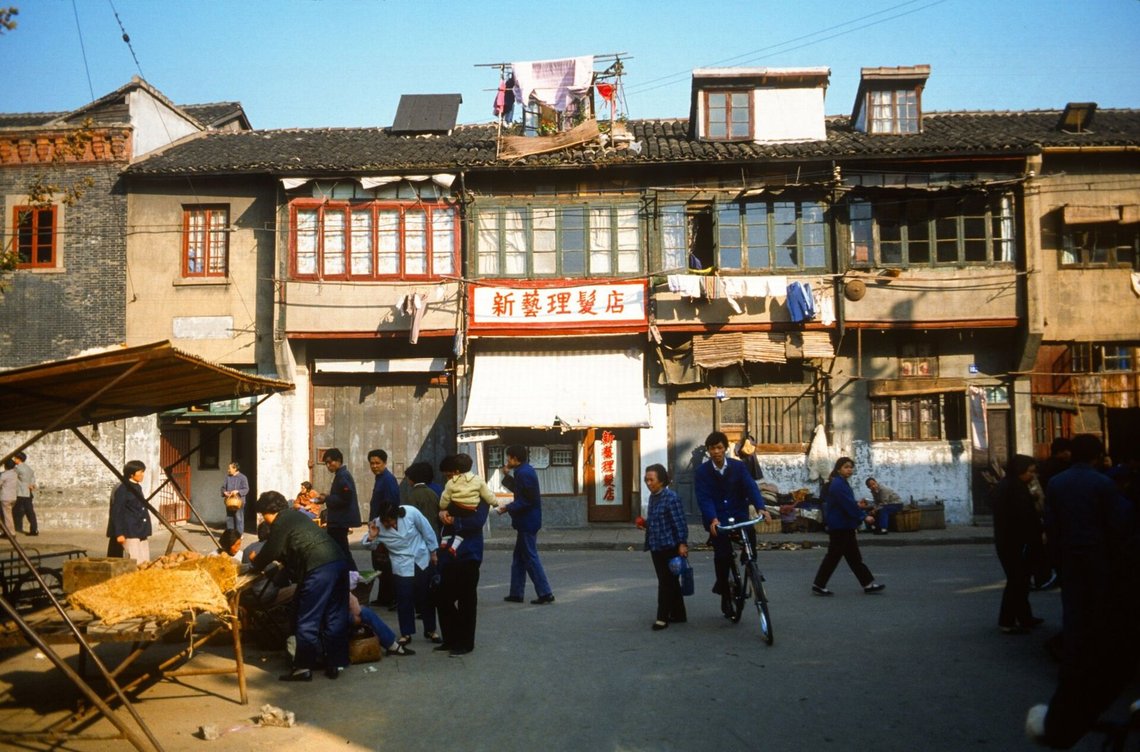


The editorial team at *Det Nye*, August 1981. PolyGram on the phone. They asked if I’d like to join Jean Michel Jarre on tour in China in October. Three weeks. Nothing paid, mind you, so *Det Nye* footed the bill. I thought: How unusual. The trip cost over 20,000 kroner. 20,000 was a fortune in 1981.
But just for the sake of it, I went in to see editor-in-chief Rigmor Foss and delivered the most wretched sales pitch ever. I started with the price. Just think – 20,000. Unheard of. I sighed in exasperation, shook my head and rolled my eyes. Besides, you’d have to be away from the editorial office for three weeks. The trip was a complete waste of time; everyone could see that.
It didn’t work on Rigmor. She leaned forward and studied me intently through her glasses whilst I babbled on. Her gaze was both curious and cheerful. Suddenly, she cut me off in the middle of yet another tirade against ridiculously expensive trips abroad.
– Well, Yan, would you like to go to China?
I couldn’t lie. “Yes,” I said, “of course I would, but it’s so expensive.”
Rigmor shook her head indulgently.
– Well then, I think you should go.
She said. And just like that, it was settled. I rang PolyGram. I ended up being the only Scandinavian on the trip.
Just think – China, only five years after Mao’s death. What a boss I had.
On 15 October 1981, I boarded the Air France flight in Paris and set off for Beijing. Excited and scared. The latter because I was always convinced that aeroplanes would crash. The slightest bit of gentle turbulence was enough to put me on high alert.
And yes, I thought I saw that something had come loose at the very tip of the port wing. It was flapping. But did I dare tell the flight attendant? Far from it. I’d rather this thing crashed than make a fool of myself. But I did at least make some telling gestures every time she walked past. I’d sort of flinch, craning my neck and peering out. The man next to me eventually wondered if I’d pulled a muscle, the way I was fidgeting and shifting about in my seat. Then I found myself facing my fate. On tenterhooks. I didn’t sleep a wink.
We landed quietly and unhurriedly in Beijing at dusk. A farmer was guiding his ox with a plough strangely close to the runway. He didn’t even look up as the aeroplane thundered past.
By the time we’d got through the laborious passport control in the primitive arrivals hall, which smelled of damp woollen jumpers and chemicals, it had grown dark. Pitch black. The global metropolis cast no distant glow upon the sky.
The bus brought the darkness with it, only more of it. For the driver limited the use of the headlights to quick flashes. Presumably to make sure he was still on the road. In those fleeting glimpses, one could make out pedestrians and cyclists, momentarily blinded, veering towards the verge. I saw at least two nasty falls from bicycles.
It was a long way to Beijing. And when we finally reached the metropolis, we were met not by dazzling lights and neon, but by the darkness of twilight. The streetlights were on low, glowing with a deep orange twilight glow. An old man sat on the central reservation beneath a streetlight, trying to read the newspaper.
The streets were as wide as avenues, but empty. And it was dark. The houses cast little light. We were in a ghost town. The hotel looked like a fortress from Stalin’s Soviet era. Guards wearing helmets and carrying submachine guns stood at the gates leading into the complex. It didn’t seem reassuring. Who were they supposed to be defending us against?
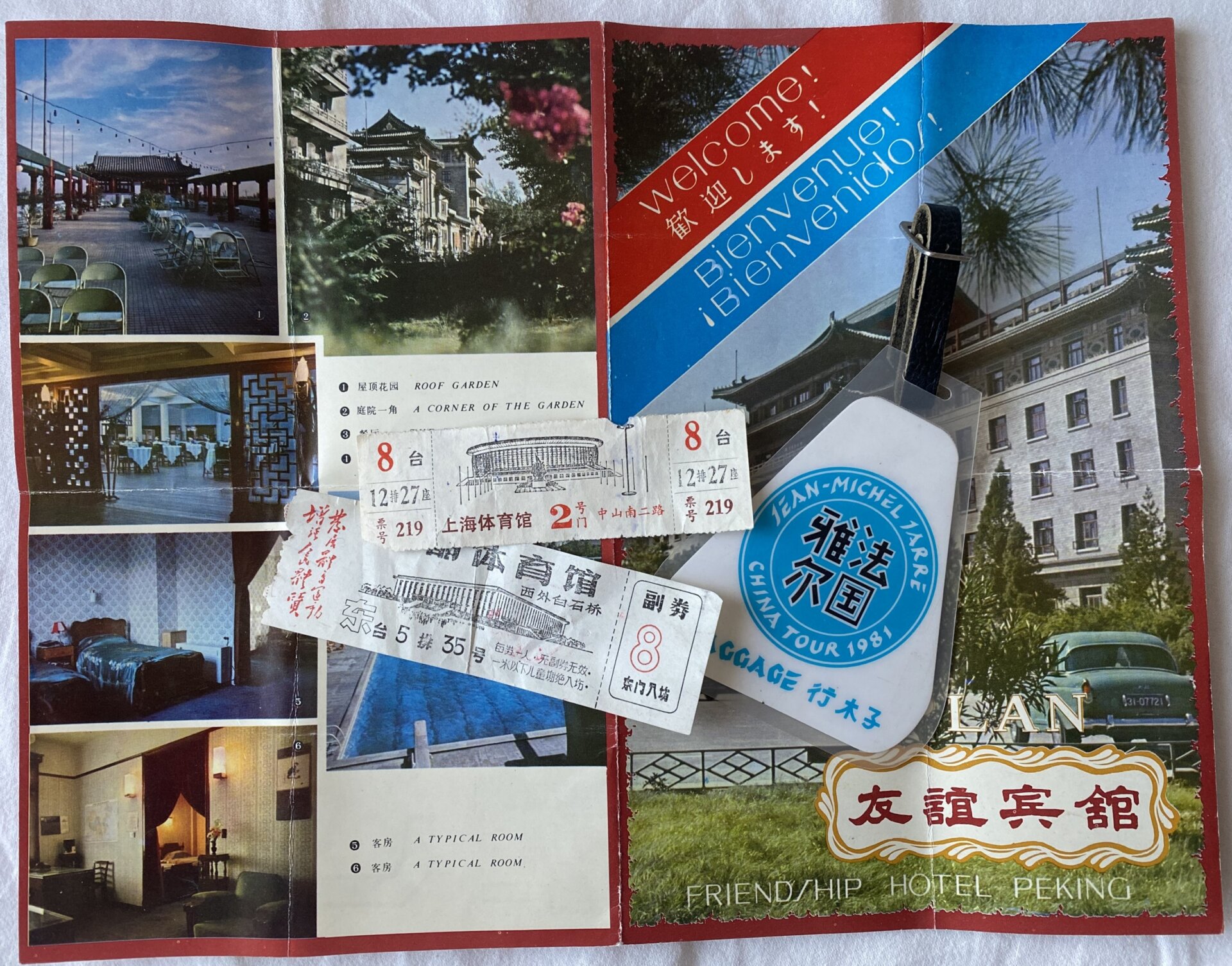
The Friendship Hotel looked like a fortress from the Stalin era, and there were armed soldiers standing outside. The tickets in the photo are from Jean-Michel Jarre’s concerts in Beijing and Shanghai in 1981. (Photo: Yan Friis)
Enormous stairwells, stuffy, dust-laden lifts that creaked like old men as they hauled the new guests up the floors. Floor attendants in the corridor. The rooms were vast, the furniture monumental.
I was to share a room with a Spanish journalist, Rafael. It was more like a small studio flat than a hotel room. A living room, a hallway and a bedroom with two epic beds. We decided to rearrange the furniture to create two bedrooms, and nearly broke our backs carrying one of the beds those few metres. Now that’s what I call solid wood!
Just as the bed was in place, two very agitated floor attendants came running in. Apparently, you weren’t allowed to rearrange hotel rooms in China. But we stood our ground. We hinted at bribes and favours if they didn’t let us be. They were then utterly horrified and accepted our temporary arrangement.
We strolled around the enormous hotel complex, across gardens, squares and lawns in the dark. Hungry now. We needed to find something to eat. After much wandering and plenty of dismissive head-shaking, we finally found something that resembled a dining room. We had no idea what they served, and they didn’t give us a choice either; they simply brought us a plate of sweet-and-sour deep-fried pork buns, but in a way I’ve never tasted anywhere else since. These buns were crispy and juicy, yet not greasy, and had an aroma and flavour that is probably the closest I’ve ever come to nirvana.
There were no knives or forks, just spoons and chopsticks. That was more than enough. We used our fingers. Back in 1981, you had to learn to eat with chopsticks the hard way.
It wasn’t easy to get to sleep in that stuffy, hot air. The heat just kept pouring out from the radiator beneath the window. I couldn’t manage to open the window, and it was impossible to turn the radiator down.
The ward attendants were called, and they sent for the radiator surgeons. They were on the scene in no time. Five lads and a pair of pliers. They huffed and puffed as they tried to turn the radiator down. It was clearly taking a lot of effort. In the end, they sounded like beached whales. The sweatest of them waved at me and pointed whilst shining a torch. Aha. It was rusted shut! They grunted and groaned, shook their heads sadly and smacked their lips. Who’d have thought it? No, this was truly surprising.
I really appreciated how wholeheartedly they threw themselves into their roles. They knew that I knew that they’d known all along that the radiator was rusted fast. I wasn’t, of course, the first to complain about the radiators. It must have been like that for years. We parted as friends. They waved gratefully.
Once they’d gone, I kicked the window so hard that it came loose from the frame – the whole window, in fact. As long as it didn’t fall out, it did the job. Now we had some air.
But jet lag kept me awake. I went out. Into the darkness. A soldier passed me. He said nothing.
At about six o’clock, some loudspeakers began blaring on the other side of a high fence. As the sun peeked out into the new day, I stood peering through a crack in the fence. I saw schoolchildren – loads of schoolchildren – doing line exercises to the crackling music from the loudspeakers.
Now the headache was monumental. And I was terribly thirsty. A glass of cold water now. Or preferably ten. What a luxury! But where were the hotel staff? Not here, not there. Not even at reception. I shouted. I banged on the counter. No reply.
Just before seven, a sleepy bloke emerged from behind a chest of drawers. He’d obviously been sleeping there. Now he looked at me with a neutral expression and muted enthusiasm. I made the international sign for ‘very thirsty’. He flinched. But he allowed himself to be reassured, albeit doubtfully, by my stiff grimace of a jet-lagged smile.
He pointed at his thermos flask and gestured upwards. I looked up. Aha! He thought I had one like that in my room. I replied in international sign language, accompanied by a ladylike voice, that that was hot water and that I needed cold water or I’d die of thirst, and besides, I had a terrible headache.
I’d now run out of international signs, and he called for help. Presumably he reckoned that this primitive foreigner, like most foreigners, was on the verge of attacking him with gnashing fangs and a fierce thirst for blood.
An elderly chap in a blue Mao suit came rushing over with a bottle of Coke; he’d probably heard that the awful swill calmed foreigners down (the Chinese didn’t like Coke in 1981, and it was expensive too). Just to be on the safe side, he’d also brought a cup of something that looked like coffee – something foreigners apparently drank too – but which tasted like ash-crackers marinated in an old man’s gums. It wasn’t my favourite.
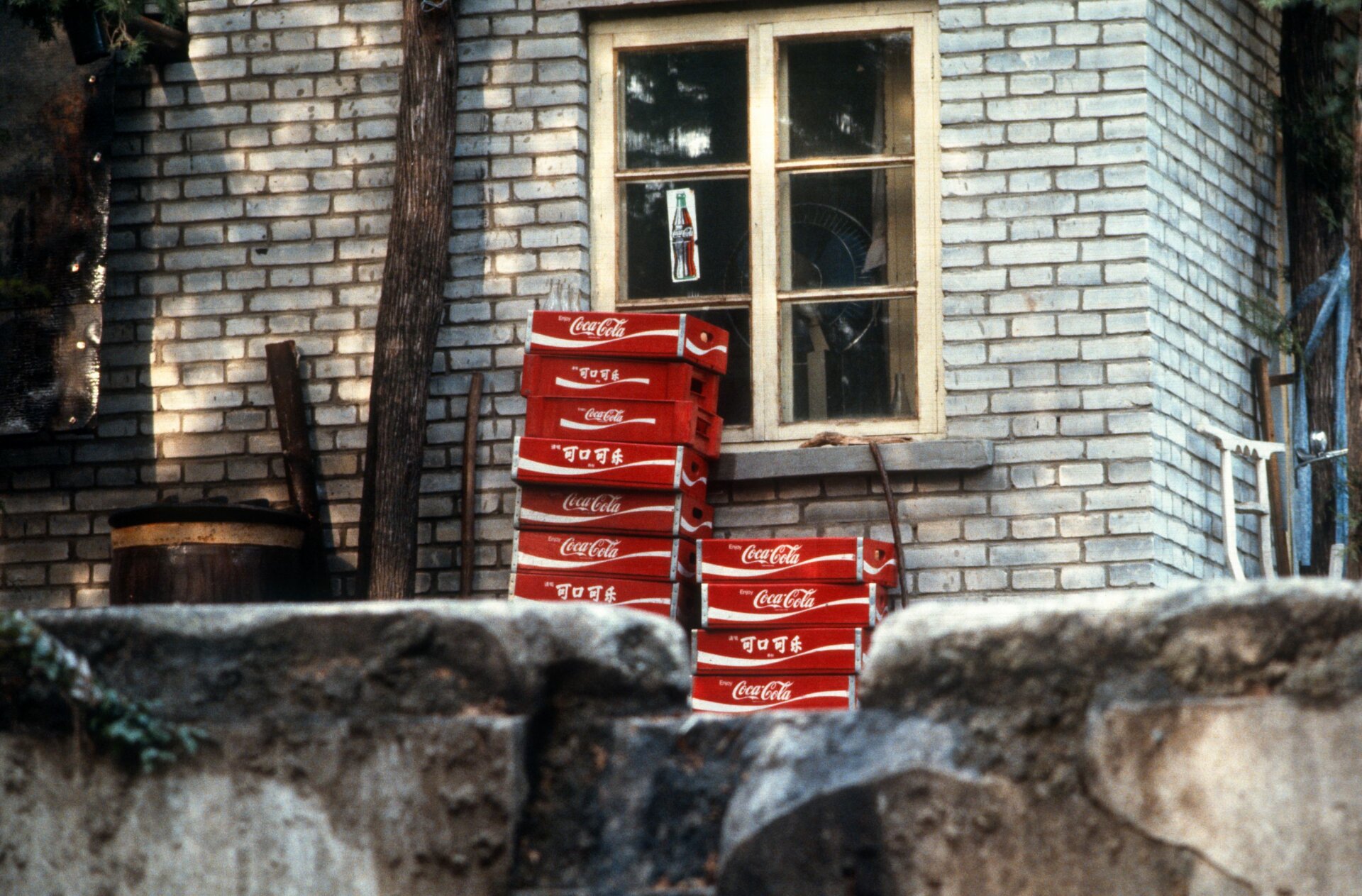
They had Coca-Cola in China in 1981. But the Chinese didn’t drink it. They thought it tasted like medicine. But foreign tourists wanted some. (Photo: Yan Friis)
I retreated to my room to get it all over with. Then there was a knock at the door. Outside stood the French-speaking guide, yes, there were only French-speaking guides there; even though most of us spoke completely different languages, it was the artist who held the upper hand, and he was French. But even I understood ‘petit déjeuner’.
And so passed my first 24 hours in China, five years after Mao’s death. He was still there. Everyone was wearing Mao-style uniforms.
China in 1981 was unimaginable. A place you’d never been to, and would never see again. Yes, because when I returned ten years later, the China I’d encountered and remembered was completely gone. In that sense, I was incredibly lucky. Autumn 1981, just five years after Mao’s death. It was still his China. His portrait shone like the sun from the entrance to the Forbidden City. In Beijing, everyone was dressed in drab colours – grey, blue or beige. The clothes had no cut to them, and the people had no smiles. Not that they were angry, but they had never seen foreigners before.
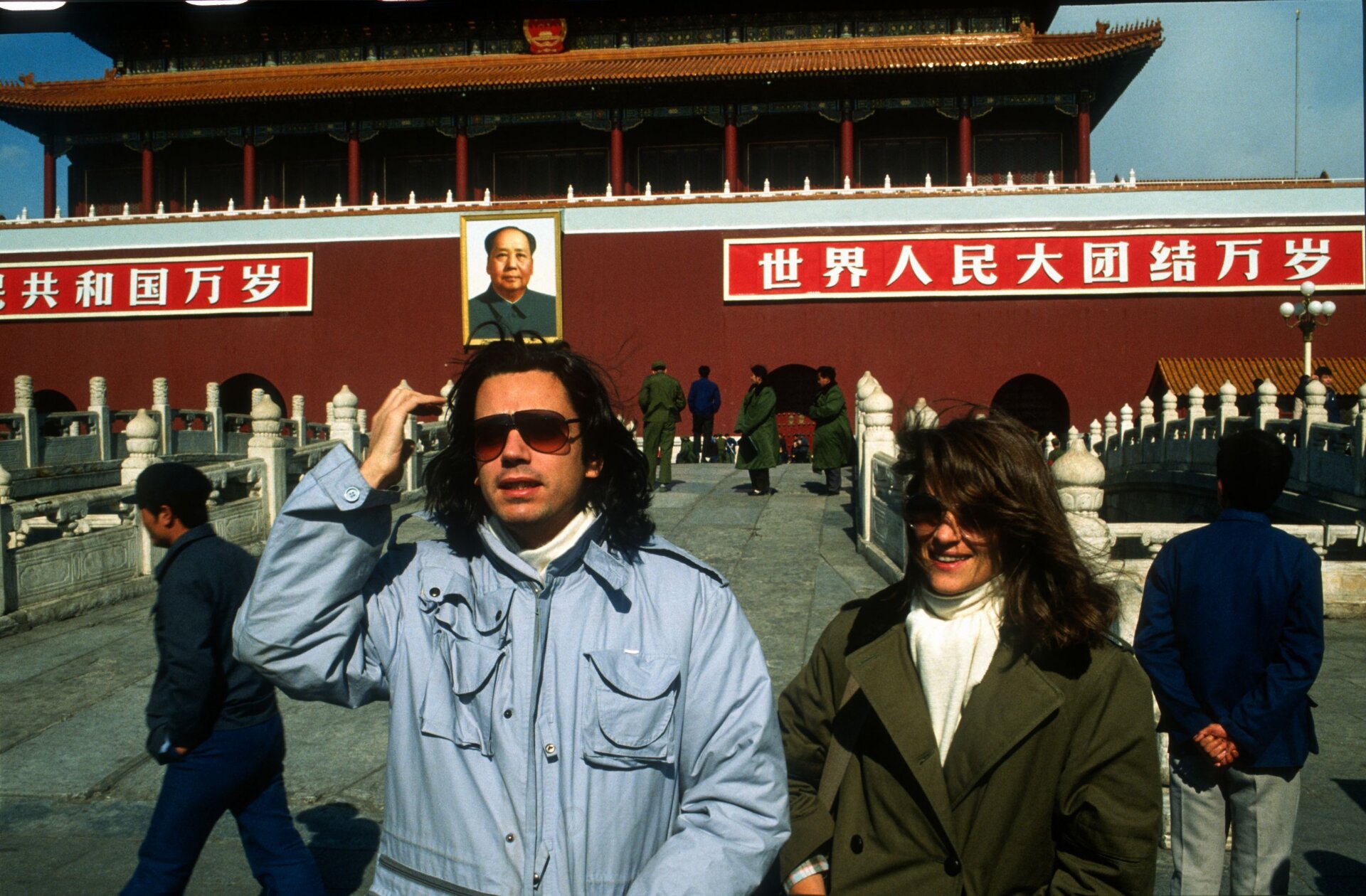
Jean Michel Jarre and his then-wife, the actress Charlotte Rampling, outside the Forbidden City in Beijing. (Photo: Yan Friis)
The bravest were curious. The others were frightened. What’s more, we smelled awful. If you stepped into a lift, you suddenly had the whole floor to yourself; all the Chinese pressed themselves against the lift’s four walls, as far away from you as they could , whilst discreetly placing a hand over their faces, as if to adjust their noses or something.
At Tiananmen Square, children and adults were flying colourful kites. When they spotted us foreigners, they flocked towards us, and within seconds we were surrounded, four beacons in an ocean of upturned, astonished faces. The children were the bravest. They did not avert their gaze. They stared. Insondable. A thousand generations deep.
They were also allowed to use red and yellow and green and blue. Children were free from shades of grey. They crackled with colour. Especially in Shanghai. There, it was summery warm and easier to dress.
In Beijing, the wind blew, sour and mixed with sand. On a day trip away from the wind, we encountered the rain, and the mud that the minibus’s tyres churned up, and not least we encountered the tormented face of the bus driver who had to endure the dreadful noise of ‘Tattoo You’ which some French journalists had forced him to play at volume 11 on the bus’s stereo.
I didn’t quite see the point of letting the Rolling Stones provide the soundtrack to the panorama unfolding outside the bus windows: the old lady with her umbrella, stumbling unsteadily in the rain on her tightly laced feet. The enormous steam locomotives labouring their way up the mountainside. The work crew limping and pulling the rear of a lorry free from the mud using sheer muscle power, whilst three pigs fled from a smashed-up cage by the roadside and vanished down the path. And finally the mist, thick, viscous, slow and impenetrable, which lay protectively over the legendary defensive structure, the Great Wall of China, ensuring that we couldn’t see a thing.
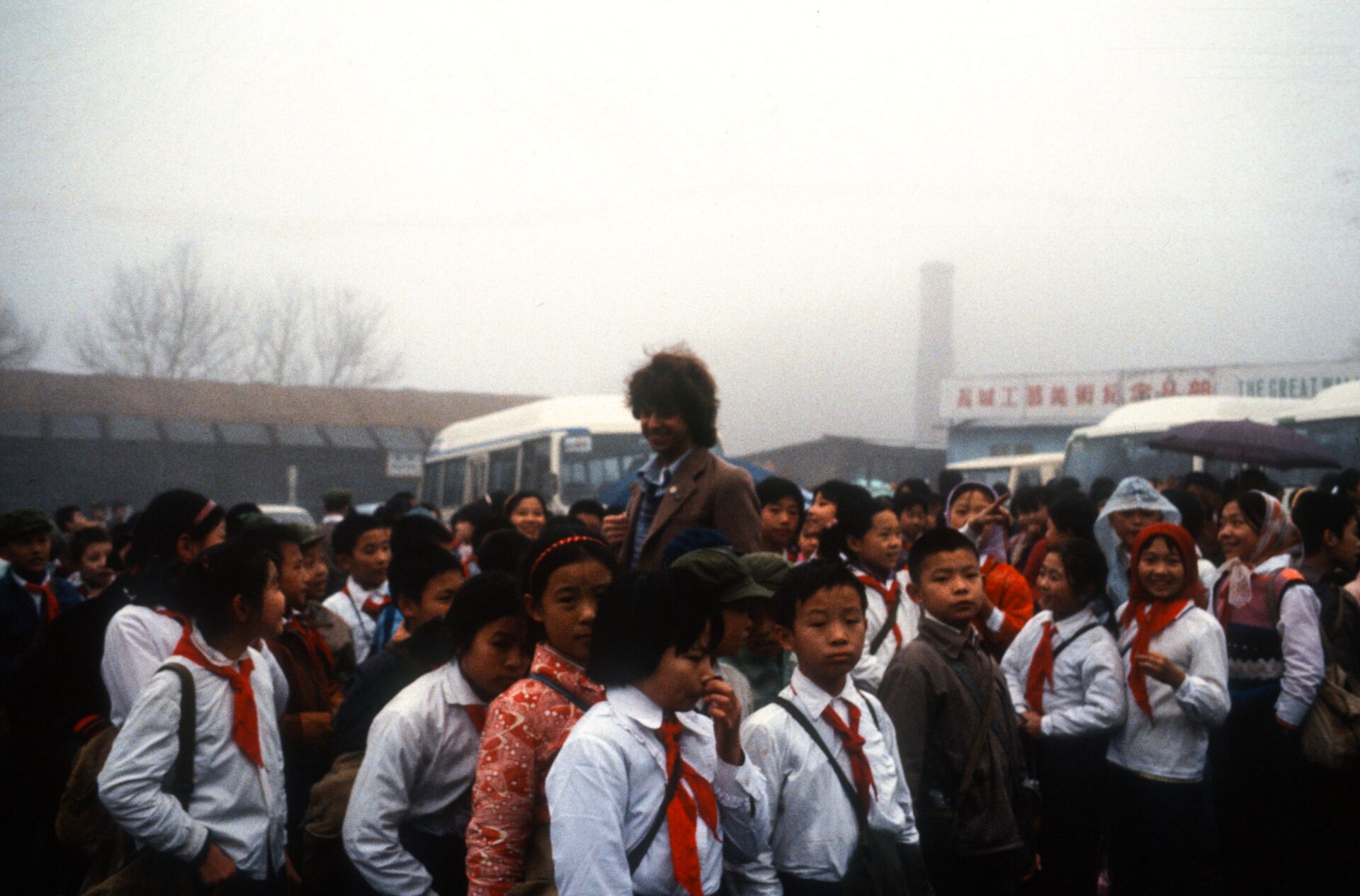
I couldn’t see much of the famous wall; the fog was thick. But at least I caused some amusement and a stir amongst all the children, who thought it was almost as much fun to see a scruffy foreigner as it was to see the historic fortifications.
Inside the restaurant, a Chinese tour group were eating snake. It was teeming with people. Neither they nor we saw what we’d come for: the Wall. But anyone who wanted to and was willing to pay received a certificate. A special price for foreigners – probably a hundred times more expensive. Just as there was a special price and a separate queue for foreigners at the Forbidden City. Always a special price.
The certificate from the Wall is lying somewhere in a storage cupboard in the loft. Nice to have. There are also a couple of packets of chewing gum that we were handed out by the friendly flight attendants in their baggy, light-blue uniforms. Apparently, the chewing gum was supposed to help with earplugs. I tried one of the strips; it lasted just one and a half chews, then dissolved into a mealy mixture of saliva and sugar.
Fortunately, the aeroplane was a brand-new jumbo jet with a well-functioning pressurised cabin, albeitby a pilot whose previous job must have been at the controls of the Chinese equivalent of a MiG-19. You could tell, during the altitude adjustments and not least during the landing in Shanghai, which involved an endless approach, 25 metres above the ground, definitely on the wrong side of the sound barrier, with the houses whizzing past right under the wings as blurry streaks – whoa!
I should have been given a certificate for that trip. Strictly speaking, I’ve only ever received that sort of serious documentation four times in my life. Namely: at the Great Wall of China, on Svalbard, in Ålesund (proof that I’d eaten halibut) and at Sjusjøen. The last one was for first place in the ski race during the winter holidays in 1970 (when most of the competitors were small children and elderly Danish ladies, and when my only serious rival, a Swede, hadn’t realised that you were supposed to run into the fireplace room and draw a pig after crossing the finish line). As you can see, I’ve been about a bit.
The Chinese rarely took taxis. They took the bus. But they probably preferred cycling, as these buses were surely left over from the war, many were missing window panes, and they were so packed that people were spilling out everywhere, almost like in a Donald Duck cartoon. So a bicycle was the better option. And they were swarming, both in Beijing and Shanghai. A silent river of pedalling China, which occasionally let out the odd polite ‘ping’.
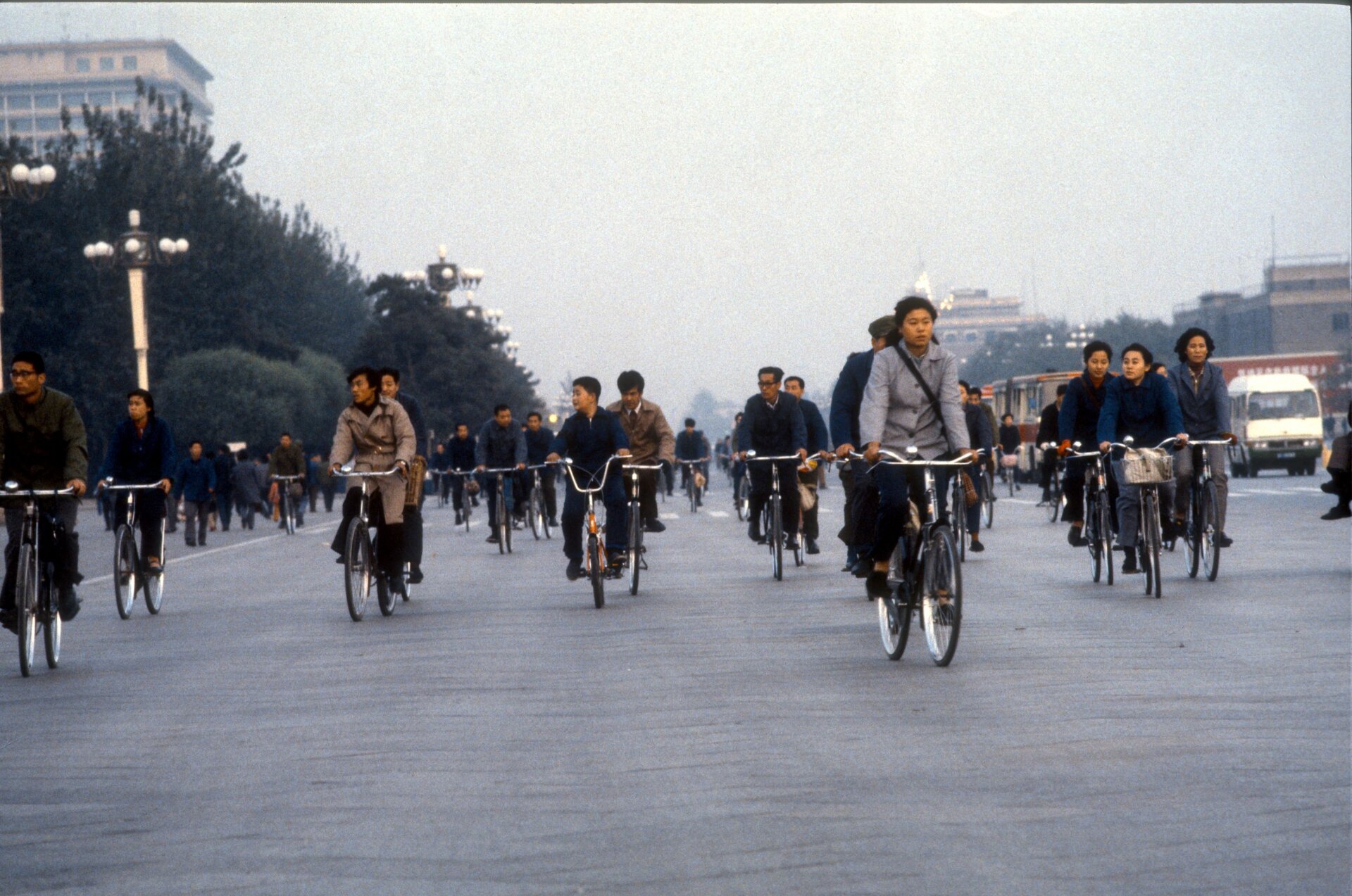
There were lots of them, sometimes like a swarm of flies, but they never cycled into you. Here in Beijing. (Photo: Yan Friis)
There were no private cars.
Foreigners could take a taxi. They were all the same Chinese model and were parked outside the hotels. The drivers were often fast asleep. So you had to find a hotel if you’d been out shopping and needed a lift, and didn’t have a clue where your own hotel was. The system worked reasonably well, as long as you had a note or leaflet with the name of your own hotel on it. Nobody spoke English in China.
Or rather, there were some who tried. They were always young, and they read English textbooks in secret. They had no teacher, nor anyone to practise their self-taught English on – apart from random passing foreigners, of whom there were so few in 1981 that they were really just a rumour.
I met some brave self-taught learners along the way. Young girls. They spoke very strangely, and you had to concentrate extra hard and be very patient. But if you understood what they were saying, even if it was just «How are you?&», they were so delighted they hardly knew what to do with themselves.
But before you’d managed to exchange more than three or four halting sentences, stern men and women in blue clothes with red armbands would turn up – local representatives of the authorities. It was forbidden to have a good time with those cunning, slick and, not least, evil foreigners. The self-taught learners’ faces always grew sad at such times, and they had to reluctantly withdraw. The armband brigade never addressed us. Presumably they didn’t speak English.
Incidentally, I actually met a very few Chinese people who spoke English well. Among them was the extremely polite young man at a venerable, former French club in Shanghai, the Ching Chiang Club. They had large billiard tables and a bar. The bar boasted an LP by Linda Ronstadt (“Mad Love») which they played on a constant loop, and the young Chinese man smoked Marlboros and was quite the character. He wanted to come across as modern and Western-oriented and was very curious about this whole business of bisexuality – that you could have sex with whoever you wanted of either gender – and whether it was common?
I thought the conversation was getting a bit dodgy, and realised I definitely didn’t want to go home with him and meet any of his friends. He was disappointed. He offered me a cigarette and said ‘Mad Love’ was a good song. I won’t hold that against him.
He gave me a note with a number on it and hoped I’d ring the next day if I changed my mind. I decided to steer clear of this club tomorrow; that much was certain.
In 1981, the Chinese spat a lot. They imagined that all the bacteria had to be expelled from the body, and quickly. Then they’d spit. Often with a hacking, brutal start to get as much as possible right from the depths of the bacteria in their bronchi. I never managed to get used to that sound. Or the sight of phlegm hurtling at projectile speed towards the spittoons placed at regular intervals on the pavements.
Spittoons. And there were spittoon trays in the bars, and on the landings all the way to the top of the hotel buildings. Many people wore face masks. I was told they had a cold, and that they did this out of consideration for those around them.
And then there was the smoking. Everywhere, and often with both hands. In the restaurants, they ate with their right hand and smoked with their left, all at the same time. In the more cramped restaurants, the smoke stung your eyes. People smoked whilst cycling, too. I even saw a cyclist who’d cut a hole in his face mask to make room for his cigarette. If you struck up a conversation, cigarettes were always exchanged as a gesture of introduction. So that’s also a sort of summary. Cigarettes and gugging.
And cockroaches.
It was here in Shanghai that I learnt how to keep the cockroaches at bay when going to sleep. Leave the light on in the bathroom. Then they won’t come up through the drain. On my first night in the hotel, they were swarming all over the room. They were much bigger than the few I’d seen in Beijing. What’s more, I discovered they could fly. You could hear them in the dark. A click when they hit the wall, and a soft plop next to you on the pillow when they tumbled down.
The next night, the light was on in the bathroom. Then they left me in peace. The trick works well in the East. It’s been a great help to me. In Thailand, too.
Shanghai in 1981 had no skyscrapers. I took lots of photos. If you compare them with photos from 2026, you wouldn’t believe it’s the same city. Not even the same planet.
I was lucky to have an editor in 1981 who said, “Well, do you fancy travelling to China, Yan?”, and then it was just a matter of going.
Thank you, Rigmor!
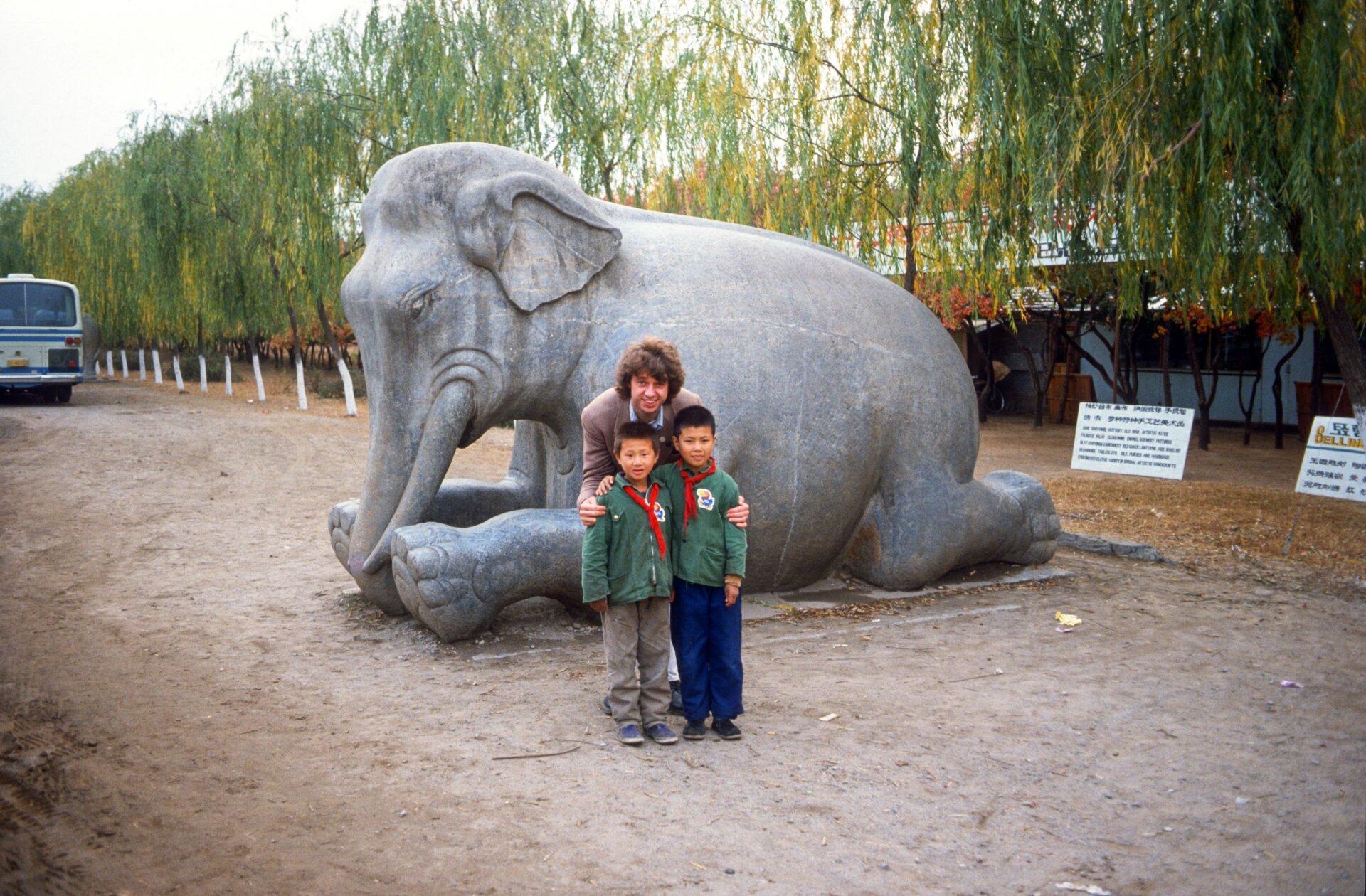
At the entrance to the Ming Tombs. The two boys insisted on being in the photo.


