



Okay, that finally settles it: France is finished. Get your croissants while they’re hot and before arson incinerates all those quaint but flammable boulangerie-pâtisseries. The nation is aflame with fringe fanaticism, as the past two weekends have demonstrated—from an especially violent Marxist-Muslim alliance.
Like in many other Western countries, the center in France has capsized. All that’s left is the death-wish nihilism of the extremes—and an unhealthy dose of Islamist menace.
The City of both Love and Light will soon become known for its Looting. For two weeks, ransacking and arson have been the weapons of choice for a revolutionary movement comprised of students, trade unions and Islamists.
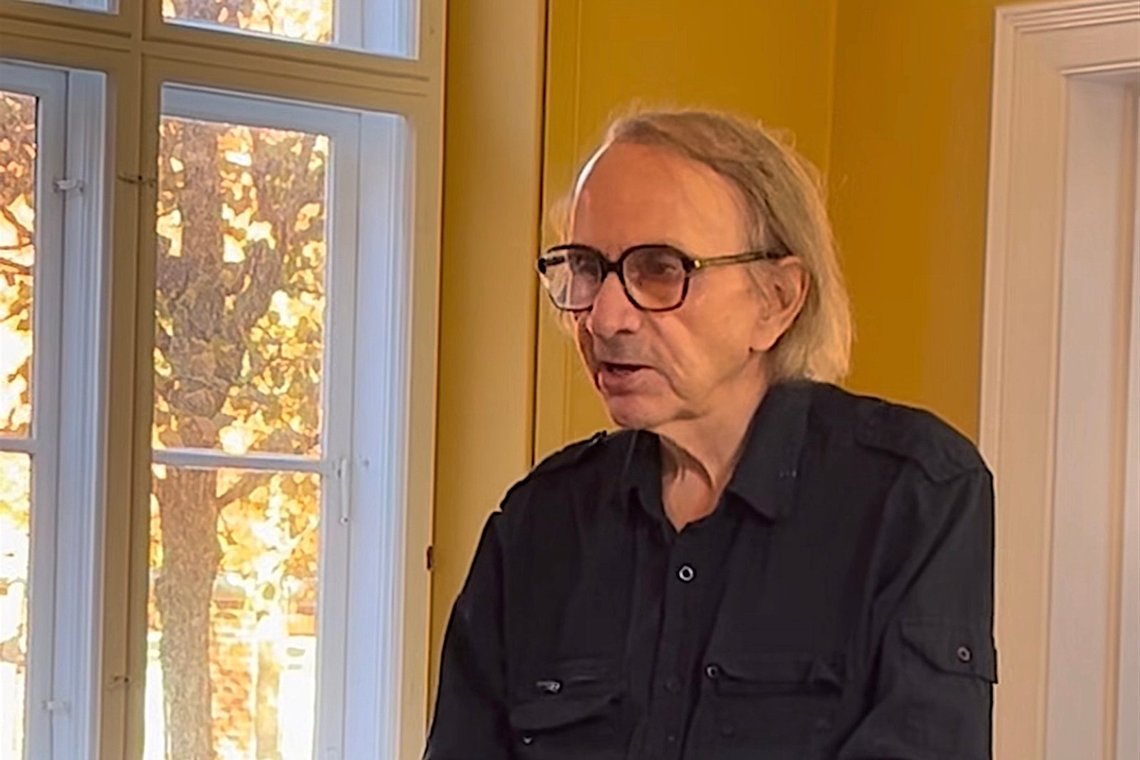
– “Violence does not arise as a result of discontent, but because people are no longer afraid of the police and the justice system,” says Michel Houellebecq in an interview with a Spanish newspaper about Europe’s decline.
When large crowds gather in France, looting is now part of the picture. Speaking at the ‘Ja! Festival’ in Bilbao, Houellebecq states categorically:
“It is not due to discontent, but to the fact that they no longer fear the police. And, above all, they no longer fear the justice system.”
This is how Houellebecq describes a society in which the threshold for committing violence has been lowered and the state’s authority is losing its deterrent effect. He rejects the explanation that social deprivation is the reason why people are looting.
In Frankfurt on 31 October, shocking events also took place. The internet is flooded with videos showing brutal violence. Particularly disturbing are the images published by the TikTok channel ‘Sehe ich anders’, which show what happened in a Snipes shop.
In the video, you can see many foreigners looting a sports shop. According to Die Welt: ‘This is what they look like, those who have escaped from the zoo.’
That’s not true – the animals in the zoo are afraid of the armed guards. But who could possibly be afraid of such ‘justice’?
El Koudri is no terrorist, concludes the Italian public prosecutor’s office regarding the attacker who ploughed through the crowd in Modena, where he killed a woman and injured many others. As I have said before: It is actually we who are mad.
And the investigating judge in Milan who released Youssef Siher writes that he merely expressed ‘forms of protest’ against ‘the policies of the current government’, as well as ‘calling for “civil disobedience”‘8217;’.
With investigative judges like this, the West needs no defence lawyers (had Siher not been a Muslim, he would already have been subject to the regime governing the terrorism legislation; of that you can be sure).
The English psychiatrist Theodor Dalrymple, who lives in France, points out a fact:
In not a single instance did the riots of 2005 spill into the centre of any major town or city, because the rioters were still afraid of the CRS, the Compagnies républicaines de sécurité, the riot police—in whose ranks, incidentally, there are now not a few descendants of North African migrants. But the rioters of October 17 have lost all fear of them, and have descended into the city centres.
On 31 October, the police in Paris were pelted with Molotov cocktails on several occasions.
‘Largely peaceful’, apart from firebombs and looting.
Violence is not something that disrupts the protests; on the contrary, it forms the very core of them. The ‘peaceful’ element merely serves as a cover for the riots.
Pascal Bruckner, another down-to-earth intellectual, writes the following from Paris in the Neue Zürcher Zeitung:
‘At around 6 pm, when I went out to do some shopping, the streets were in ruins: burning rubbish bins, burnt-out mopeds and benches, torn-up tarmac, charred cars, and shops that had been smashed up and looted. Groups of young people were shouting with joy as they poured out of the Place de la République.
Throughout the day, three types of demonstrators took turns appearing: first students and sixth-formers, then representatives of the far left, disciplined and determined, ready to set fire to anything symbolising the ‘bourgeois state’, and finally looters from the suburbs who had come to go ‘shopping’.
They were not Frantz Fanon’s ‘wretched of the earth’, nor were they the oppressed, but greedy hyper-capitalists. They feasted on a gigantic banquet, whilst terrified shopkeepers faced furious rioters.
In every city, the same apocalyptic scenes were repeated, but compared with previous riots, there was one difference: the overcrowding and the almost total absence of the police. The gulf between the idyllic image of France cultivated in the presidential palace and the reality across the country is abysmal. For years, attacks on police officers have been on the rise, even when they are off duty. Their addresses are published online; they are lured into traps to be beaten up.
School heads receive death threats, and the police seize thousands of bladed weapons in schools. Social divisions are clear, as is the risk of widespread fires in certain suburbs.
France appears to be a country in complete decline, obsessed with the idea of making its own situation even worse. We have become so accustomed to destruction, fires and work stoppages that they have become the norm. We are moving towards a creeping civil war that has not yet broken out openly. ‘La Grande Nation’ is imploding.”
The Mayor of Marseille, Benoît Payan has some advice for residents: ‘Make sure you stay safe’. In other words, people must stay at home.
Oh no, it’s not a ban – no, no, it’s more subtle: ‘It’s for your own good’, as they say in woolly political language.
That was the situation in Marseille last Saturday. Who actually dares to leave the house?
We have Houellebecq, and then we have another famous author, but one whom I have always regarded as a complete loser, namely Jonathan Littell, who writes the following in *Le Monde*: ‘The French police are brutal, Macron offers nothing but repression; the danger comes from the far-right militias’.
I, on the other hand, believe the exact opposite: namely, that the police are brave, that Macron is weak, and that the danger comes from those who wish for the West’s downfall.
But if one is to believe the authors, Molotov cocktails are harmless, and we should lock ourselves away in our homes – at least for as long as they are still ours.
As Ayaan Hirsi Ali says: ‘Say goodbye to France; it’s over.’
‘They are capable of restoring order, but they are choosing not to do so. City Hall towers are coming down. Statues have been defaced. But apparently, no mosques have been attacked. That’s all to appease the organised Muslim Brotherhood groups that being mobilised now against French citizens.
Make life hard and sometimes impossible for law-abiding citizens, but then they allow all this disorder. So there is something truly strange about these governments in France and in other Western countries.
Thane Rosenbaum is also very harsh:
In Lyon, Israeli and American flags were set alight.
Many homes have since been abandoned.
Actress Virginie Khalifa Hag followed the events in Paris with concern. But for the 40-year-old star of the hit Israeli series ‘Fauda’, the violence was more than just disturbing images of the city where she was born and raised. Her mother was, in fact, right in the thick of it.
My mother manages a shop on a small street near the Champs-Élysées,” says Khalifa Hag. Suddenly, Free Palestine flags appeared as well.” Her mother, she said, hid inside the shop until she could leave safely.
She practically hid in the store, quietly closed up and walked to a Metro station farther away, just to avoid all the chaos, with people destroying, burning and smashing everything.
For Khalifa Hag, who immigrated to Israel thirteen years ago, these events have reinforced a feeling she says she has had for years: the Paris she remembers from her childhood no longer exists.
What’s happening in France is insane, but the writing was on the wall,” she said. “This is not the country I grew up in. My late father always told me, ‘We grew up in Algeria. We’re not afraid.’ But today, Jews are afraid. Paris is burning. It’s really an intifada
She was born in Paris to a father of Algerian descent and a mother of Polish descent. To those who remain, the actress has a piece of advice that differs from that given by the mayor of the city conquered by the barbarians: ‘Be ready to leave, for in France you will no longer be safe.’


