

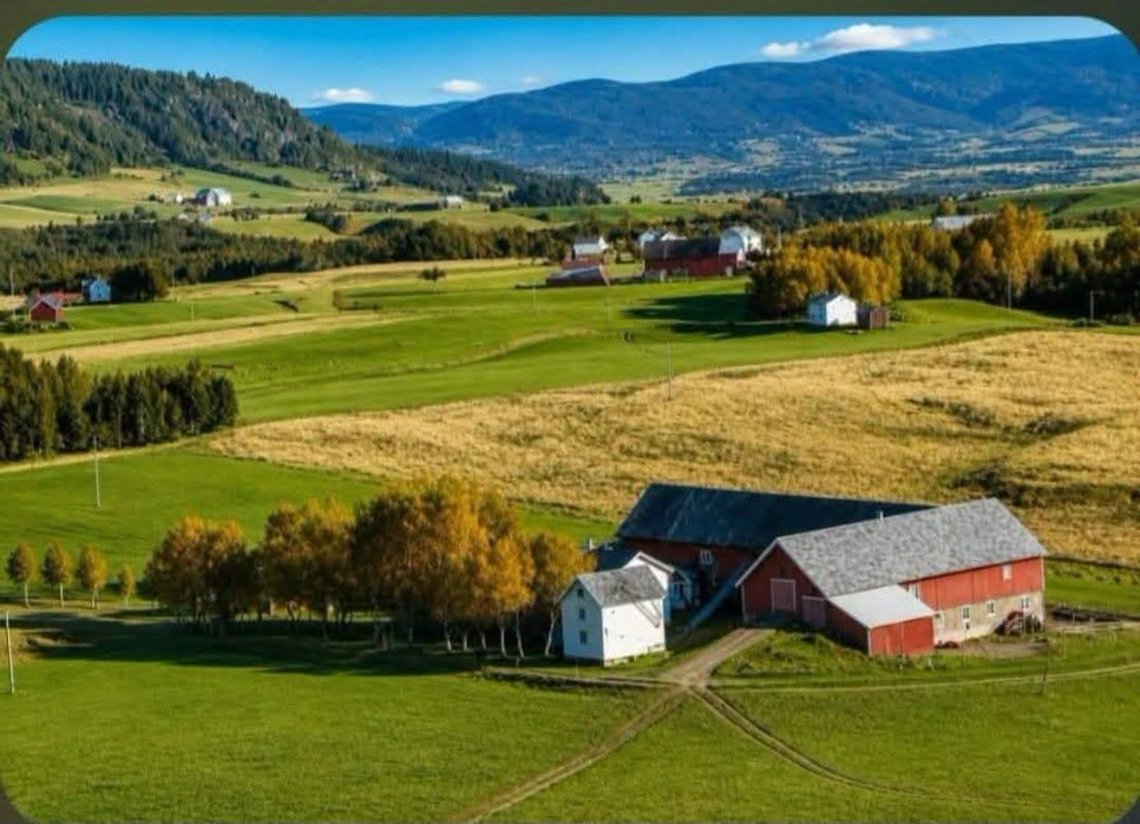


The farm belongs to Jens Petter Haug, who writes on Facebook: “I run a farm producing only grain; I fill up the diesel tanks in the autumn, and in one year that cost has risen by 100,000 kr. A price increase of almost 70 per cent; this cost means that the net profit is correspondingly lower, and from the New Year it will also be subject to a CO₂ tax. I use propane to heat the chicken coops; this has been subject to a 50 per cent CO₂ tax for some time now. On top of that, we’re now required to have a climate calculator on the farm, and if it shows a negative balance, we’ll have to pay a levy there as well. The strange thing about this is that we are not allowed to take into account the factors that result in a positive balance in the climate accounts. And the Farmers’ Union endorses this nonsense. I’ve resigned from it.
Monday 26 October 2026 marked the start of Civil Preparedness Week, during which the authorities at the Directorate for Civil Protection and Emergency Planning are focusing on how individual citizens can prepare for a crisis or war. The riots in several European countries highlight this need in a way that is hardly surprising to *Documents*’ readers, but it is nonetheless important to actually be prepared. This time, the authorities are focusing on the internet and mobile phones, whereas previously they had a broader focus.
The DSB’s objective with personal preparedness is to help individuals cope on their own for a whole week. In a series of articles, Document will take a closer look at societal and personal preparedness. In this first article, the author will share some general observations, whilst subsequent articles will address specific topics, advice and considerations we believe individuals should take into account. The aim is to address weaknesses in the DSB’s advice and provide you, the reader, with a better basis for preparing yourself and your family for a crisis.
Then and now
Forty years ago, during the Cold War, Norway had a civil defence model that was largely state-run and based on stockpiles combined with significant domestic production. We had large fuel reserves and three refineries, compared with just one today. We had the Norwegian Medicines Depot which, together with the domestic pharmaceutical industry, ensured the availability of medicines. We had large grain stocks, and self-sufficiency in potatoes and vegetables was considerably greater than it is today. The diet consisted to a greater extent of food that could be produced in Norway. The area used for food production was also much larger, and today’s production is more dependent on fertiliser, which also presents its own supply challenges. We still have our fisheries, but these, in turn, require a supply of fuel. The aquaculture industry has emerged, but this is largely based on imported feed, as is the case with pig and poultry production.
In short, we are in a far worse position than we were.
Hoarding
We all remember how vulnerable global supply chains proved to be when large parts of the world went into lockdown in 2020, when shops quickly ran out of toilet paper and a range of other essential goods. This was due to hoarding, and clearly demonstrated a consequence of today’s just-in-time model for the supply of goods, with only small stocks of most items. A key purpose of personal preparedness is precisely for each individual to make themselves and their families less vulnerable to this. In 2020, the authorities tried to urge the public not to hoard, but this was only partially successful. This is entirely natural – if you are unsure whether goods will be available to buy tomorrow, you buy what you can today. This is particularly true when you know that society has little in stock to fill the shop shelves. The authorities have therefore, by reducing their preparedness, probably made the problem of hoarding during a crisis worse than it would otherwise have been.
Planning, a holistic approach, knowledge and skills are preparedness
Preparedness is more than just having essential supplies at home; if you don’t know how to use a primus stove, it’s of little use. Using equipment incorrectly can, in the worst case, cost lives – for example, if you run a generator indoors, resulting in carbon monoxide poisoning. And candles and a wood-burning stove are useless if you don’t have matches, unless you’re one of the few who’ve practised lighting a fire without them. And if you haven’t used the wood-burning stove for 20 years, it can be unpleasant to discover that a crow has built a multi-generational home in the chimney…
Personal preparedness is a personal matter
There is no one-size-fits-all answer to what constitutes good personal preparedness; it is important to thoroughly assess your family’s unique needs. In this series of articles, we’ll highlight a number of questions you should consider, and how well you and your family cope during a crisis will depend on how seriously you take this task.


