

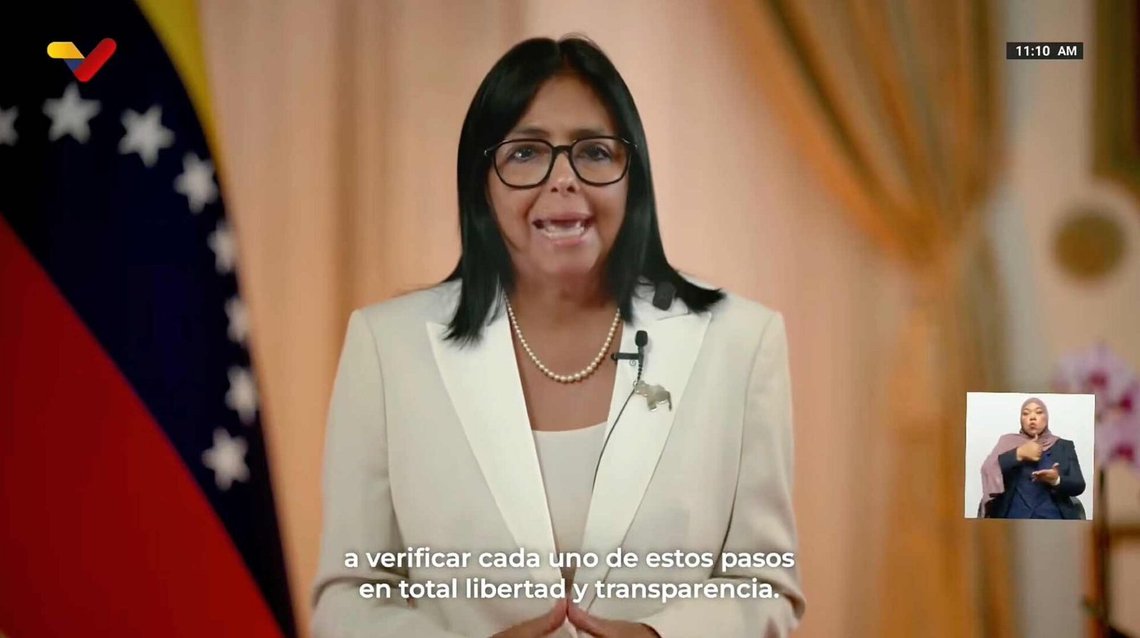


Interim President Delcy Rodríguez, who is at the mercy of Donald Trump, promised in a televised address to Venezuela both free elections and a break with Hugo Chávez’s nationalisation policy.
Rodríguez promises free elections with a new electoral authority, but gives no date. At the same time, she states that the government wishes to privatise state-owned enterprises that are not considered essential, or return them to their former owners. According to the acting president, this work is already well under way.
In a speech broadcast on radio and television on Thursday, Rodríguez presented herself as the guarantor of a democratic transition in Venezuela, following pressure on the government from the recently returned Nobel Peace Prize laureate and opposition leader María Corina Machado, and US Secretary of State Marco Rubio, to hold democratic elections.
The speech was delivered just one hour before Machado was due to hold her first press conference at the Catholic University of Caracas.
– It is now clear that there will be a presidential election in 2027. The transition to democracy cannot be reversed, and we are here to ensure that it is peaceful and orderly,” said Machado in her speech.
“I come from within the system
Marco Rubio has previously promised that a reformed Supreme Court in Venezuela in 2027 will rule that Maduro is permanently removed from the presidency. A new presidential election must be held no later than six months after this.
Rodríguez spent much of her speech defending her role as the leader of the transition, or as the Spanish newspaper El Mundo puts it: to ‘attempt to position herself in the political centre, between the [Bolivarian] revolution and María Corina Machado’.
– The decisions we make and must make are not easy. For some, this means giving in too much; for others, it means not going far enough. It is between these two tensions that we navigate, and we have chosen a path that, with steady steps, will lead us to a successful outcome, said Rodríguez.
– I come from the very system we are set to reform, and I make no secret of that.
Amnesty and freedom of the press
Rodríguez highlighted that nearly 9,000 people who were in prison have been granted amnesty. She also admitted that a controversial ‘hate speech’ law had been misused for censorship purposes, and that the government had therefore lifted the block on 200 websites.
She also said that the police have been instructed that no one should be arrested without a court order, and that the right to peaceful protest must be upheld.
El País points out that the classic revolutionary concepts of Chavismo (Hugo Chávez’s political platform), such as anti-imperialism, collectivism and popular power, were completely absent from the speech. Instead, Rodríguez spoke of the rule of law, reconciliation and guarantees for capitalist investment.
Rodríguez did not use the word ‘privatisation’ in his speech, but stated that the constitution protects private property rights in Venezuela too, which, by all accounts, comes as a surprise to all Venezuelans at home and abroad who have had their property and businesses confiscated or outright stolen from them.


