

NHO chief Ole Erik Almlid speaks out in VG and claims that foreign data centres are “an important part of the infrastructure” and that it is good for Norway that these giants are investing here.
These investments do not contribute to our shared infrastructure – they act as a supranational vacuum cleaner, sucking up our most precious shared resources.
The Norwegian Board of Technology makes this clear in a recent report:
There is absolutely no correlation between a giant data centre being located on Norwegian soil and it making a positive contribution to Norwegian society.
On the contrary, the report reveals that these facilities function as nothing more than ‘raw material enclaves’. They import their servers, they send their profits straight out of the country, and once the facilities are completed, they are run as automated ‘ghost halls’ with a minimum of local jobs.
The only thing they leave behind locally is monopolised network capacity that pushes genuine, value-creating Norwegian industry out of the queue, because EEA law prevents us from prioritising.
The truth is that companies like Google and TikTok are not coming here to build up Norway; they come here because the EU’s ‘Twin Transition’ (the parallel ‘green’ and digital transition) has established a legal framework that turns Norway into a cheap raw materials colony.
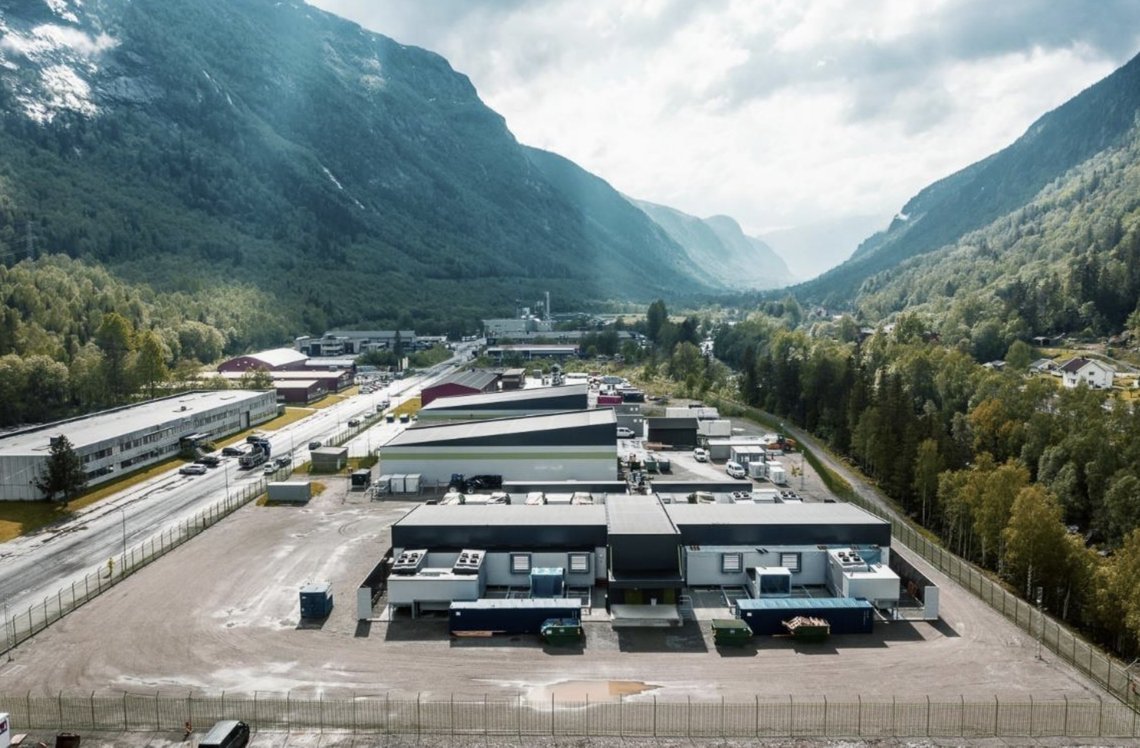
What Almlid calls ‘infrastructure’ is, in reality, massive, physical factories that require extreme, round-the-clock cooling to prevent thousands of servers from overheating and melting.
This requires a cynical two-front war against Norway’s shared resources.
Firstly, the facilities require astronomical amounts of clean, renewable electricity to power their ventilation systems.
Secondly, they consume millions of litres of clean fresh water – taken directly from the local authorities’ own drinking water networks – for evaporative cooling, where the water evaporates during the process.
The Norwegian Water Resources and Energy Directorate (NVE) presented a brand-new report today that demonstrates the scale of the disaster in real time.
Data centres that have already been allocated capacity in the Norwegian electricity grid will, on their own, consume 25 TWh in 2035 – more than eight times the current level.
NVE Director Kjetil Lund warns that this will wipe out Norway’s entire historical power surplus, plunge us straight into a real power deficit, and cause a price shock where your electricity bill will rise by up to 55 per cent.
Why can’t we just stop it?
Because the EEA Agreement’s market obligations and the connection requirement prevent Norwegian politicians from setting priorities.
The state is not permitted to discriminate between value-creating Norwegian industry and foreign crypto mining. If they have secured their place in the queue, they are entitled to our electricity and fresh water.
This is the whole point of the trap the power elite has locked us into through the energy packages.
Under the infamous 70 per cent rule, Statnett is legally obliged to make at least 70 per cent of the capacity in the international cables available to the European market at all times.
Market robots and algorithms drain our reservoirs 96 times a day (every 15 minutes) as long as prices in Europe are higher.
When our reservoirs are drained by this export pressure and the data centres’ voracious demand, we are forced to import the electricity back from Europe – but then at European gas, coal and marginal prices.
And as a final kick in the teeth, the power elite is using this artificially created power deficit to demand that we destroy the rest of our Norwegian natural environment with wind turbines, which, under the EU’s REPowerEU plan, are now defined as a «overriding public interest» that trumps local democracy.
So no, Almlid. The data centres are not infrastructure for Norway.
They are the core of a supranational plunder of Norwegian power and fresh water, sanctioned by a power elite that has traded away national sovereignty for a pat on the back in Brussels.
The answer to why NHO chief Ole Erik Almlid defends data centres and the EEA system so fervently lies in the fact that NHO (the Confederation of Norwegian Enterprise) is one of the most powerful and uncompromising EEAlobbyists in the whole of Norway.
The link between the EEA and the NHO is based on a shared ideology, pure market thinking and the economic interests of the largest companies.
Here are the four key points that explain this close alliance:
NHO’s primary objective:
The borderless market:
NHO represents the major capital and export forces in Norway.
For them, the four freedoms of the EEA Agreement – the free movement of goods, services, capital and labour – are the absolute foundation of the Norwegian economy.
NHO believes that laws, regulations or political control of our resources specific to Norway are an ‘obstacle’ to business. They want market forces and the EU’s harmonised rules to take the lead, as this gives large corporations free rein across national borders.
For NHO, cheap, regulated hydropower is not a national competitive advantage for Norwegian industry or a public good for the population.
They view electricity as just another commercial commodity to be bought and sold on a free market at the highest possible price.
That is why NHO fought hard for the Third Energy Package, ACER and the international interconnectors.
They welcome the fact that European market algorithms and the 70 per cent rule govern the flow, because they believe that market integration with Europe attracts foreign capital – such as investments in data centres and battery farms under the Twin Transition.
The alliance with the Brussels establishment:
NHO has its own office in Brussels and is a member of BusinessEurope (the European umbrella organisation for business).
NHO bureaucrats work closely with the European Commission and Norwegian government departments to ensure that EU legislation is implemented as quickly and smoothly as possible in Norway.
When the head of NHO speaks, he is in reality speaking as a spokesperson for the supranational market model designed by the EU.
The division within NHO (The great paradox):
The most tragic aspect of NHO’s EEA ‘blindness’ is that its policies harm its own grassroots members.
NHO represents thousands of small and medium-sized Norwegian businesses, including traditional mainland industry, which is entirely dependent on predictable and low electricity prices to survive.
Although small businesses make up the vast majority in terms of headcount, it is the giant industrial conglomerates, the major contractors and the power companies that contribute by far the largest sums in membership fees. It is these giants that have direct access to the boardrooms and shape NHO’s official policy.
When Almlid rejoices that foreign data centres are set to consume 25 TWh and drive up the electricity bill by 55 per cent (as the NVE is warning today), he is, in effect, sacrificing traditional Norwegian cornerstone businesses on the altar of the EEA market.
NHO’s senior management is thus prioritising the multinational tech giants, the power exchanges and the major wind power developers over the uniquely Norwegian industry that built the country.
In short:
NHO and the EEA Agreement are two sides of the same coin.
The EEA provides the legal framework that removes democratic control, whilst NHO provides the political defence and smokescreens in the Norwegian media to keep the trap shut.