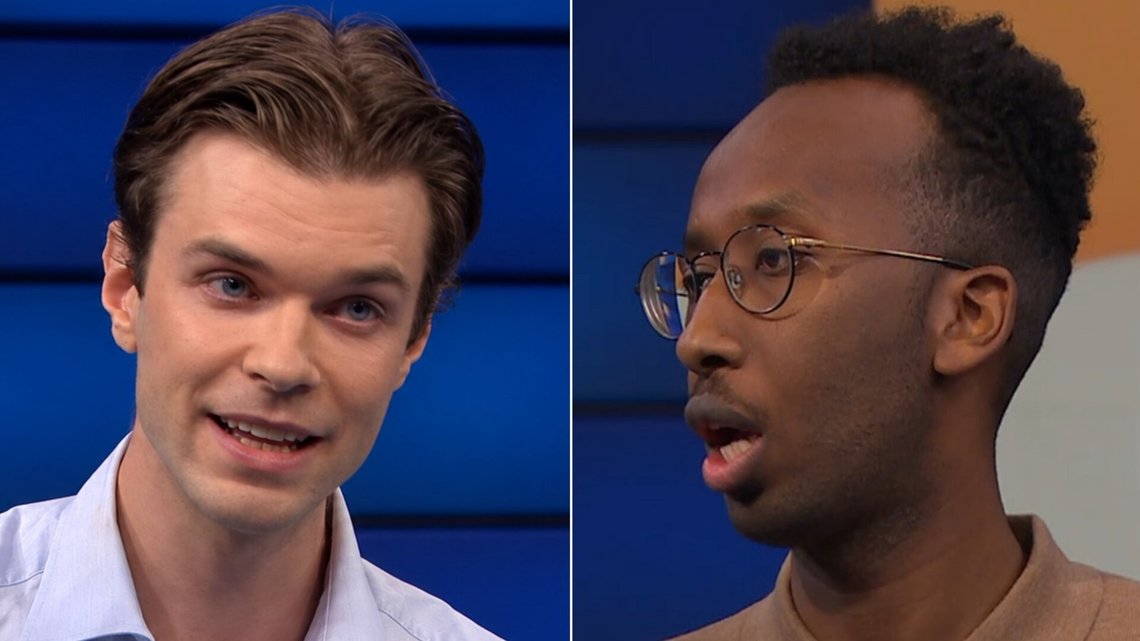


The Norwegian Broadcasting Corp. (NRK) invited Progress Party (FpU) leader Sebastian Saltrø Ytrevik to a debate with the new Labour Youth (AUF) leader on family reunification. Then NRK changed its mind and switched the topic to inequality.
Ytrevik (23) was due to face AUF leader Fawzi Warsame (28) in a debate entitled ‘To what extent should Norway allow family reunification?’. According to Ytrevik, NRK sent the invitation in writing, both to him and to the other youth party leaders.
NRK then changed its mind. According to Ytrevik, NRK justified the change by saying that the topic had become ‘too controversial’ to discuss. The debate was given a new topic: inequality.
– “Following a conversation with the debate moderator Steinar Suvatne, I cannot interpret this sudden change in any other way than that it is simply because NRK does not wish to hold this debate, even though it is one of the most important challenges facing Norway,” Ytrevik wrote on Facebook on Thursday.
He does not know whether the AUF has been involved.
– Whether or not this is due to pressure from the AUF, I know nothing about it, but it seems striking, writes the FpU leader.
Document has contacted the presenter of NRK Debatten, Steinar Suvatne. We asked him whether Ytrevik’s claims were true, and what the reason was for shifting away from this topic to an issue close to the AUF’s heart.
Suvatne has not responded to our enquiries.
Both youth party leaders are new to the role. Ytrevik was elected at the FpU’s extraordinary national conference on 10 October. Warsame took over the AUF from Gaute Børstad Skjervø on Sunday.
Ytrevik believes this is not an isolated incident.
“This is yet another example of how NRK chooses to shy away from these debates,” he writes.
He highlights *The Dark Side of Immigration*, the new book by former NRK correspondent Anders Magnus. According to Ytrevik, NRK initially tried to silence the book. Sylvi Listhaug then referred to it in her speech to the Progress Party’s national executive committee on Saturday 17 October, in which she demanded that Norway investigate the extent of criminal clans.
On the same day, Dagsrevyen covered the story. There, criminologist and professor Sveinung Sandberg of the University of Oslo stated that research provides little evidence that clan culture is a dominant feature in Norway. The NRK reporter asked Listhaug what evidence she had apart from a single book.
– NRK could have chosen to interview some of the many sources in Anders Magnus’s book or some of the others who have documented honour-related crime in Norway, but NRK chose not to, writes Ytrevik.
One of the sources in the book is Ole Jørgen Arvesen, head of the investigation and intelligence department at Kripos. Speaking to Magnus, he describes it as “an absolutely crucial factor” for the police to understand the clan structure, given that the criminal actors come from regions where such structures are deeply entrenched.
The FpU leader also points out who is footing the bill.
– “These are just two examples of political choices made by a media organisation that is 100 per cent funded by you, the taxpayer, and which give cause to question the political agenda of the country’s public service broadcaster,” he writes.
Ytrevik concludes with a clear message:
– We must dare to tackle the difficult debates as well. I would argue that this is the most important debate.