



Here, we will examine the actual demographic trends in Norway, with particular emphasis on the period 2020–2024. The aim is to establish an irrefutable data foundation based on raw data and to highlight discrepancies between the conclusions of official government reports and the observable, visual reality in society.
This study differs from standardised analyses in that it employs a systems-analytical approach. Through critical filter selection and historical accumulation, the long-term trends in Norwegian population change are brought to light.
The actual figures for permanent settlement (2020–2024)
To map the steady inflow of foreign nationals who settle permanently, we have established a model based on three measurable and legally distinct pillars (A + B + C).
To ensure continuity and isolate the general trend, Ukrainian nationals under temporary collective protection have been excluded from the data set in this specific breakdown.
- A: Refugees (persons settled after being granted asylum or recognised as having a need for protection)
- B: Family (persons resident through family reunification or settlement)
- C: Work (persons registered as resident on the direct basis of employment)
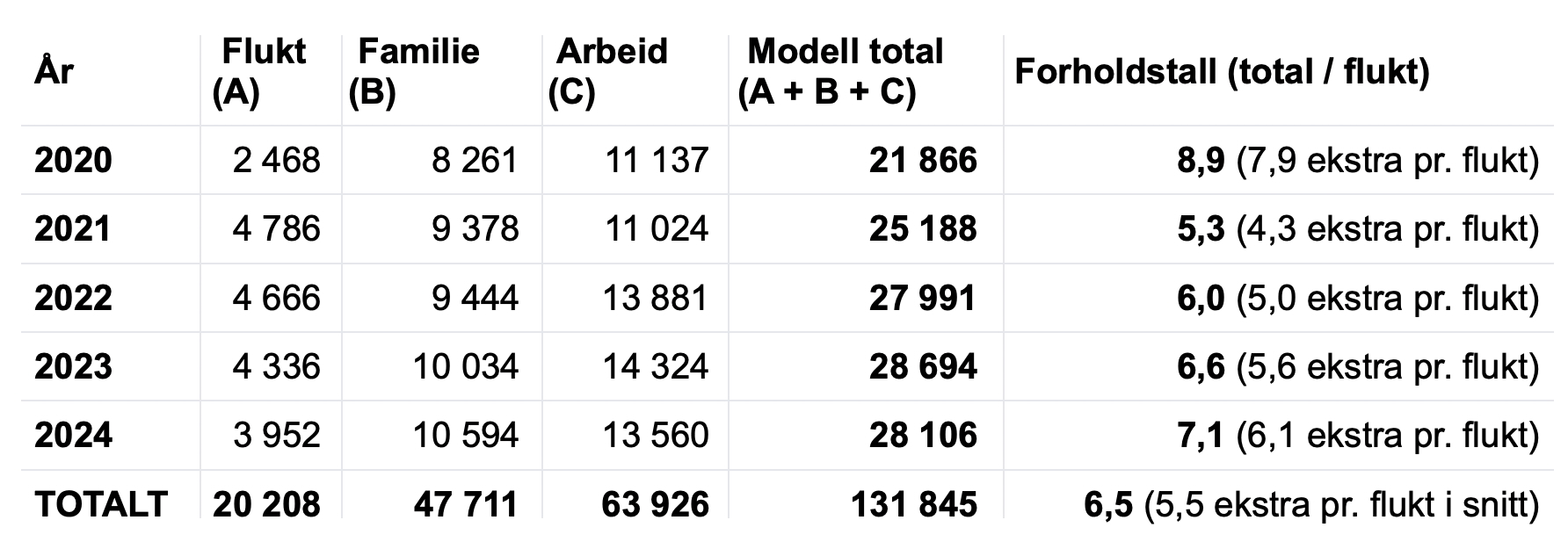
Raw data for permanent arrivals (excluding Ukraine)
The following table shows the official records from Statistics Norway (SSB) sorted according to our model:
Key statistical findings:
- Cumulative volume: A total of 131,845 people in categories A + B + C arrived during this five-year period.
- Annual average: This amounts to an average of 26,369 people per year. Over five years, this volume corresponds to the permanent population of the entire central urban area of Stavanger.
- The Covid-19 slowdown: The system analysis shows that this average is artificially low due to the pandemic (2020–2021). In the preceding five-year period (2015–2019), the average for the same categories stood at 36,500 people per year. Under normal global circumstances, this period would have added nearly 180,000 people to Norway’s population.
Analysis of birth figures and statistical methodology (2020)
To understand the dynamics of population growth, birth figures must be analysed with an eye to how the registration systems are programmed. In 2020, 52,979 live births were registered in Norway. The official breakdown was as follows:
- Both parents born in Norway: 36,675 children (69.2 per cent)
- Both parents born abroad (immigrants): 9,692 children (18.3 per cent)
- One parent born abroad / mixed: 6,612 children (12.5 per cent)
Unravelling the statistical filtering model
The stark discrepancy between the authorities’ published reports on declining fertility among immigrants and the reality on the ground is due to a technical and definitional time bomb in the syntax of the data model.
Because the system automatically resets a family’s immigration history in the third generation, in the coming years we will see a sharp, artificial increase in the number of children born to ‘two Norwegian parents’, as young women who, in everyday life and in the public sphere, are perceived as part of a multicultural population, are coded as ‘Norwegian’ in the systems as soon as they give birth (because they themselves were born in Norway).
The number of children born to two Norwegian parents will therefore rise sharply in future, as the multicultural population changes status within the system. At the same time, the number of children born to foreign parents will remain stable and steady going forward, because this category captures only the very latest arrivals from the ongoing steady flow of immigration. To an analyst, it is obvious that this methodology dilutes the figures and conceals the real, cumulative growth.
The historical 45-year simulation (1980–2025)
Mass immigration to Norway really took off around 1980. By calculating a historical accumulation over a continuous period of 45 years, the true extent of the demographic change is made clear.
- Accumulated estimate: With a historical average of 35,000 permanent arrivals annually (A+B+C) over 45 years, a total of around 1.5 million people of multicultural origin have arrived in Norway and been granted permanent residence.
- The database discrepancy: Whilst official statistics at the start of 2026 state that there are 987,120 immigrants (1st and 2nd generations) living in the country, the difference of up to 1.5 million is due to emigration, natural attrition (deaths), and the systematic reclassification whereby 3rd to 6th generations have ‘become Norwegian’ in the system.
- The actual proportion of the population: At the start of 2026, Norway has 5,627,400 inhabitants.
The authorities’ narrow definition states that immigrants now account for 17.5 per cent. Our cumulative model, which measures the population based on actual origin over time (including the 3rd to 6th generations and those of mixed background), shows that the actual figure stands at around 1.5 million people. This currently accounts for 26.7 per cent (rounded to 27 per cent) of the total population.
Projections and time horizon: When will 51 per cent be reached?
The use of a purely linear and cumulative projection based on actual realities challenges the authorities’ official forecasts. Since it has taken 45 years to bring the actual population of multicultural origin from near zero to the current 27 per cent, only 24 percentage points remain before this group constitutes the majority in Norway.
When adjusting for the statistical shift of third- and fourth-generation immigrants into the ‘Norwegian’ categories, the growth towards the majority threshold will occur significantly faster than the diluted models estimate. If it took 45 years to reach 27 per cent, it will take no more than just under 40 years to climb the remaining 24 percentage points. The national tipping point of 51 per cent will therefore occur around the year 2065.
At this point, people of multicultural origin will constitute the new majority in Norway. This trend is being driven primarily by the largest urban areas (such as Oslo and its central districts), which are 15–20 years ahead of this national average.
Norway as a demographic and economic magnet
The next crucial factor in understanding the future outlook is the asymmetry in the economic laws of gravity between nations. Immigration figures to Norway are, by all accounts, set to rise sharply in the coming years, rather than stabilising, due to Norway’s unique position as a global welfare and financial magnet.
- The economic gap in Europe: Whilst most countries in Europe lack oil wealth and will struggle with rising public debt and consequent cuts to welfare programmes, the Norwegian Oil Fund occupies a unique position, with assets of over 22,000 billion kroner. This gap makes Norway the most attractive market in Europe for migration.
- Labelled a ‘paradise’ abroad: Norway unofficially markets itself as the world’s richest country, with unique welfare benefits that are well known throughout the world. From day one, new arrivals are guaranteed an introductory wage (a statutory introductory programme at 2G), full entitlement to benefits, guaranteed housing, free access to hospitals and healthcare services, as well as a predictable framework for family reunification.
- Impact of oil and stock markets: As oil prices remain stable and global share prices drive the Oil Fund upwards, this ‘paradise’ image is reinforced. Migrants who see welfare benefits shrinking in other European countries will seek refuge in the safe haven of Norway.
- Accelerated timeline: This ‘magnet effect’ means that the volume in pillars A, B and C is likely to increase beyond the historical average of 35,000 people per year. With an increased influx driven by economic incentives, the remaining 24 percentage points will be eroded more rapidly, and the tipping point of 51 per cent could be reached well before 2065.
There is thus a significant gap between the politically sanitised reality on paper and the actual demographic realities. By using statistical models that systematically reset a family’s immigration history after just two generations, the long-term trends in society are under-represented.
One should never rule out the impact of data that can be measured visually – what one sees with one’s own eyes in schools, hospitals, on public transport and in parks.
When one corrects for the data model’s built-in filtering and factors in the growing appeal of the Norwegian welfare and oil paradise, the reality is that, by 2026, over a quarter of Norway’s population will be of multicultural origin. Driven by economic pull factors, this group will constitute the new majority in Norway in less than forty years.


