



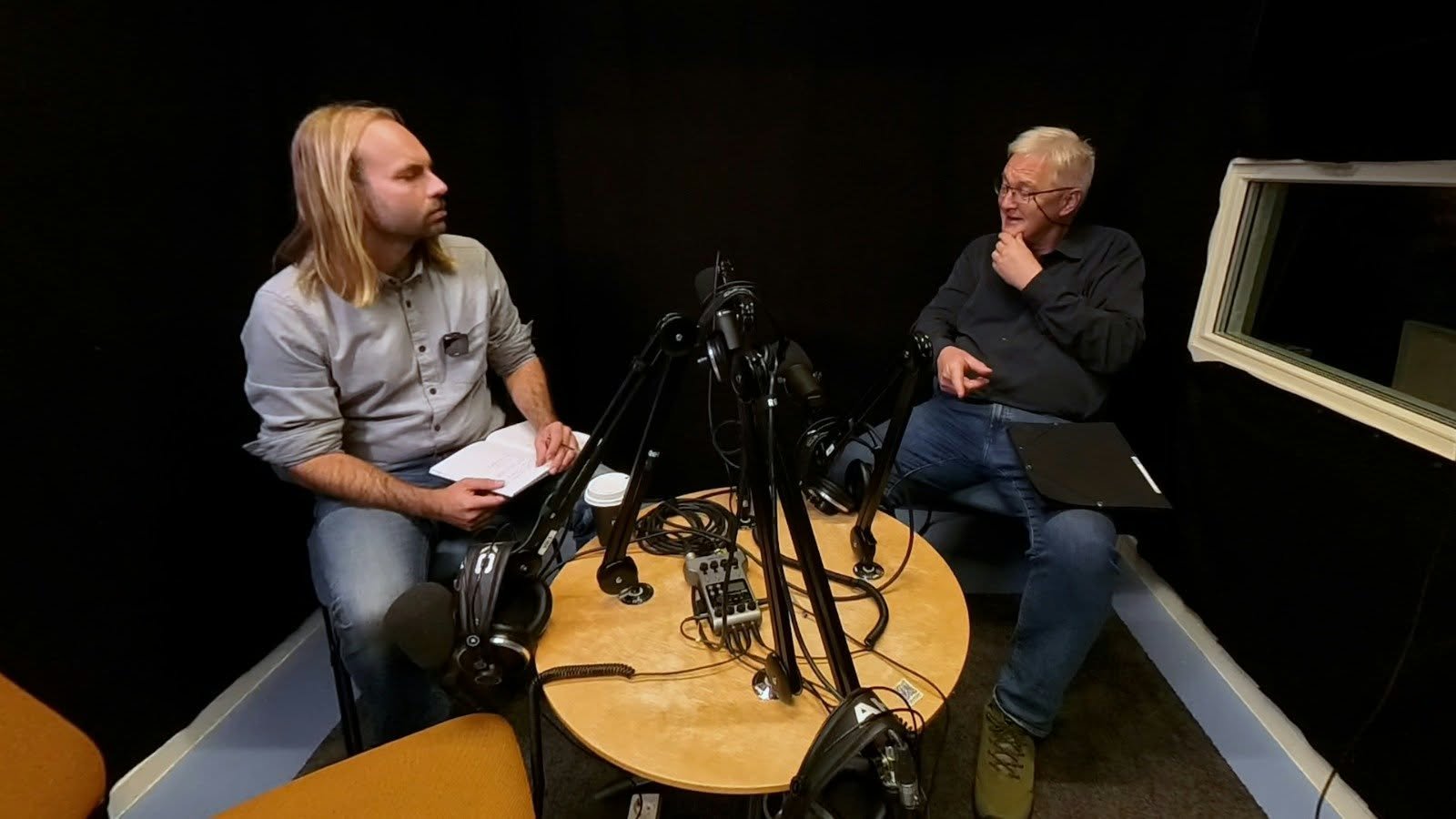
Eirik Værnes and Yngve Nedrebø in the podcast studio at Bergen Library. Photo: Document
When I heard Yngve Nedrebø on the podcast AVHØRT, I wanted to find out more about him. The former National Archivist had carried out a handwriting analysis of Shada’s suicide note. He disagreed with Rodgeir Vinsrygg’s view that Shada had been murdered, and at the same time he was deeply involved in child welfare cases and had played a part in bringing Norwegian cases before the European Court of Human Rights. I travelled to Bergen to interview him. Here I’m trying to piece together the threads from our first episode, which was broadcast on Brennbart on Tuesday 13 October.
Yngve Nedrebø first took us to an old house in Bergen city centre. The first children’s home in Norway. He explains that children were taken off the streets and placed there alongside criminals and prostitutes. The streets were cleared, but many children began their criminal careers at the children’s home.
Bergen Manufakturhus was built in 1646 and was the first institution for orphaned children. There, they were to learn a trade. But after a year, the institution also began taking in women of loose morals. Gradually, criminals arrived too, and the children may well have been taught things other than crafts. The house remained in operation until around 1880.
We moved on to the library in Bergen city centre, where we set ourselves up to conduct an interview.
Documenting abuse
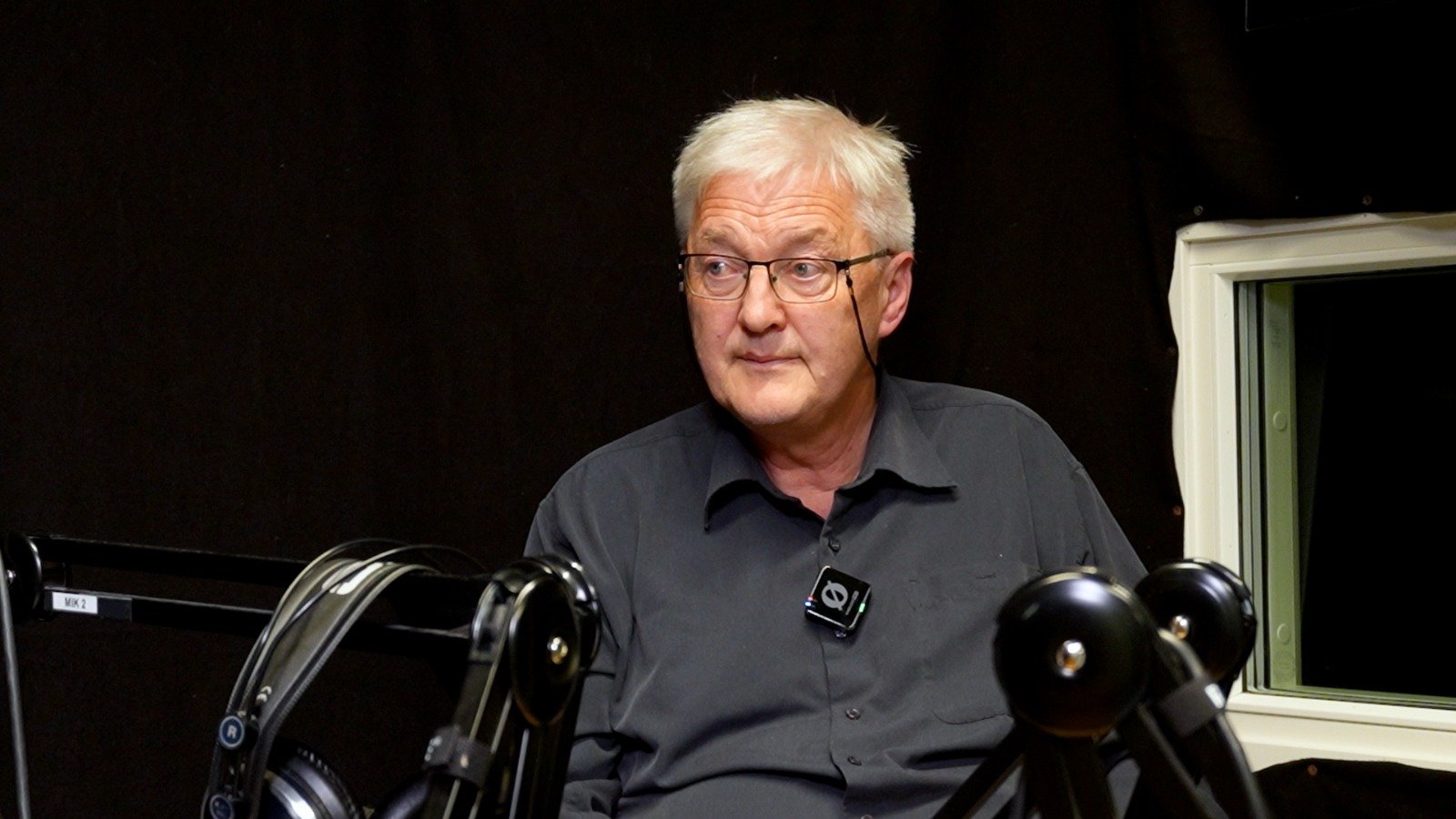
Historian Yngve Nedrebø. Photo: Document
Nedrebø is a historian and, for almost thirty years, was the head of the National Archives in Bergen, where he was responsible for an enormous amount of historical material — a total of 260 million pages — which he quality-checked and made available to the public.
It was whilst investigating conditions at children’s homes in Bergen that he became interested in child welfare. Many of the victims, who lived in children’s homes between 1954 and 1980, said they had been subjected to abuse.
Bergen City Council refused to investigate the matter; City Council Leader Anne-Grete Strøm-Erichsen believed it would be offensive to those who had worked at the institutions, who were now deceased and unable to defend themselves against the allegations. The municipal council refused to let the matter rest, and the Drægebø Committee was set up. State Archivist Nedrebø was tasked with locating documentation and interviewing survivors from the institutions.
The Drægebø Committee’s report was published in 2003 and concluded that sexual abuse and physical abuse had taken place, and that the supervision of the children had been inadequate.
Closed doors in court
But Nedrebø’s involvement did not stop there. He was active in several legal proceedings and spoke in our interview about his experience of them. On how Norwegian courts close their doors when child welfare cases are underway and the public is denied access.
Since 1890, Norwegian courts have not published transcripts of criminal cases. How, then, is one to know what has taken place? If cases are to be reopened, there is nothing to build on, neither witness statements nor expert opinions. These are only reproduced in summary form in the judgement.
Nedrebø cites a case from 1906, in which a man and his two sons were convicted of the murder of a neighbour. In the 1930s, the convicted men managed to have the case reopened. But there were no court transcripts. There was nothing else to go on but a journalist’s presence in court. Fortunately, he had documented the proceedings, and the newspaper reports proved crucial to their acquittal.
In 2005, it was decided that audio and video recordings of all court proceedings.
However, the courts were not allocated the necessary funds and could not afford to purchase the equipment or implement the decision.
What happens when participants in a court case purchase their own equipment?
Nedrebø appeared in a court case in 2017 and purchased equipment to film the proceedings. The judge initially refused to allow him to use it. He was then allowed to make recordings, after presenting a letter from the Minister of Justice, Anders Anundsen. However, Nedrebø was told by the judge that he would not get either the recording or the equipment back!
Something is wrong when the courts want to keep the contents of a trial hidden from the public. Are there any reasons other than a lack of funds for not allowing court proceedings to be filmed?
Nedrebø estimates that the Child Welfare Services win 98 per cent of their cases in court. If the trials had been held in open court, Nedrebø believes the cases might have gone in favour of the parents in 80 to 85 per cent of instances.
The need to protect the children is another excuse for denying public access.
At the European Court of Human Rights, child welfare cases are heard in open court. Those observing the proceedings are instructed to respect the child’s privacy, “and that is good enough”, says Nedrebø.
Generates money
The quality of the legal work carried out in child welfare cases is therefore poor. Nedrebø attributes some of the blame for this development to the country’s oil wealth. There has been little criticism of public spending. People have been able to position themselves advantageously to milk the public purse.
Expert psychologists can earn good money by writing reports, but according to Nedrebø, many of the reports are ‘cut and paste’ jobs from previous cases. This is revealed when names and addresses other than those being discussed appear in the expert’s report. Many psychologists are dependent on assignments from child welfare services and the public sector, and therefore do not go against their wishes, according to Nedrebø. At the same time, municipal lawyers are hired on a contract basis and must win cases at any cost, otherwise they lose their contracts with the local authority.
It is no longer the case, as it once was, that those with paedophilic tendencies are drawn to children’s homes and accept low wages. There is now plenty of money in the child welfare industry. Yet at the same time, the stories of sexual exploitation of defenceless children have not disappeared.
Rape and jealousy
Several stories have come to light in recent years. Tanya Nysveen recounts life in a child welfare institution, and how relationships developed between male staff and the girls living there, which could also cause jealousy amongst the female staff. Nysveen says she was raped whilst she was a resident at the institution, and that those responsible still work with children and young people.
Amir was a foster child of a man who ran two child welfare companies and made millions from them. At the same time, the man sexually abused his own foster son. Before the trial was due to begin, Amir took his own life. The man was sentenced to two years and two months in prison, but he still sells services to child welfare services.
Yngve Nedrebø raises questions about who the clients of this foster father and his child welfare companies were. When Nedrebø mentions that the Drægebø Committee revealed that, in some cases, children were ‘rented out’ to private companies at weekends, and that children’s homes opened their doors to people who came in to abuse children, one might well ask whether this is still happening today. And if so: how organised is it?
How important is the presence of journalists in court? If the media are barred from court proceedings – as there have been several attempts to do recently – judges, lawyers and defendants are allowed to dictate the narrative.
Nedrebø believes that what we are seeing is merely the tip of the iceberg when it comes to abuse. In France, it was revealed that abusers linked to the Catholic Church abused an average of 100 children each. This emerged in a 2021 report covering the years 1950–2020.
With the Epstein revelations in mind, we can allow ourselves to think a little further ahead. Could the stories coming to light be signs of something much bigger and perhaps even more malicious than we have so far imagined? Do we dare to dive into the ice-cold water to find out more?
Next week, you can watch the next episode with the historian. Tune in to Brennbart on Tuesday 20 October at 8.00 pm.
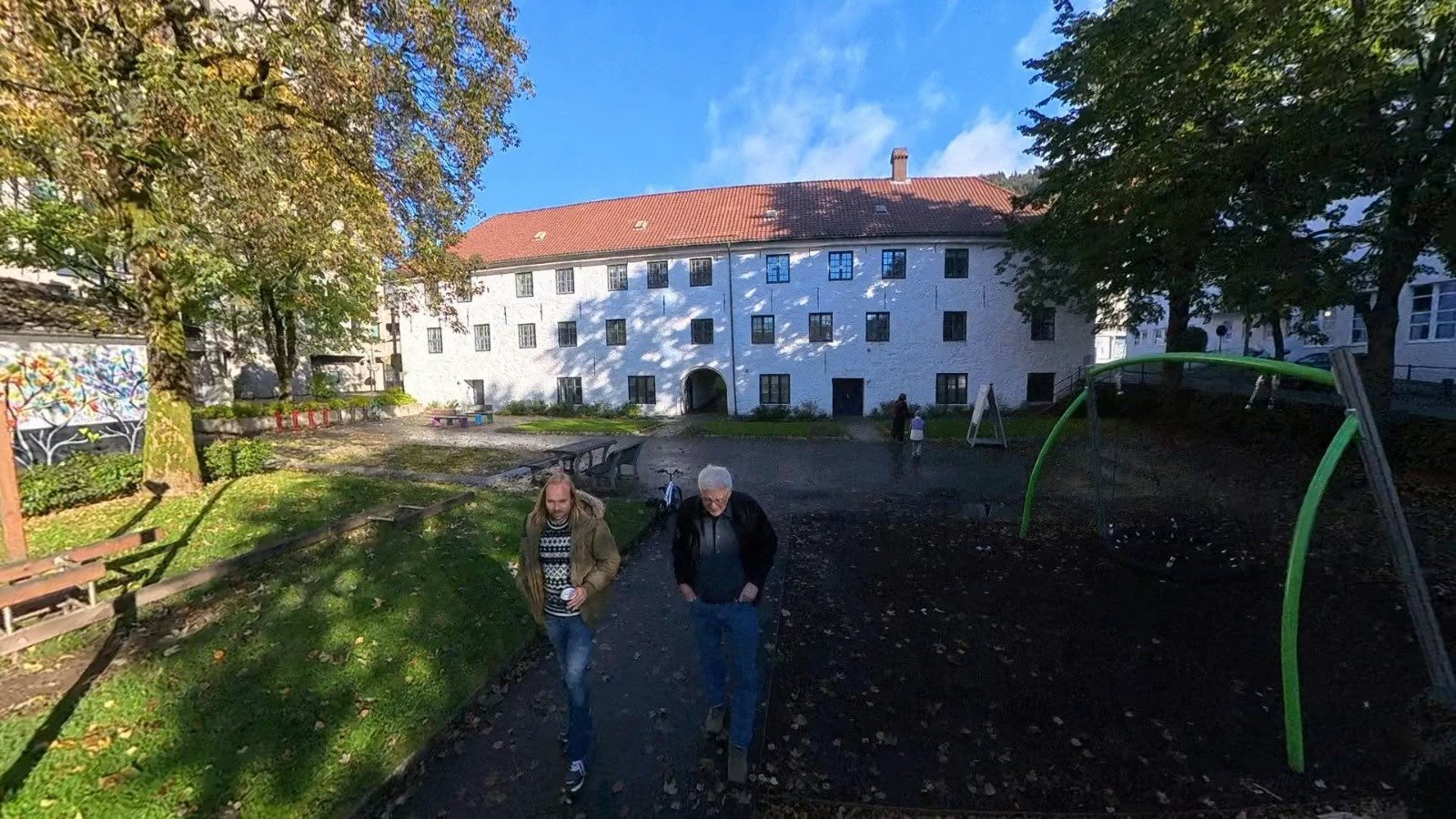
On the way out of the Bergen Manufactory. Photo: Document
Act on the Recording of Court Proceedings
AVHØRT’s interview with Yngve Nedrebø
Tanya Nysveens talks about life in an institution


