



Last week, US Secretary of State Marco Rubio delivered a rousing passionate speech in front of the Acropolis. The backdrop of the ruins illustrated two points. Firstly, the past as a present reality – the heritage from which we – both the US and Europe – stem, our shared Western civilisation. Secondly, the past as a living tradition upon which we must continue to build.
In short, it was a vital speech about the future of the West. Rubio posed the question: What is it that we are defending? Why do we wish to carry our civilisation forward? And so the Acropolis served as a reminder of both creative power and transience. For the West will disappear without the will and the drive. We lack not only capacity, but also cultural self-confidence.
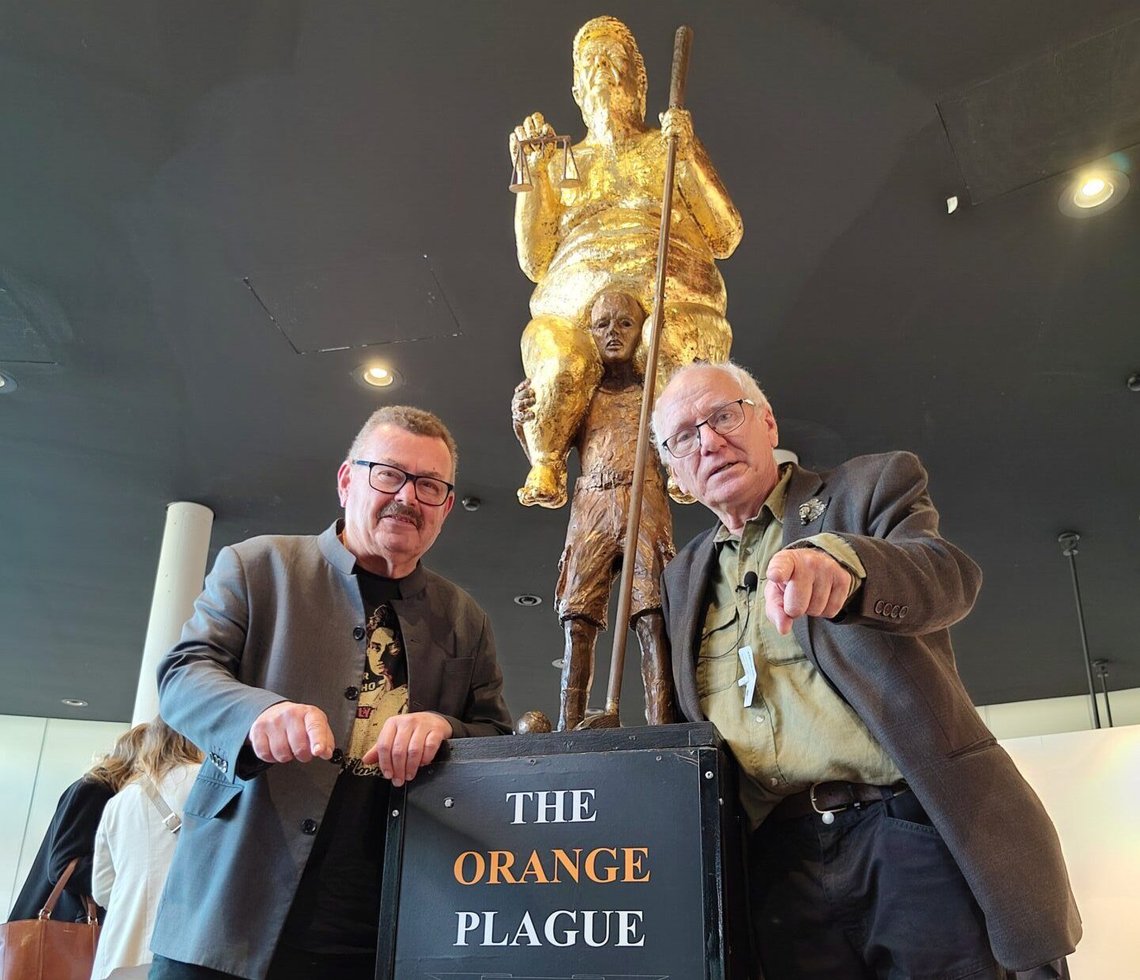
Within the Western community, Europe has become a millstone around the neck. Europeans have become listless losers sinking into complacency, as the new sculpture in the European Parliament illustrates. It is a monument to disgrace, created by a radical left-wing charlatan artist with the aim of defaming Trump and, by extension, Europe’s most important ally. Censorship, mass immigration, regulation and low growth, a lack of defence capability, inefficient energy policies, undemocratic centralisation – the EU excels at all of these.
Europeans have become ‘the last men’ of history, as Nietzsche warned.
The ruins behind Rubio were thus not merely a backdrop, but a question to those who still live: we can still admire what our civilisation has created. But do we still believe that we ourselves can create something similar?
What the West has in common: a civilisation
Rubio’s perspective was civilisational, and in this he drew on Samuel Huntington’s famous ‘Clash of Civilisations’ paradigm, in contrast to Francis Fukuyama’s idea that we have reached the end of history with our supposedly universal form of society based on human rights and liberalism.
No, the West is not universal, but rather a historical and cultural community. The West’s classical heritage consists of Greek philosophy, Roman law and Christianity, from which strong nations, cohesion, prosperity and freedom spring forth. The alliance with the USA can tell us who we are fighting alongside. A civilisation can tell us why.
It is, in fact, crucial that Europeans join forces, for there is no automatic movement towards a single, shared world model. The Chinese and Muslims will not become like us. On the contrary, they will become our opponents and perhaps even enemies whom we will be forced to fight.
Nor does modernisation entail Westernisation. The fact that the Chinese are far more efficient than Europeans in new technologies such as nuclear power and artificial intelligence does not mean that they will become like us. It means that they will become formidable opponents.
Western values do not prevail simply because we like them. As Huntington was notorious for writing: the West did not dominate the world because of our values, but because we were so damn good at using organised violence. Strength means everything in the new – as well as the old – world order.
‘Down with us!’ and European self-hatred
It therefore calls for, as Rubio said, a conscious assertion of self. That is what lies in the Greek word thymos.
Paradoxically, it was Fukuyama himself who brought this concept back into the spotlight, writing convincingly about it in his book ‘The End of History and the Last Man’. But he never drew the full consequences of it.
Europeans in particular have lost that thymotic passion, the urge to assert themselves and prevail over their rivals. Fukuyama warned against becoming ‘the last man’, but that is precisely what his disciples in the liberal elite have become by insisting on denigrating the West and permitting mass immigration, thereby allowing our enemies to settle within our walls.
Thymos: The fire of speech
Thymos denotes courage, pride, a fighting spirit, a sense of honour, and the urge to excel. It means regarding something as valuable and being willing to make a sacrifice for it.
In terms of realpolitik, this means that Europe must cease to be a weak client of the US. This is also the US’s wish, something that not only Rubio but also Vance have repeatedly stated to grumbling Europeans who believe that the alliance with the US is now over.
The point of the American message is that Europeans must learn that civilisation is a task, a continuous exercise of will, not merely a possession. Comfort may sustain life, but it does not give life direction. That is why Rubio attacked the lowlands of mediocrity where no one rises above, and focused positively on ambition and the creative drive.
His speech was a defence of the idea that excellence must once again become an ideal, of duty and achievement. To strive beyond one’s own comfort. To become a kind of ‘first people’, disciplined by the forms of civilisation: love for our own rather than hatred of others.
Forward-looking conservatism
Thymos is the driving force that turns cultural heritage into more than mere cultural consumption. No conservative wishes for a regression to an idealised golden age. Tradition, on the other hand, serves as a source of energy for new endeavours. Faith, philosophy, art, science and technology are different forms of creative power. It is in the forge of tradition that new forms are hammered out of old metal.
That is why the Acropolis was an obvious backdrop: the monument as a challenge. We must not merely preserve what the dead have created. We must ourselves create something worth leaving behind for future generations once we ourselves are dead.
That is the positive challenge in Rubio’s thymotic impassioned speech. The West must rediscover the will to carry on the legacy of civilisation.
We must hope that our future leaders, inspired by this thymotic passion, can realise this legacy. And that Rubio becomes the next President of the United States.


