

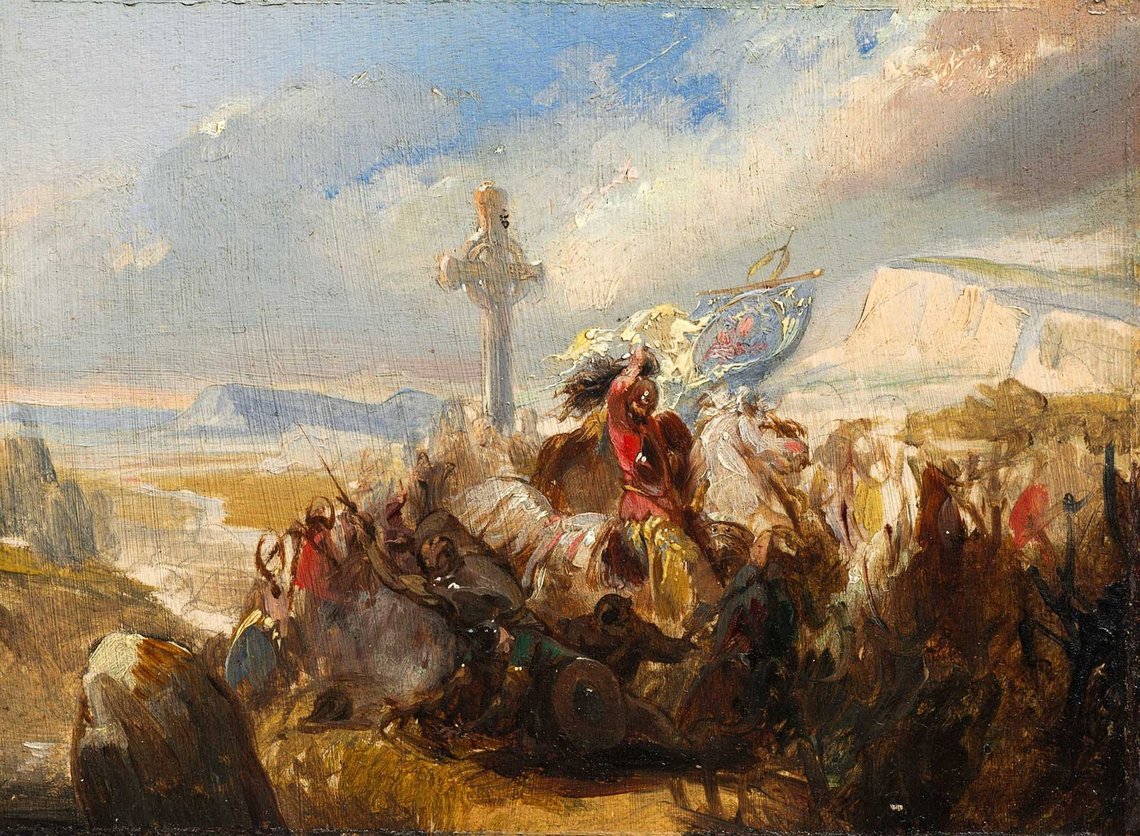


On 10 October 732, Europe stood at a crossroads. The outcome was decided by a wall of shields on a hill between Tours and Poitiers – and by the man who would come to be known as ‘The Hammer’ – Charles Martel.
Two armies met on the plains between Tours and Poitiers. On one side was a formidable Frankish force led by Charles Martel. On the other stood a well-trained and battle-hardened Islamic army from the mighty Umayyad Caliphate in al-Andalus, led by Abd al-Rahman al-Ghafiqi. The outcome was to have a profound impact on the future fate of Europe.
Towns fell, churches were plundered, men were killed, women were raped
What followed was to become one of the most decisive battles of the Middle Ages. A confrontation that many historians believe determined whether Western Europe would remain Christian – or become part of the Islamic world.
In just over a hundred years, Islamic expansion had transformed the Mediterranean region. After Muhammad’s death in 632, the Muslims conquered vast territories. Syria, Egypt and North Africa came under their control. In 711, the Muslims crossed the Strait of Gibraltar from Ceuta and began the conquest of the Visigothic Kingdom on the Iberian Peninsula.
The battle was the culmination of several decades of Islamic expansion from the Iberian Peninsula and further into what is now France.
Having conquered almost the entire Visigothic Kingdom in Spain, they crossed the Pyrenees. In 732, Abdul Rahman Al Ghafiqi led a large army into Aquitaine. Towns fell, men were killed, women were raped and taken as sex slaves, churches were looted and set alight – and the Frankish nobility was crushed.
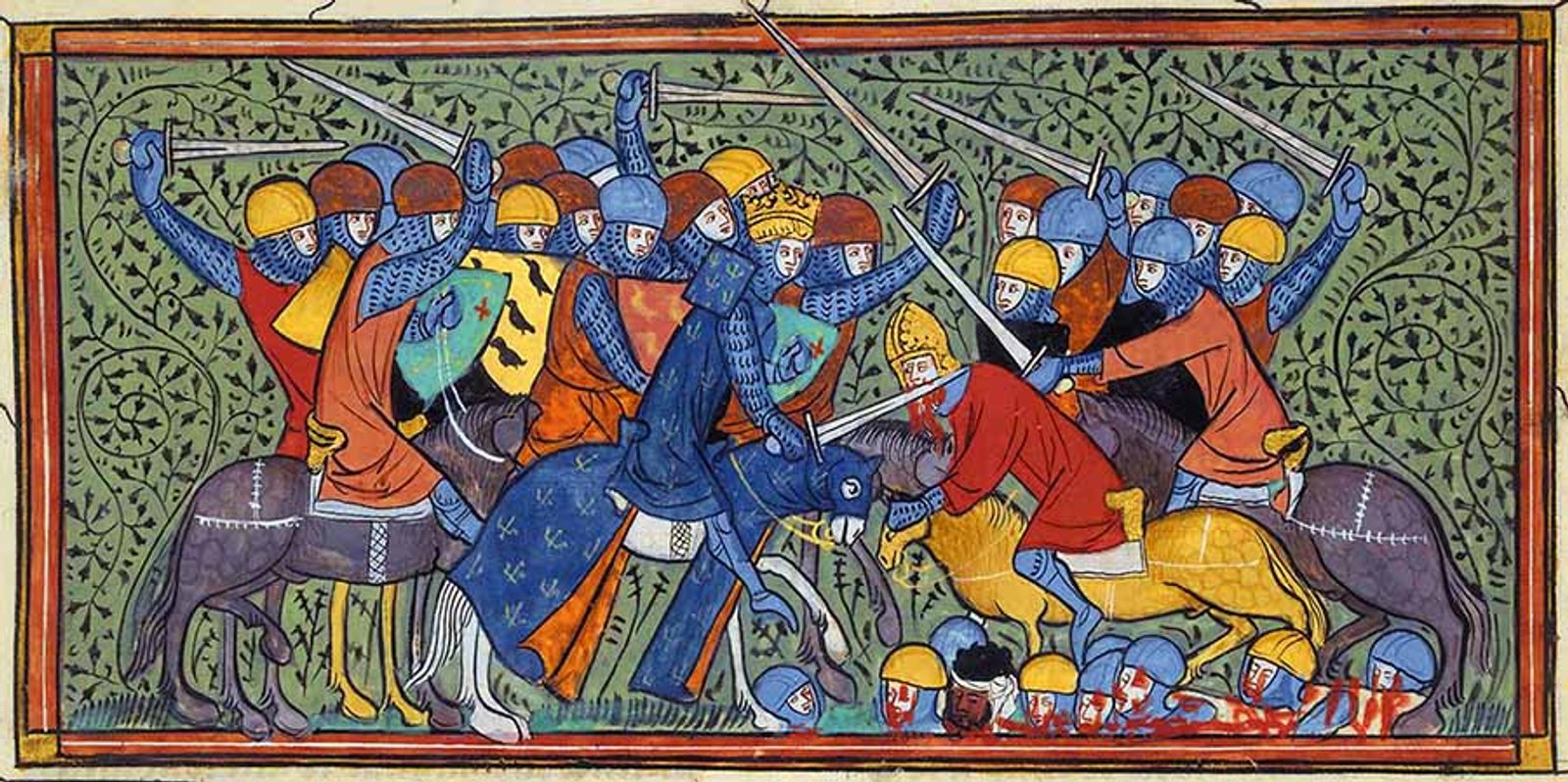
Charles Martel at the Battle of Tours, Great Chronicles of France
The initial aim was not necessarily to conquer the whole of France. The campaign took the form of a major military raid aimed at gradually expanding the influence of Islam – and plundering wealth and spoils.
‘The Hammer’ Charles built a formidable military power base
The army marched through Aquitaine, a region that enjoyed a considerable degree of autonomy under Duke Odo (or Eudo). Odo, who had previously attempted to cooperate with the Muslims, was taken by surprise; he fled northwards and asked his former rival Charles Martel for help.
Charles Martel was not king of the Frankish realm, but real power was increasingly concentrated in him and his family, who had built up a formidable military power base.
When Odo asked for help, Charles saw an opportunity both to defend the Frankish kingdom and to strengthen his own position.
Charles marched south. The two armies met between Tours and Poitiers. The exact location of the battlefield is a matter of debate, but the area is associated with the plains near the rivers Vienne and Clain.
The Christian army consisted mainly of heavily armed infantry, whilst the Muslims had a greater proportion of mobile forces and cavalry.
Abdul Rahman led a classic early medieval Muslim army: light and medium cavalry, archers and a core of experienced warriors. They were mobile, confident after years of victories – and expected a swift triumph.
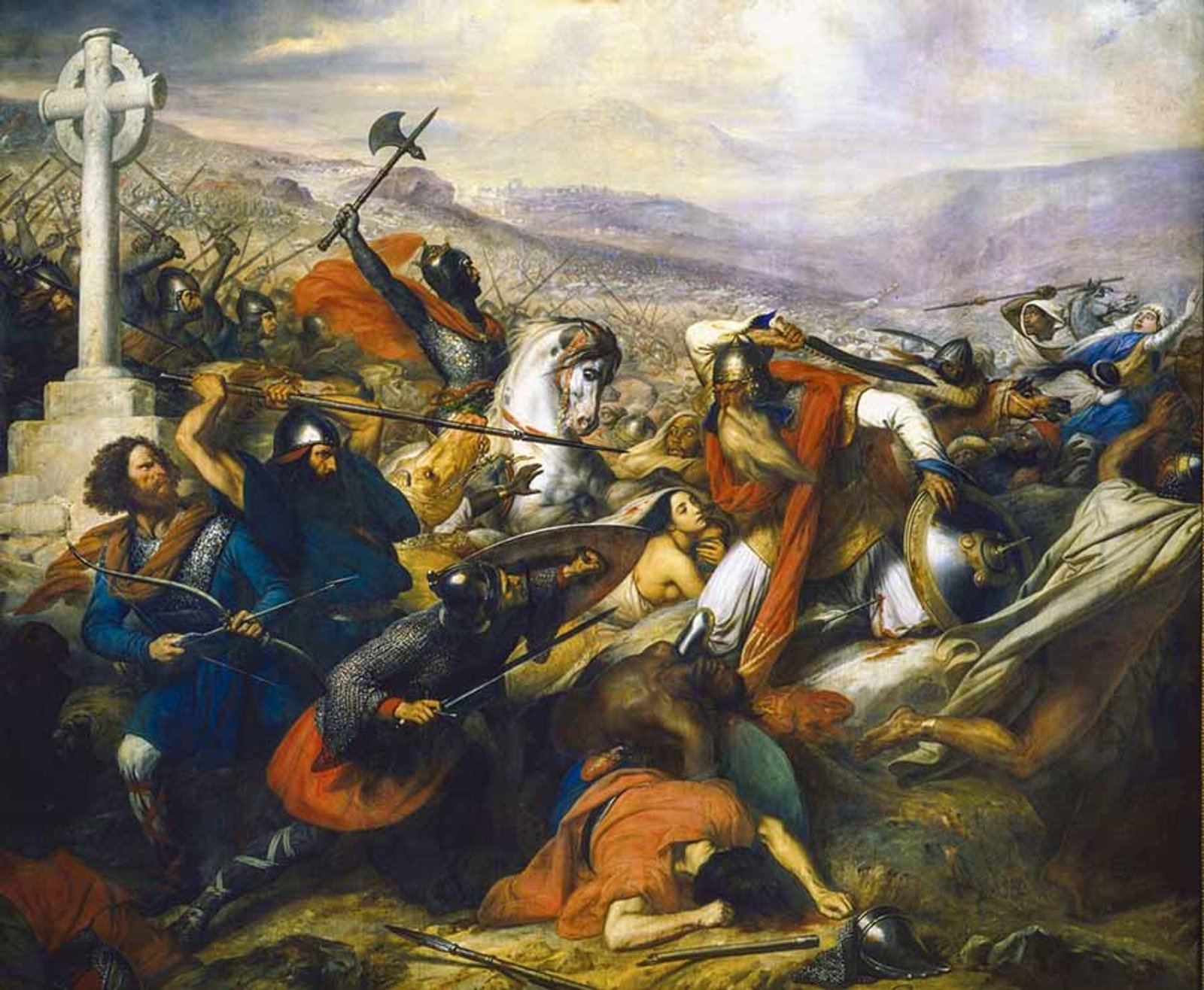
Charles de Steuben (1788–1856); Battle of Poitiers, October 732
On 10 October, the battle began
Charles Martel avoided open plains where the cavalry could dominate. He deployed his men in a dense, almost impenetrable formation of infantry on what was probably a wooded hill. There, the Franks formed what contemporary sources describe as a ‘wall of ice’ of shields and spears. Charles’s men were characterised by high morale and discipline.
For several days, the armies faced each other without any decisive confrontation taking place. The Muslims tried to lure the Franks into open battle. Charles held his ground – but on 10 October, the battle broke out.
Waves of Muslim cavalry charged the Frankish line. Again and again. But the formation held firm. The heavy Frankish warriors, armed with long spears and sturdy shields, withstood the attacks.
The Battle of Vienna on 12 September 1683 saved Europe from the Muslims
The fighting intensified dramatically, but the Franks held their ground. Sources describe ruthless close-quarters combat in which large numbers of horses and riders were cut down. The turning point came when Abdul Rahman himself fell in battle. As the news spread, the Muslim army lost its will to fight. At the same time, a small Frankish force is said to have attacked the Muslims’ camp from behind the lines, causing panic that the spoils they had gathered – gold, silver and European women – were in danger.
As night fell, the Muslims fled in disarray
The circumstances surrounding Abdul Rahman’s death are not known in detail, but the fact that the commander was killed had a dramatic effect. As night fell, the Muslims retreated, and the next morning the Franks discovered that the enemy had vanished. They had abandoned their camp and begun the long retreat towards Iberia.
The Franks had triumphed.
On 10 October 732, Charles Martel, Charlemagne’s grandfather, halted the Muslim advance into Europe at the Battle of Tours.
The Christian Reconquista began in France. It may very well happen again. Just as back then, Western Europe and Islam are, in fact, two incompatible forces.#dkpol pic.twitter.com/AskI2UfDbH
— Peter Rasmussen (@PeterRa58783464) 11 October 2025
Charles Martel pursued the enemy only a short distance. The Muslims’ defeat was crushing. Abdul Rahman was dead, and the vast invading force was in retreat. In the years that followed, Charles undertook several campaigns to the south and secured control of Aquitaine and Provence. The Muslims’ expansion north of the Pyrenees had been halted.
One of history’s great turning points
The Battle of Poitiers has for centuries been portrayed as one of history’s great turning points – the battle in which Charles Martel halted Islam’s conquest of Europe. He demonstrated that the Muslim expansion could be stopped and used the victory to strengthen Frankish power in the region.
Charles died in 741, but his descendants would soon take over the kingship and, a few decades later, build a vast Frankish empire.
His son, Pepin the Short, deposed the last Merovingian king in 751 and became king of the Franks.
Under Pepin’s son, Charlemagne, the Frankish empire grew to encompass large parts of present-day France, Germany, Italy and Central Europe.
Thus, the victory at Poitiers also became part of the history of the emergence of Carolingian Europe. In other words, Charles Martel’s victory had political significance that extended far beyond the battlefield.
But the Muslims did not disappear
The Battle of Poitiers did not put an end to all Muslim military activity in Gaul. Muslim forces continued to operate to some extent north of the Pyrenees, and Charles Martel launched further campaigns against Muslims in southern France in the years following 732.
On the Iberian Peninsula, al-Andalus was to endure for almost 800 years. It was not until 1492 that Granada was conquered by the Christian kingdoms – the last of the Muslim kingdoms on the Iberian Peninsula.
Charles Martel eventually attained an almost mythological status. In Christian European historiography, he is the man who halted the Muslim advance, and the Battle of Poitiers has come to be regarded as ‘the battle that saved Europe’. The battle took place at a time when the Islamic world was at the height of its expansion. At the same time, the Frankish Empire was in the process of developing into a dominant power in Western Europe.


