

The Nordic countries dominate this year’s happiness rankings. At the same time, Iceland, Norway, Sweden and Finland have the highest suicide rates amongst women in Eurostat’s latest European comparison.
In the World Happiness Report 2026, Finland, Iceland and Denmark take the top three places. Sweden comes fifth and Norway sixth. Five of the world’s six highest-ranked countries are therefore Nordic.
However, another statistic reveals a darker side.
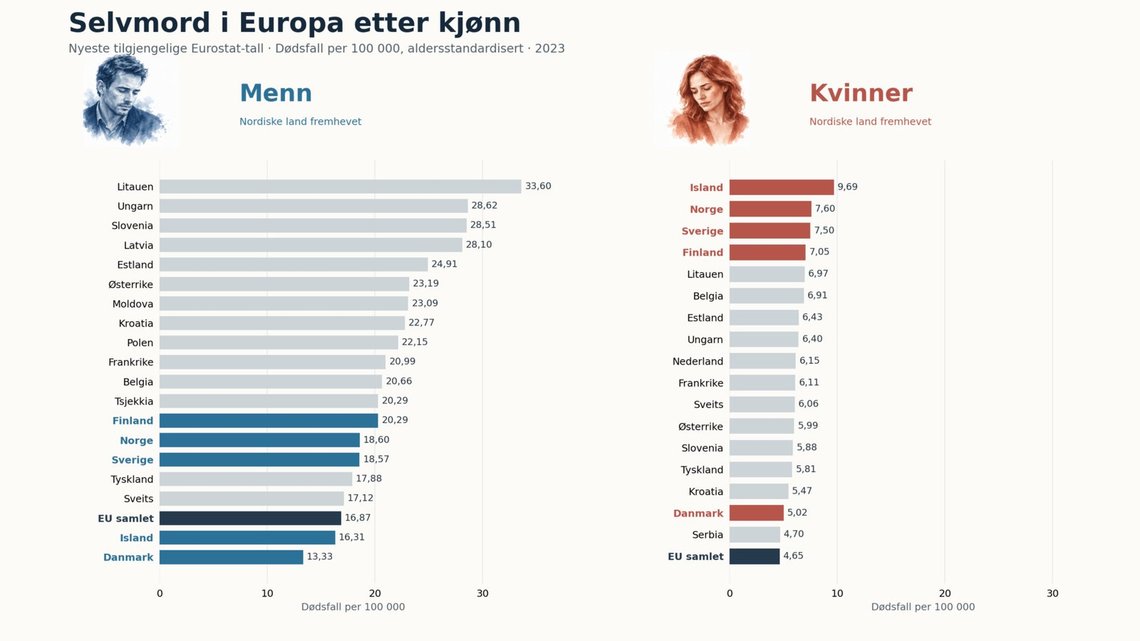
In Eurostat’s latest available comparison of suicide rates amongst women, Iceland has the highest rate, followed by Norway, Sweden and Finland. The four Nordic countries have the highest rates amongst the countries with available figures in the dataset. Iceland has 9.69 suicide deaths per 100,000 women, Norway 7.60, Sweden 7.50 and Finland 7.05. The EU rate is 4.65. Denmark also exceeds this, with 5.02. Eurostat presented the latest suicide figures in September this year. Due to the time lag in cause-of-death statistics, the comparison relates to deaths in 2023.
The figures are age-standardised: the countries are compared as if they had the same age distribution. Differences in the number of young and older people living in each country should therefore not influence the result.
Men nevertheless die by suicide far more often than women. The EU rate for men is 16.87. Lithuania, Hungary and Slovenia have the highest rates in the comparison. Finland, Norway and Sweden are above the EU rate, whilst Iceland and Denmark are below it.
High levels, mixed trends
The high rates among women do not mean that suicide is becoming increasingly common amongst women in the Nordic countries. Eurostat’s time series show that all five Nordic countries saw an increase from 2022 to 2023. Compared with ten years earlier, however, Finland, Sweden and Denmark still had lower rates. Norway’s rate was slightly higher, whilst Iceland’s was roughly the same, with significant fluctuations along the way. Furthermore, Iceland’s small population means that relatively few deaths can have a major impact.
For Norway, the Norwegian Institute of Public Health that the rate among women has remained fairly constant since around 1995. In 2024, 196 women died by suicide, compared with 198 the previous year. The overall increase in 2024 was among men.
Risk factors
The Nordic Council of Ministers’ research review from 2024 describes several known risk factors. Mental health disorders, substance abuse and serious physical illness are associated with a higher risk of suicide. Separation, divorce and the loss of a spouse are also associated with an increased risk. Marriage and parenthood are associated with a lower risk; young children in particular appear to be a protective factor for mothers. Among older people, studies point, amongst other things, to undiagnosed depression and a reluctance to become a burden on others.
This is knowledge about risk among individuals. It does not provide a definitive explanation as to why Nordic women rank so highly in the European comparison.
What does ‘the happiest in the world’ mean?
The World Happiness Report bases its ranking on people’s overall assessment of their lives on a scale from zero to ten. This year’s ranking uses the average of responses from 2023–2025. It therefore measures the population’s average assessment of their lives, not the absence of mental illness or despair.
The report’s Nordic review from 2020 also emphasised that the Nordic region does not dominate in the same way when it comes to measuring positive emotions. High happiness scores and severe despair amongst a small proportion of the population can co-exist. However, the top positions in the happiness rankings do not explain why so many Nordic women are lost to society. That question remains unanswered.