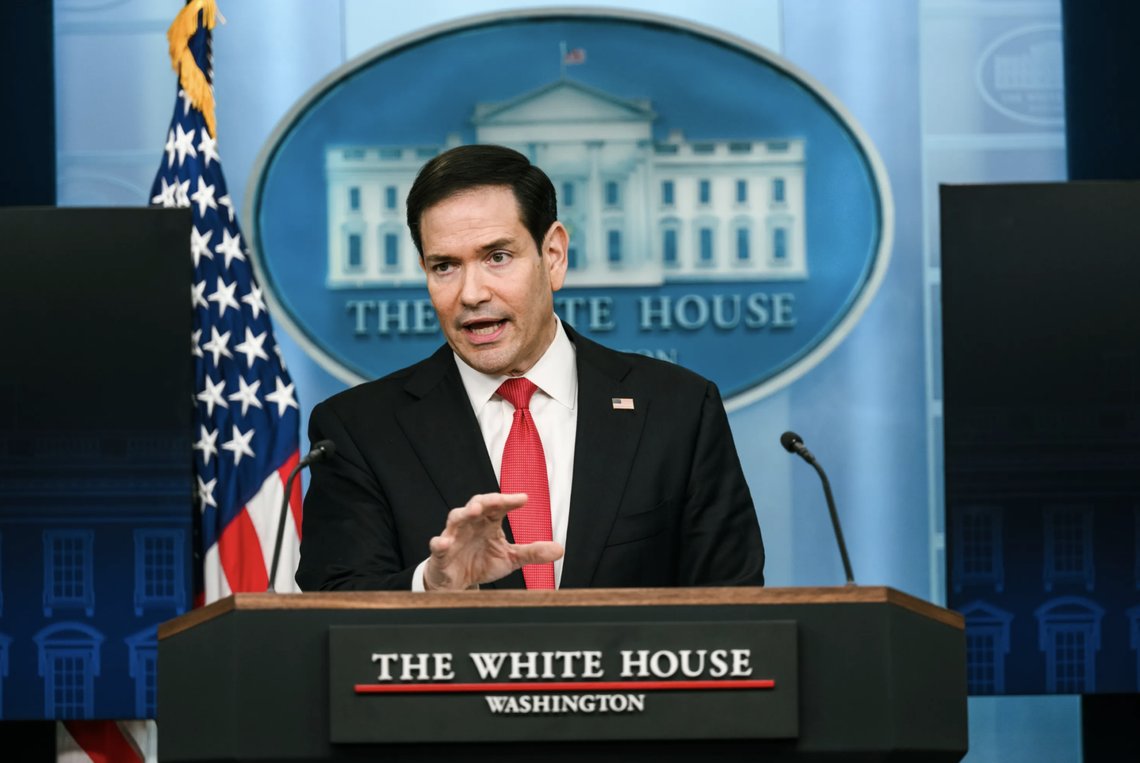


The war in Ukraine is in a strategic stalemate, and that is dangerous, says Marco Rubio. Without a negotiated settlement, the war risks escalating beyond its original boundaries, according to the US Secretary of State.
Rubio gave this assessment of the war in Ukraine, as well as several other geopolitical issues, in an interview with Kathimerini during his recent visit to Greece, where he delivered an important speech in front of the Acropolis.
You have said that the war in Ukraine is not, in essence, the US’s war, but it is a war that is still ongoing. Is there any chance it might come to an end?
Well, unfortunately it looks set to enter its fifth year, which was never the original plan. I don’t think that was Putin’s plan for this war, so it hasn’t gone the way he planned.
And I believe, unfortunately, that the situation is now at a strategic stalemate, and that is dangerous. Strategic stalemates are broken in only one of two ways: a) through a negotiated settlement, or b) through escalation by one or both sides, which ends up spreading beyond the boundaries of the original conflict.
At the moment, there appears to be no prospect of a negotiated solution. We are prepared to play whatever part we can to make that happen. And we have tried before, but so far it has proved difficult to achieve.
The Russians have defined victory as the whole of Donetsk. They have repeatedly stated that this is their objective, and they continue to uphold it as such. And that is a condition which is quite simply unacceptable to Ukraine.
A diplomatic solution has thus eluded us, but we are prepared to help bring it about, should we be able to play a constructive role. In the meantime, we are monitoring the situation with great concern, as it could escalate.
As recently as yesterday, several ships were attacked in the Black Sea in a coordinated drone strike. We are concerned about a sabotage operation in a neighbouring country that could spiral out of control. And there are clearly obvious signs that Russia intends to use the coming winter to destroy what remains of Ukraine’s power grid and force them to capitulate.
At the same time, Ukraine has become more effective in its ability to carry out long-range strikes deep inside Russia. So we share the same concern. The whole world views this situation as something that could escalate and perhaps develop into a wider conflict.
In the interview, Rubio also spoke about the world’s need to diversify its energy supply, the importance of maintaining functional relations between Greece and Turkey, and the situation in Iran, where he believes the Iranian regime is at risk of facing a revolution in the near future.
In conclusion, Rubio made some references to what, at the time of the interview, was his imminent Acropolis speech:
What makes our relationship with countries in Europe, particularly places like Greece, so special is that so much of what we have in our country – literally, from the architecture to our system of government – has its roots in our shared cultural heritage; that is the core. It is this that keeps these things alive and vibrant. And we must constantly remind ourselves of this. We should be proud of Western civilisation, not apologise for it. That does not mean that we hate other civilisations or other cultures, or that we reject them. This is by no means discriminatory. But we should be proud, not ashamed, of our shared heritage, because it underpins our system of government; it is the foundation of our history; it is the foundation of our alliance.
The speech revealed a side to Rubio that is leading many to wonder whether he is a potential presidential candidate in 2028.