
 Arnt Jensvoll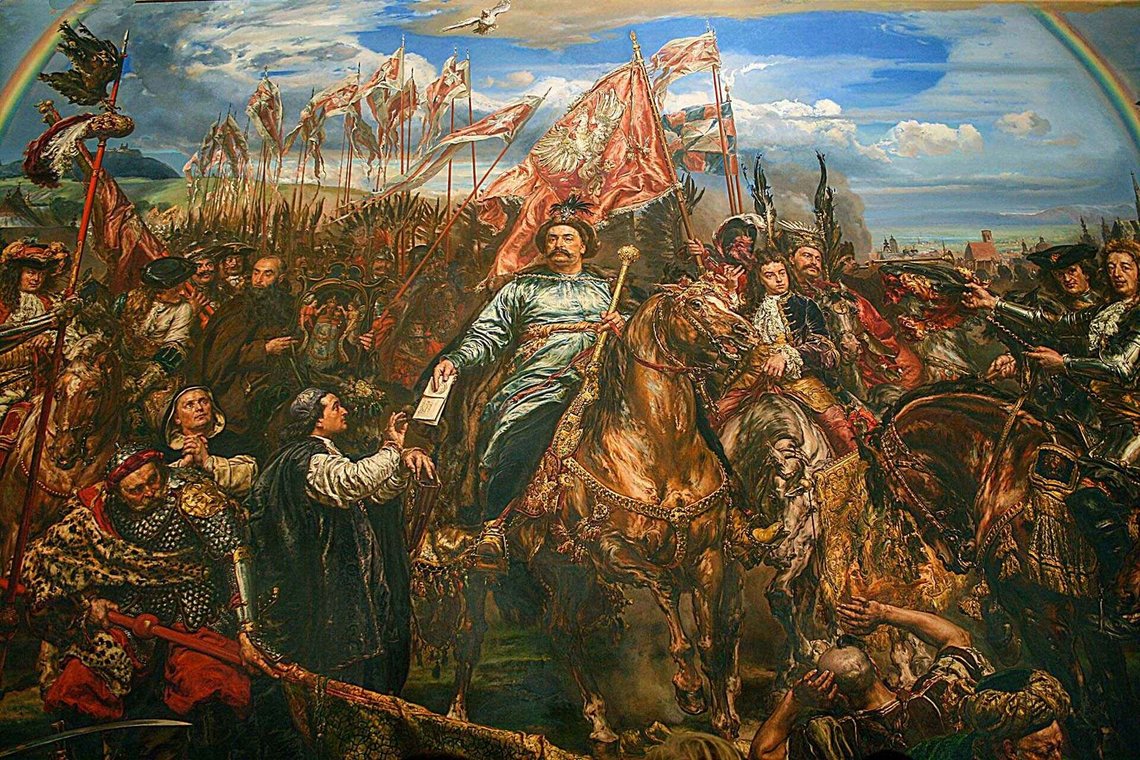
In 1683, Jan III Sobieski led an alliance of Polish and Holy Roman Imperial forces to relieve Vienna, which was under siege by the Ottoman Empire. Sobieski personally led the largest cavalry shock attack in history, in which 18,000 horsemen – including 3,000 Winged Hussars – crushed the Muslims in less than an hour.
In 1683, Europe faced an existential threat. An enormous Muslim army of between 90,000 and 150,000 men under Merzifonlu Kara Mustafa Pasha had besieged Vienna for more than two months. The city was on the verge of falling. An exhausted garrison under Ernst Rüdiger von Starhemberg fought desperately to hold its position when relief arrived on 12 September – led by the Polish king Jan III Sobieski and his legendary Winged Hussars.
Jan III Sobieski
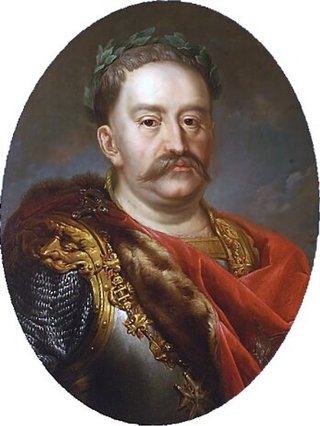
Jan III Sobieski. Painting by Marcello Bacciarelli
Jan Sobieski was born on 17 August 1629 into a noble Polish family in Olesko, in present-day Ukraine. He was educated at the Jagiellonian University in Kraków and subsequently travelled around Europe, learning languages and the art of war.
He began his military career as a volunteer in the army in 1648 after returning home from his European educational journey. In 1666, he was promoted to Field Hetman, military commander-in-chief on the battlefield, and in 1668 was appointed Grand Hetman, commander-in-chief of the Polish-Lithuanian army.
Sobieski fought against Cossacks, Russians, against the Swedish ‘Deluge’ and, not least, the Ottomans. His victory over the Turks at the Battle of Khotyn in present-day Ukraine in 1673 made him a national hero and paved the way for his election as King of Poland in 1674 under the name Jan III Sobieski.
Sobieski was a skilled military commander, a deeply devout Christian and a man of great personal charisma. He was known for his bravery, his physical strength and his ability to inspire soldiers. When he set out for Vienna, he was an experienced commander of 54, convinced that he would halt the Muslims’ expansion in Europe.
The Ottoman Empire under Sultan Mehmed IV sought to penetrate deep into Europe. Grand Vizier Kara Mustafa saw an opportunity when the Kuruc asked for help. The Ottomans declared war on the Holy Roman Empire and marched towards Vienna in 1683.
The Kuruc were Hungarian rebels who fought against the Habsburgs in Hungary between 1670 and 1711.
The Turkish siege of Vienna
The siege of Vienna began on 14 July 1683. The Ottomans dug tunnels beneath the city walls, used mines and put the garrison under intense pressure. The population of Vienna suffered from hunger, disease and constant bombardment. Emperor Leopold I had fled, and things looked bleak for Europe and Christendom.
Pope Innocent XI worked frantically to assemble a coalition. He provided financial support and appealed to European princes for help. The decisive alliance was concluded between Poland-Lithuania and the Habsburg Monarchy in March 1683.
Sobieski promised to come to the aid of Emperor Leopold I. In August/September 1683, he led a Polish army of 20,000–27,000 men northwards.
Along the way, they met and joined forces with troops from Saxony, Bavaria and other German states, in addition to Imperial forces under Duke Charles of Lorraine.
In total, the allied relief force assembled around 70,000–80,000 men. This was the first time Poland and the Holy Roman Empire had cooperated militarily against the Muslims on a large scale. Sobieski was given overall command.
On 6 September, the Poles crossed the Danube at Tulln in Austria. On 11 September, they reached the Kahlenberg hill north of Vienna. From the summit, they surveyed the Muslims and the besieged city.
The battle of 12 September 1683
The battle began early in the morning. The Ottomans attacked first in order to disrupt the Allies’ deployment. The Imperial forces under Lorraine attacked on the left flank and in the centre and captured several villages (Nussdorf, Heiligenstadt).
Sobieski waited. He observed the fighting from Kahlenberg. Late in the afternoon, at around 16:00–17:00, he decided to launch the decisive attack, and at 18:00 the largest cavalry attack in history began.
Some 18,000 Polish, Austrian and German horsemen charged down the slopes. At their head rode around 3,000 Polish Winged Hussars – an elite cavalry force known for its long lances, massive armour and fearsome wing-shaped ‘decorations’ on their backs that made a rushing sound during an attack. Sobieski himself led the charge in his magnificent armour and with the marshal’s baton in his hand.
With the cry ‘Jesus, Mary, help!’ the massive wave broke through the Ottoman lines. The Janissaries and Sipahi cavalry were overwhelmed. Panic spread rapidly. When Kara Mustafa fled from his red tent, the Ottoman defence collapsed.
– We came, we saw, God conquered
The battle lasted around 15 hours in total, but the cavalry attack lasted only half an hour. The Ottomans lost their camp, artillery and most of their equipment. The Allies captured enormous quantities of spoils of war.
Sobieski entered Vienna and was received as a hero. The population hailed him as their very saviour.
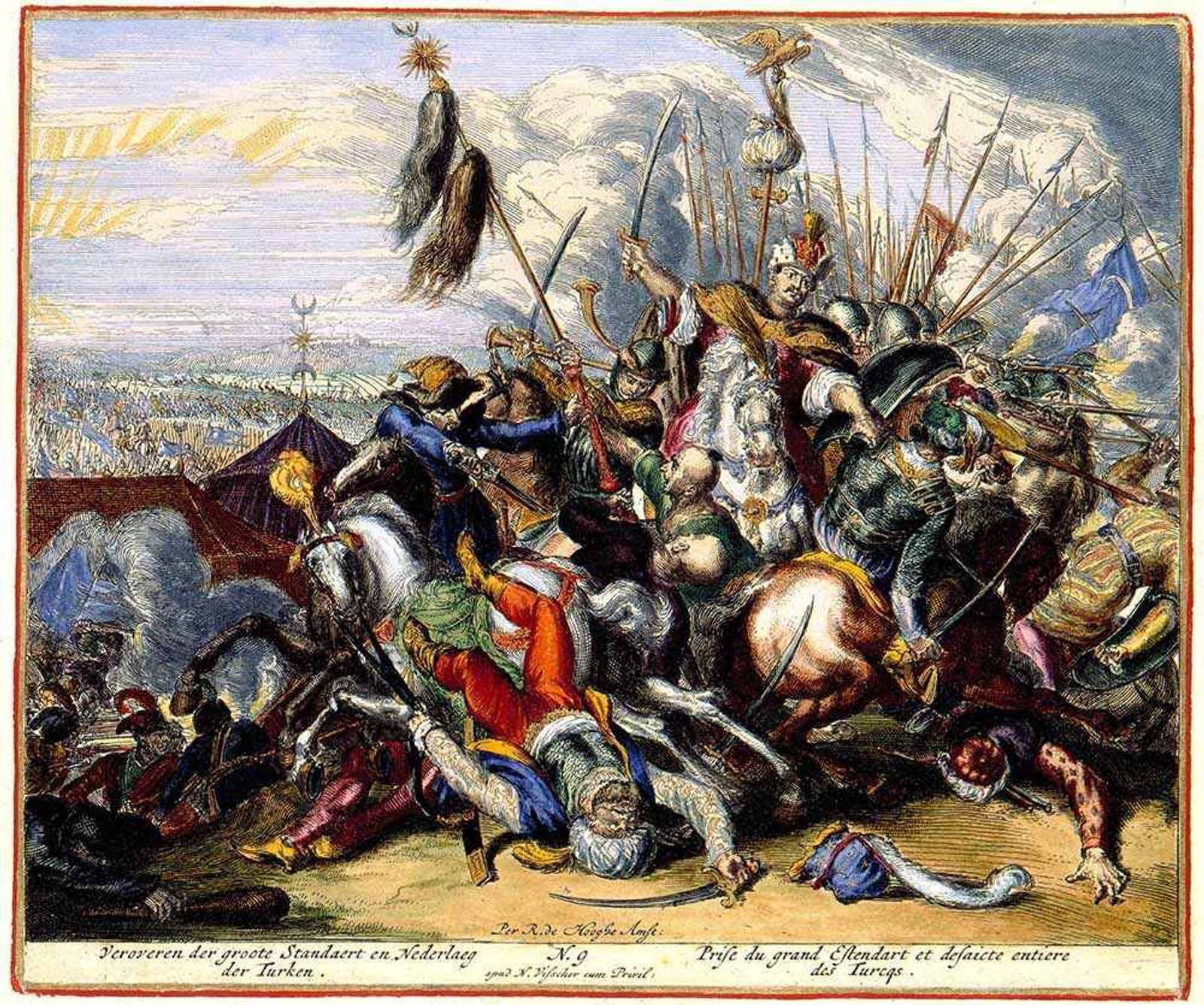
King Jan III Sobieski captures the Turks’ banner. Painting by Jacobus Peeters, Koninklijke Bibliotheek, The Hague.
Sobieski wrote to the Pope: ‘Venimus, vidimus, Deus vicit’, ‘We came, we saw, God conquered’ – a Christian reworking of Julius Caesar’s ‘Veni, vidi, vici’, ‘I came, I saw, I conquered’.
The Ottomans had lost many tens of thousands of soldiers, in addition to the wounded and deserters. Allied losses were far lower, between 3,500 and 4,500.
The victory led to the establishment of the Holy League in 1684, a military alliance organised by Pope Innocent XI, which led to a prolonged offensive against the Muslims. The Habsburg Monarchy regained large parts of Hungary in the years that followed.
The battle marked the beginning of the end of Muslim expansion in Europe. The Ottomans, or Turks, have never subsequently threatened Vienna militarily.
For Poland-Lithuania, the victory was a final triumph. The Commonwealth was weakened by internal conflicts and entered a period of decline.
Sobieski died in 1696, disappointed that Poland had not gained more from the victory.
One of the most decisive battles in European history
The Battle of Vienna is regarded as one of the most decisive battles in European history. It halted Muslim expansion in Europe and strengthened Europeans’ Christian identity.
The Winged Hussars became a symbol of Polish bravery, and Jan III Sobieski became a national hero who is still celebrated in Poland.
Today, the battle is remembered as an example of how a united Europe can withstand an overwhelmingly powerful enemy. Sobieski’s words to the Pope – ‘God conquered’ – emphasised that it was a holy war. Without Sobieski’s victory in 1683, Europe could have been like North Africa today.
But it was also a classic military triumph: good leadership, discipline and a daring cavalry attack at the right moment.
The Winged Hussars were one of the most visually striking cavalry forces in history. They attached wooden frames bearing goose, eagle or vulture feathers to their armour. At a gallop, the wings created a fearsome, loud sound that frightened the enemy’s horses and unsettled the opposing infantry. They wore heavy armour decorated with exotic animal skins to display wealth and status.
Their principal weapon was a 4.5–6-metre-long hollow lance that was light enough to be used with one hand and long enough to strike enemy infantry before they could reach the hussars with their own spears. They rode specially bred Polish horses that combined the strength of heavy warhorses with the endurance and speed of Asian breeds and attacked in a close, wall-like formation.
The combination of speed, the long lances and their fearsome appearance meant that they could break through almost any infantry line. The hussars consisted exclusively of wealthy Polish noblemen who financed their own equipment. They trained for warfare throughout their lives.


