

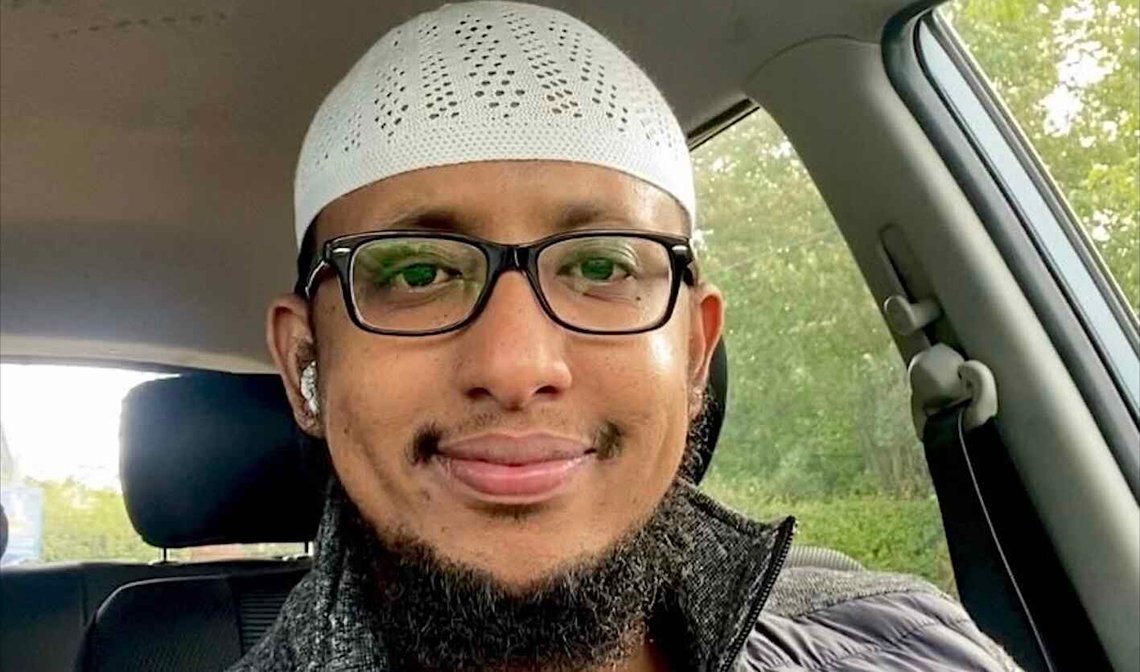
Murder of a family father and an upper secondary school pupil, expenses in the billions, hatred of Danish culture and the undermining of cohesion – five current cases once again demonstrate the totally failed immigration policy.
There are a good many of us who have had enough of foreigners who are hostile towards Denmark. Our patience is used up. Finished. End of story! We simply do not want them here in the country.
Why have they not long since been thrown out of the country, and why have they come here at all? There are – at least – ten reasons for that.
1. Reward of contempt
The more contempt for Denmark a person expresses publicly, the stronger his negotiating position appears to become. The Somali flexijobber Mohamed Abdi Kahn demands 3.5 million kroner from the Danish state in order to travel home to Djibouti, at the same time as he calls Denmark an Islam-hostile and sick society.
We have difficulty tackling the immigration problems, because our institutions are built for citizens who acknowledge the rules of the game, not for those who deliberately exploit them. There is no built-in mechanism in the public debate that punishes this form of incompatibility between words and demands. On the contrary: the more sensational the rejection is, the more speaking time and negotiating weight is gained by the one who makes the rejection.
2. Rights turned against the host country
When Inger Støjberg in BT’s podcast asked whether Kahn was at all grateful for what Denmark has done for him, he answered no. He is, he said, grateful for the European human rights, which protect him against Denmark.
A legal system that was originally built to protect the citizen against the state’s abuses is here used to legitimise an open confrontation with the same country that has given the protection. The rights no longer function as a framework for a common citizenship, but as a protection foreigners can invoke against the national community.
3. The illusion of conversation
Far too many believe that every disagreement can be resolved through arguments, if only we talk enough together. This assumption was challenged when DR’s “Deadline” invited a representative of Hizb ut-Tahrir (HuT) into the studio. The Islamic organisation urges all Muslim upper secondary school pupils in Denmark to hold fast to their identity as Muslims and reject Danish culture. Abdi Kahn has in the same way written that the Koran is more important than all human laws, including Danish law.
We thus have so-called conversation partners who in advance declare themselves released from the legislation the conversation is to result in. Then the very precondition for debate is gone.
4. Liberal democracy as an exception in history
Many also speak of democracy as if it were a state of nature to which man returns, if only he is allowed. “In every Muslim there dwells a liberal democrat who is waiting to break out when the oppressor disappears.”
In reality democracy is a fragile and historically unusual construction that requires active defence in order to endure. The self-evidence with which our form of government is spoken of is itself part of the problem, because it renders us blind to how easily it can be undermined from within.
5. Hijacking of language
A language that was originally developed to liberate the individual is used for the opposite purpose. The popular singer Isam B. has defended the niqab as a feminist choice on the grounds that men like to look at the woman, and that she therefore ought to cover herself.
The burden is placed on the woman, not on the man, who cannot control his gaze. That is also HuT’s strategy. A language of rights, identity and self-esteem is hijacked in order to recruit young people into an anti-democratic movement and to convince naïve Danes.
A curiosity: the series “The Tingbjerg Experiment” showed that the Muslim women despised the woke colonists, because they moved so close in that they could see into others’ flats. It was otherwise the sanctuary where the women could finally throw off the hated niqab.
6. The symptom is confused with the cause
When immigrants commit lethal violence, the reaction directs itself against what the authorities can control, rather than against those who exercise the violence. Bans on “puttefester” and large-screen events are proposed as a response to murder and violence, while focus on expulsion of the criminals is absent.
7. The missing category
When Pelle Dragsted of the Red-Green Alliance was to explain why Hizb ut-Tahrir must be combated, he called the organisation reactionary and right-wing. But Islamism is a collectivist ideology, and it is not a little reminiscent of left-wing socialism.
Correspondingly, pan-Islamism involves a radical break not only with the secular constitution, but with the nation-state itself and popular government. That is to say precisely what the conservative right wishes to preserve. The left thus lacks a conceptual apparatus for an opponent that fits neither on the classical right/left axis. The threat must first be translated into familiar enemy images before it can be made politically acceptable.
As the comedian Brian Mørk aptly wrote on X: “Pelle Dragsted can both create the problem, deny the problem and afterwards place the blame for the problem on those who warned against the problem.”
8. The universalist misinterpretation
Islamism is to be understood on the basis of Huntington’s civilisational paradigm as the expression of a radically different, anti-Western civilisation. But the progressive left sees the Islamist in what Ryan Smith has called a universalist victim image, precisely as a marginalised human being who through inclusion and dialogue can be made progressive.
It is therefore logical that it is precisely the left that historically has had the closest collaboration with Islamist actors, among other things the Red-Green Alliance’s nomination of Asmaa Abdol-Hamid. The civilisational conflict is underestimated time after time, because the optical frame through which it is viewed knows only of individuals and oppression, not of rival social orders.
9. The Trojan horse
The fact is that the left allies itself with Islamism, the so-called gaucho-Islamism, and totalitarian currents. The Red-Green Alliance’s many years of collaboration with the terrorist movement DFLP, which has ties to Hamas, is an example. In addition the left and the liberals have precisely defended an immigration policy that lets Islamists into the country and makes it easy for them to remain Islamists, as the former Islamist Yaqoub Ali has pointed out.
10. Freedom of expression’s double bookkeeping
The defence of freedom of expression is used differently, according to who is speaking. In the BT podcast Abdi Kahn accused Støjberg of hypocrisy: she defends freedom of expression when it concerns criticising the prophet Muhammad and Islam, but according to him wishes to deprive others of the same freedom when they criticise Denmark. He went further and called Støjberg’s tightening of immigration policy systematic discrimination.
The word discrimination is here turned on its head, so that it no longer describes the one who breaks the norms, but the one who enforces them. Correspondingly, tolerance is no longer a demand directed at the one who listens, but at the one who expresses himself. The implied is: one must not offend Muslims.
The ten theses show that we lack language and institutions that can handle enemies of Danish culture who do not acknowledge the rules of the game. Therefore the conflicts remain unresolved.
When does patience run out?


