

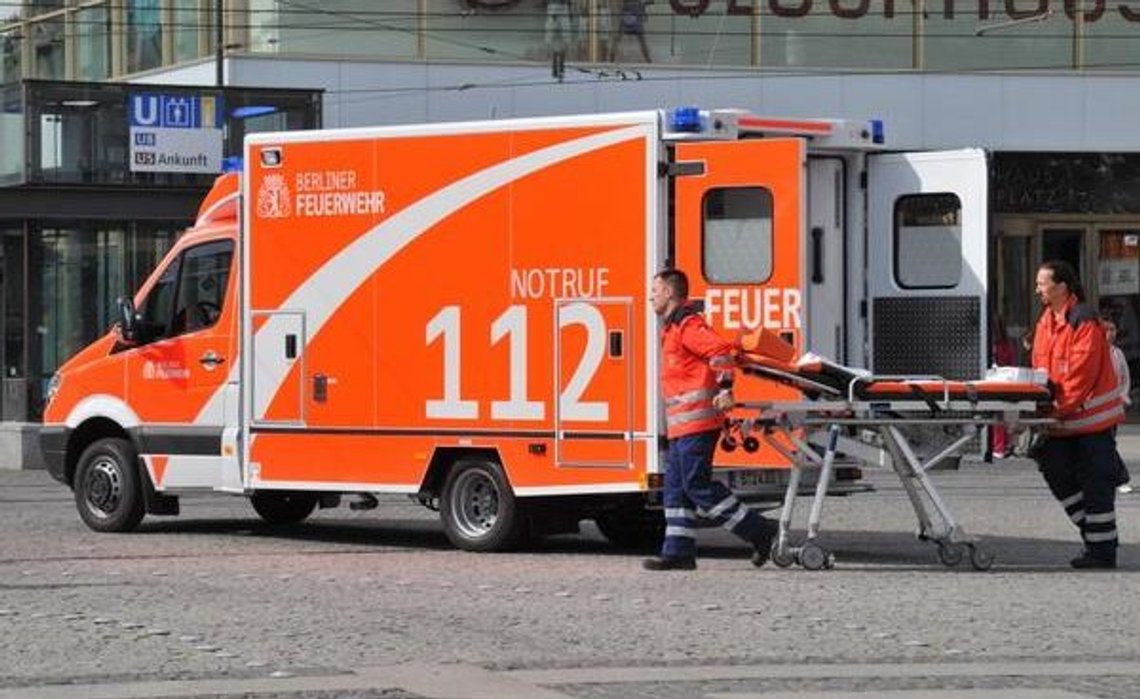
When injured Arab clan members increasingly end up in hospital after a shooting or stabbing in Berlin, the police turn out in force at the emergency department both to secure the area and gather evidence, a nurse who works in an emergency department in the German capital reveals to Die Welt.
As a consequence of these operations, it is often several hours before the hospital can admit new patients, reports the German newspaper’s domestic affairs editor Uma Sostmann. The nurse, who has worked at the emergency department in question for ten years, is afraid of getting into trouble at work and therefore speaks anonymously.
The admission of clan members creates a veritable state of emergency, says ‘Felix’:
Fortunately, in our case the police have always arrived more quickly than the relatives. Then 15–20 police vehicles arrive with hundreds of police officers, and for five to ten minutes you hear nothing but sirens. Everything is cordoned off, not just the hospital grounds, but entire streets, sometimes even the next underground station. It makes quite an impression. They carefully check in advance who is allowed to drive where, stop cars and carry out identity checks.
The police are normally present before many others in the clan manage to reach the injured member, who is often accompanied by two or three others.
It usually does not take long before 20, 30, 40 family members turn up outside the hospital. They have their own Telegram groups in which they keep one another updated, and often aggressively seek to make their presence felt: ‘We are here; we support our people – and you had better be prepared for something if anything happens to them.’ In these circles, it is common for the mothers and women to scream loudly and very dramatically. This high noise level is a stress factor both for the staff and for the patients. At the hospital this can be managed to a certain extent; at the scene of an incident it is considerably more difficult.
The nurses’ worst nightmare is that the clan member dies in hospital.
It may sound malicious, but we are relieved every time the injured person dies at the scene rather than with us. The stress that police officers have to endure in such cases is enormous: Since there is usually no one left from the hostile clan, the police and emergency personnel are attacked: ‘Help him, then! Do something!’ – and the women sit beside them screaming as though they were being impaled.
The nurses become nervous at the thought that the police might not be able to step in to support them, ‘Felix’ says.
To what extent can we rely on receiving support if we ever have to defend ourselves? So far we have always been fortunate enough that nothing worse has happened, but perhaps you remember the camera footage from New Year’s Eve, when a nurse was beaten unconscious at another hospital? Things like that happen too.
Many clinics offer courses in self-defence or de-escalation. But I am not particularly enthusiastic about this. Many courses try to ‘professionalise’ dangerous situations in a way that leads to a kind of reversal of the perpetrator-victim roles. Why should I adapt to a situation caused by the fact that the other party has not learnt how to behave properly?
‘Felix’ wants to remain anonymous to the clan members.
I have not worn a name badge in the emergency department for several years because I do not want to be identifiable. We take precautions: When two Arab boys need to be treated, I do not send two girls in, but at least one man. In such cases, I also try to keep colleagues with Jewish surnames out of it.
Anyone who dares to talk about what kind of clientele creates these problems is immediately reprimanded by the system.
‘You mustn’t put it like that; it’s too generalising,’ they say. That may be true – but we simply do not have these difficulties with other groups. The fact that we cannot raise this issue is a problem. I am constantly accused of racism. Colleagues in healthcare and the police understand what I mean. In certain circles in Berlin, however, this subject is regarded as socially unacceptable.
Of course, the problems with clan members are connected with immigration policy. And politics has undoubtedly failed to set clear boundaries, particularly in Berlin.
‘Felix’ himself, however, does not want to turn it into an immigration debate, and he is careful to distance himself from the AfD.
Nurses in the Berlin emergency department in question rarely remain in the job for long, Die Welt reports.


